
World War I didn’t just end with a peace treaty and some sad monuments.
It rewired politics, money, borders, medicine, gender roles – and yes, it’s still messing with your news feed today.
In one quick hit, the main effects of World War I were:
-
Four major empires collapsed (German, Austro-Hungarian, Ottoman, Russian)
-
The map of Europe and the Middle East got radically redrawn
-
Economic power shifted towards the United States
-
Society flipped: women’s roles, youth culture and a “Lost Generation”
-
New global bodies (hello, League of Nations) tried to keep the peace
-
A nasty chain of events was set in motion that helped lead to World War II
Quick TL;DR: What actually changed?
Between 1914 and 1918, over 60 million soldiers were mobilised. Millions died. Millions more came home to a world that felt like it had been taken apart and badly reassembled.
Because of World War I:
-
The old imperial world – emperors, dynasties, huge land empires – pretty much collapsed.
-
The United States stepped up as a major economic power.
-
Everyday life changed: from women working and voting to people coping with mass trauma.
-
New ideas – communism, fascism, nationalism – moved from the fringes to the centre.
-
The “peace” settlement quietly loaded the world with problems that would explode in World War II.
So if you’ve ever wondered “Why is the 20th century so… intense?”, World War I is your starting point.
Geopolitical effects of World War I: When empires rage-quit history

Four empires fall in one war
Imagine opening the news app and seeing four major powers collapse in just a few years. That’s basically what 1917–1923 looked like.
-
German Empire
-
Loses the war, the Kaiser abdicates, monarchy over.
-
The Weimar Republic is born – a bold but fragile democracy trapped between anger and hope.
-
-
Austro-Hungarian Empire
-
A multi-ethnic empire held together by the Habsburgs simply disintegrates.
-
The result? A jigsaw puzzle of new states and border changes in Central and Eastern Europe.
-
-
Russian Empire
-
Military disaster + hunger + anger = revolution.
-
The Tsar is overthrown; the Bolsheviks eventually win, and the world’s first communist state appears.
-
-
Ottoman Empire
-
After centuries as a major power, it finally breaks apart.
-
The core becomes modern Turkey; the rest is carved into new “mandates” and states.
-
Four empires in, almost none intact by the end. The old order literally didn’t survive the war.

New borders, new nation-states
With empires gone, politicians reached for a big new idea: national self-determination. The basic concept: “Each people should have its own country.”
Reality check: it worked… sort of.
From the ruins came:
-
Poland – back on the map after being partitioned for over a century.
-
Czechoslovakia – combining Czechs and Slovaks.
-
Yugoslavia – a new state for various South Slavic peoples.
-
New or enlarged borders for Austria, Hungary, Romania and others.
On classroom maps, it looks neat. On the ground, millions of people suddenly became minorities in new countries.
That tension never really went away.

Versailles and the League of Nations
After the fighting stopped, the arguing started.
The Treaty of Versailles (1919) did three big things to Germany:
-
Took away territory.
-
Limited its army and navy.
-
Demanded huge reparations (war payments).
Many Germans saw it as humiliating and unfair – a “dictated peace” rather than a negotiated one.
At the same time, leaders tried a totally new idea: a permanent organisation to keep peace.
Enter the League of Nations:
-
Members were supposed to talk through crises rather than fight.
-
If one country attacked another, the rest were meant to react together.
The League eventually failed to stop World War II, but it’s basically the prototype for the United Nations.
Mandates and the modern Middle East
Now for one of the most long-lasting effects: what happened to the Ottoman territories in the Middle East.
Instead of full independence, many of these lands became League of Nations mandates:
-
Iraq, Transjordan and Palestine – under British control
-
Syria and Lebanon – under French control
These borders were:
-
drawn quickly,
-
often with straight lines,
-
and with more attention to imperial strategy than to local realities.
Throw in conflicting wartime promises, diverse communities and strategic oil interests – and you’ve got a region whose 20th- and 21st-century history is tightly tied to what World War I did to the map.
Economic effects: Debt, reparations and the rise of the US
If World War I was a human disaster, it was also a financial one.
Europe in debt, America in credit
Before 1914, Britain and France were like the world’s wealthy uncles: they lent money and invested abroad.
After four years of total war:
-
Their economies were damaged.
-
They were buried in war debts, especially to the United States.
-
Huge sums were needed to rebuild railways, factories and cities.
Meanwhile, the United States went from “up-and-coming” to “major global creditor and industrial powerhouse”. If you’re wondering how America got pulled into the conflict in the first place, check out our explainer on why the US entered World War I.

A Bolsheviks meeting
Reparations and hyperinflation in Germany
Germany was hit with heavy reparations. To keep things afloat, the German government:
-
borrowed,
-
printed more money,
-
and hoped it would all somehow work out.
Spoiler: it didn’t.
By the early 1920s, Germany experienced hyperinflation so wild that:
-
prices skyrocketed in hours, not years,
-
wages were rushed home in wheelbarrows,
-
life savings were reduced to worthless paper.
This wasn’t just a financial problem. It was psychological. People lost trust in their currency and in their political system.
That bitterness became fertile ground for radical politics.
A fragile global economy
After the war, many countries pulled back from global trade:
-
more tariffs (taxes on imports)
-
more rules on money crossing borders
-
more “protect our own” economic thinking
Combine that with war debts, reparations and shaky currencies, and you get a world economy that was stressed and unstable – long before the Great Depression hit.
World War I didn’t just wreck economies during the fighting – it left a long economic hangover.

Social and cultural effects: The “Lost Generation” and changing lives
The “Lost Generation”
For those who lived through the war, it often felt like an entire generation had been shattered.
-
So many young men were killed or maimed.
-
Survivors came home with physical injuries and mental scars.
-
Families across Europe had missing brothers, sons, husbands and friends.
Writers and artists poured trauma and disillusionment into their work. The idea of a noble, glorious war died in the trenches.
In its place came a darker question: “Was any of this worth it?”
Women’s work and the vote
World War I dragged millions of men to the front – but someone still had to run the factories, farms, offices and hospitals.
Enter: women.
During the war, women took on roles that were traditionally “male”:
-
munitions workers
-
tram and bus drivers
-
clerks, typists, telephonists
-
farm labourers
-
nurses closer than ever to the front
After 1918, it was pretty hard to argue that women were too “fragile” or “uninformed” for politics.
In Britain, for example:
-
The Representation of the People Act (1918) gave the vote to all men over 21
-
and to women over 30 who met certain property rules.
-
Full equal voting rights followed later in 1928.
World War I didn’t magically create gender equality, but it gave women new leverage and visibility.
Nationalism and anti-colonial movements
Another big shift: people living in empires started asking some very pointed questions.
-
Colonial troops from India, Africa, the Caribbean and elsewhere fought and died in a European war.
-
They saw European powers weakened and divided.
-
They heard a lot of talk about “freedom” and “self-determination”.
After the war, nationalist and independence movements gained strength across the colonial world.
The age of the old European empires was now on a countdown timer.
Technological and medical effects: The birth of modern warfare
New weapons, new rules
If you imagine war before 1914 as cavalry charges and shiny uniforms, World War I is where that fantasy goes to die.
The war brought:
-
machine guns that made old-style charges suicidal,
-
heavy artillery firing shells for miles,
-
tanks rolling across trenches,
-
submarines sinking ships unseen,
-
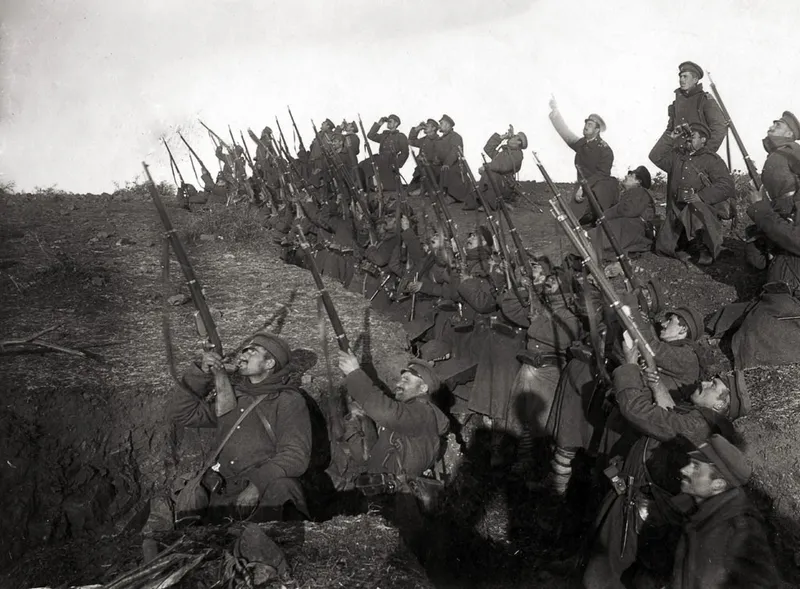
aircraft spying, dogfighting and bombing from above,
-
and large-scale use of chemical weapons like chlorine and mustard gas.
The result was industrial-scale slaughter – and a grim preview of 20th-century warfare. You can dive into the full arsenal in our guide to weapons used in World War I.
Logistics, communications and the “war machine”
To keep millions of soldiers supplied, governments had to become incredibly organised:
-
coordinating railways and shipping,
-
managing massive factories and armaments production,
-
expanding telegraph, telephone and later radio networks.
Those systems didn’t go away in 1918.
They laid the groundwork for the highly organised states and economies of the later 20th century.
Medicine, surgery and prosthetics
Where there’s industrialised injury, there’s forced medical innovation.
World War I accelerated:
-
trauma and orthopaedic surgery,
-
better techniques for blood transfusions,
-
early plastic surgery to reconstruct damaged faces,
-
improved prosthetic limbs and physical rehabilitation.
Horrific injuries pushed doctors and
nurses to develop methods that still influence hospitals today.
The 1918–1919 influenza pandemic
Just when the world needed a break, it got hit by the 1918–1919 influenza pandemic (often called the Spanish flu).
-
It infected a massive portion of the global population.
-
It killed more people than the war itself.
-
Troop ships, camps and demobilisation helped it spread even faster.
The war didn’t cause the flu – but it created perfect conditions for a deadly virus to go worldwide.
Psychological and demographic effects
Shell shock and the invisible wounds
For the first time on a huge scale, societies had to face the psychological impact of war.
Soldiers suffering from “shell shock” experienced:
-
trembling and paralysis,
-
nightmares and flashbacks,
-
inability to speak or think clearly,
-
intense fear or emotional numbness.
Today, a lot of this would be called PTSD (Post-Traumatic Stress Disorder).
World War I pushed mental health into public discussion in a way that hadn’t happened before.

Fewer people, different lives
Demographically, World War I hit hard:
-
millions dead,
-
millions injured or disabled,
-
huge numbers of widows and orphans.
In many places, there were simply not enough young men.
That changed:
-
who people married (or if they could),
-
how many children families had,
-
how work and family life were organised.
These weren’t just numbers – they were everyday lives, reshaped for decades.
From World War I to World War II: How one war set up the next
World War I was marketed as “the war to end all wars”. History disagreed.
The link between World War I and World War II isn’t a single cause, but a messy chain of consequences:
-
Resentment in Germany
-
Many Germans saw Versailles as humiliating and unjust.
-
This became powerful fuel for Hitler’s message of revenge and restoration.
-
-
Economic instability
-
War debts, reparations and later the Great Depression wrecked economies.
-
People lost faith in moderate politics and turned to extremes.
-
-
Tense new borders
-
New states and border changes left minorities unhappy and neighbours suspicious.
-
-
Weak global peace system
-
The League of Nations had ideas, but not enough members, authority or force.
-
By the 1930s, these problems converged – and the world slid into another global war, even more destructive than the first. To see how that second conflict actually played out on the battlefield, explore our rundown of famous WW2 military operations.
How World War I still shapes your world today
Over a century later, World War I is still quietly influencing your world.
You can see its fingerprints in:
-
Borders and conflicts – especially in Eastern Europe and the Middle East.
-
International organisations – today’s United Nations and related bodies grew out of lessons from the League of Nations.
-
Remembrance culture – poppies, war memorials, Armistice/Remembrance Day ceremonies all trace back to this war.
-
Ideas about peace and security – diplomacy, arms control, international law… all shaped by trying (and often failing) to avoid “another 1914”.
Spotlight: Why World War I still matters in the Middle East
If you want one region where the effects of World War I are still very visible, look at the Middle East.
Because of the war and its aftermath:
-
Former Ottoman provinces were turned into British and French mandates.
-
New states – Iraq, Syria, Lebanon, Transjordan, Palestine – were created or reorganised.
-
Promises made during the war to different groups didn’t always line up afterwards.
Many modern disputes over borders, identity and power in the region connect back, in one way or another, to decisions made between 1916 and the early 1920s.
World War I isn’t just something that happened “over there, long ago”. It’s woven into today’s headlines.
Common questions about the aftermath of World War I
How did World War I change the map of Europe?
It blew up the old imperial map. The German, Austro-Hungarian, Russian and Ottoman Empires collapsed, and new or re-formed states like Poland, Czechoslovakia and Yugoslavia appeared.
Existing countries like Austria, Hungary and Romania also got new borders.
The result: a map that looked more “national” but was full of minorities and border disputes.
What were the economic consequences of World War I for Germany?
Germany came out of the war with:
-
defeat and political turmoil,
-
reparations to pay,
-
and later, a terrifying bout of hyperinflation.
People saw their savings wiped out and their economy collapse. This economic trauma made many Germans receptive to anyone promising stability, pride and a way out – including extremists.
How did World War I affect women’s rights?
World War I pulled women into new roles – running factories, offices, farms and hospitals while men were at the front.
After the war, that experience helped fuel demands for political rights. In several countries (including Britain), women gained the vote in the years following the war, often with restrictions at first that were gradually lifted.
It didn’t solve everything, but it was a big step in turning women from “hidden helpers” into recognised citizens.
Did World War I directly cause World War II?
Not in a simple “WWI → WWII” way – but it set up the conditions:
-
angry, defeated powers,
-
fragile democracies,
-
border disputes,
-
global economic crises,
-
and a weak system for enforcing peace.
Think of World War I as loading the gun. The 1930s pulled the trigger.
Why is World War I considered a turning point in modern history?
Because it’s where the old world really ends and the modern one begins.
After World War I:
-
empires gave way (slowly) to nation-states,
-
new ideologies – communism, fascism – moved centre stage,
-
global power tilted away from Europe towards the US,
-
warfare, medicine and technology took giant, often terrifying, leaps,
-
politics became more mass-based, with more people voting and participating.
If you want to understand the 20th century – and plenty of the 21st – you have to go through World War I first.
Cheat sheet: 20 key effects of World War I

Here’s your quick MuseumFacts summary list – perfect for revision, teaching or just winning arguments on the internet.
Geopolitical
-
Collapse of four major empires: German, Austro-Hungarian, Ottoman, Russian.
-
Break-up of Austria-Hungary into Austria, Hungary, Czechoslovakia, Yugoslavia and territorial gains for other neighbours.
-
Creation of the Weimar Republic in Germany after the Kaiser’s abdication.
-
End of the Ottoman Empire and rise of the Republic of Turkey.
-
Growth of anti-colonial nationalism in Asia, Africa and the Middle East.
-
Success of the Bolshevik Revolution and the birth of a communist state in Russia.
-
Rise of fascism in Italy, with Mussolini capitalising on post-war anger.
-
Creation of the League of Nations, an early, flawed attempt at global collective security.
Economic
-
Devastated European economies, weighed down by war damage and debt.
-
The United States emerges as a leading global creditor and industrial power.
-
Growth of protectionism – more tariffs and trade barriers worldwide.
-
Inflation and hyperinflation, especially in Germany.
-
Long-term war debts and reparations that destabilise the world economy.
Social, cultural and medical
-
The deadly 1918–1919 influenza pandemic, partly spread by wartime conditions.
-
Major advances in women’s suffrage, especially in countries like Britain.
-
Rapid development of modern warfare technology – tanks, aircraft, submarines, machine guns and chemical weapons.
-
The emergence of a traumatised “Lost Generation” in art, literature and society.
Psychological and long-term political
-
Wider recognition of war-related psychological trauma (“shell shock”, now linked to PTSD).
-
A fragile, crisis-prone interwar order, with unstable democracies and polarised politics.
-
Deep bitterness and unresolved grievances, especially in Germany and parts of Eastern Europe, helping pave the path to World War II.
World War I shattered four major empires, redrew borders across Europe and created new nation-states like Poland, Czechoslovakia and Yugoslavia. The aftermath also left economies damaged, societies traumatised and politics far more unstable.
When the Ottoman Empire collapsed, its lands were carved into new states and League of Nations mandates ruled by Britain and France. Those borders and promises still shape politics and conflicts in the modern Middle East today.
Not directly, but the effects of World War I set the stage for the next conflict: bitter resentment in Germany, harsh peace terms, economic crises and fragile new democracies. These problems helped radical movements rise and ultimately led to World War II.
Women stepped into wartime roles in factories, farms, offices and hospitals, proving they were essential to national survival. After 1918, this helped fuel campaigns for women’s suffrage and led to voting rights in several countries.
The effects of World War I are still visible in modern borders, alliances, remembrance culture and global institutions like the United Nations. Understanding the war’s aftermath helps explain everything from Middle Eastern politics to European integration.
Sources
“Aftermath of World War I” – Wikipedia
Encyclopaedia Britannica – “Causes and Effects of World War I”
ThoughtCo – “The Consequences of World War I”
National WWI Museum and Memorial
The Holocaust Explained – “The Effects of the First World War on Germany”