
Introduction
Sea shanties were not entertainment. They were technology.
Before steam engines and electric winches, sailing ships relied entirely on human muscle. Moving a ship meant hauling tons of rope, canvas, and iron by hand. Sea shanties emerged as a practical solution: rhythmic work songs that transformed dozens of individual sailors into a single, coordinated force.
To understand sea shanties properly is to see them not as folk music, but as a form of industrial-age engineering, powered by breath, timing, and collective effort.
What Is a Sea Shanty?
A sea shanty is a traditional work song sung aboard merchant sailing ships, primarily during the late 18th and 19th centuries.
Unlike ballads or leisure songs, shanties existed for one reason only: to organise labour. Their rhythm dictated movement. Their structure controlled effort. Their timing prevented chaos.
Most shanties followed a call-and-response pattern:
-
The shantyman’s call allowed sailors to prepare their grip or footing.
-
The crew’s response marked the exact moment of maximum exertion.
In effect, the song functioned as a human metronome, ensuring that everyone pulled, heaved, or turned at precisely the same time.
The Multicultural Origins of Sea Shanties
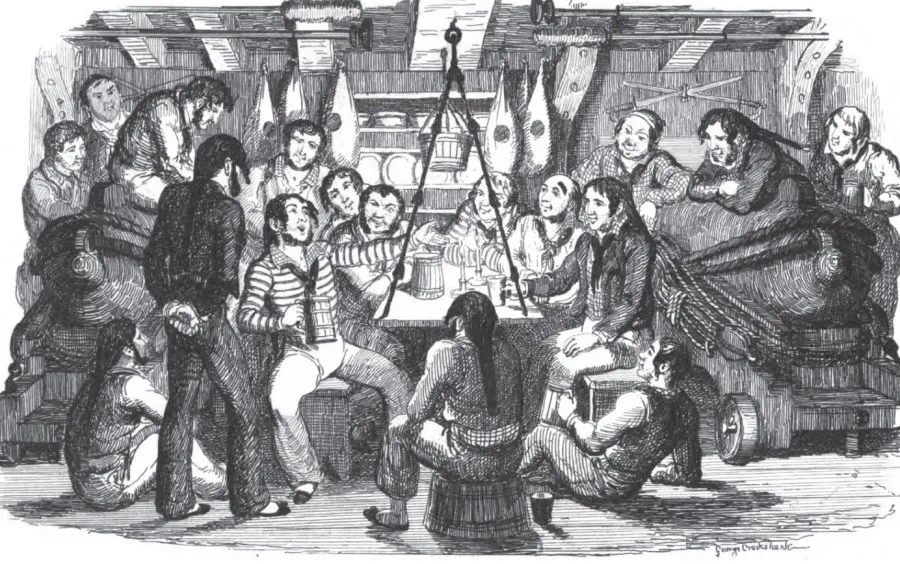
Sea shanties were born in one of the most multicultural workplaces of the 19th century: the Atlantic merchant ship.
Crews were often a mix of:
-
British and Irish sailors
-
African-American seamen
-
Caribbean dock workers
-
Former enslaved people and free Black mariners
A key group were the “packet rats” — sailors on fast Atlantic packet ships running between Britain, the Caribbean, and the Americas. These men blended Irish rebel songs, English folk melodies, and African-American work chants into rhythms that worked under strain.
The call-and-response structure common in shanties closely mirrors West African labour songs, while melodies often borrowed from popular tunes sailors already knew. What mattered was not musical purity, but what worked under pressure.

Why Were Sea Shanties Used on Ships?
Life aboard a sailing ship was brutally physical.
Hauling a sail or raising an anchor required dozens of men pulling together. If even a few were out of time, effort was wasted and injuries were likely.
Sea shanties solved this by:
-
Synchronising muscle power
-
Preventing premature or mistimed pulling
-
Reducing exhaustion over long tasks
-
Maintaining morale during monotonous labour
Importantly, shanties were sung only when rhythm mattered. They were not background noise. Singing at the wrong moment could disrupt work and was often discouraged by officers.
Halyards and Capstans: The Main Types of Sea Shanties
Different jobs required different rhythms. Shanties evolved to match specific mechanical needs.
Short-Haul (Short Drag) Shanties
Used for quick, explosive pulls on ropes.
These songs had sharp, staccato rhythms timed to brief moments of force. The chorus landed exactly when sailors threw their weight back.
Rhythm guide: 2–4 time, abrupt and forceful
Example: Haul Away Joe
Halyard (Long Drag) Shanties
Halyard shanties accompanied longer pulls, such as raising sails.
They allowed sailors to build sustained pressure over several beats, rather than jerking the rope. The pauses between lines gave just enough time to reset grip.
Rhythm guide: 4–4 time, heavy emphasis on beats 2 and 4
Example: Blow the Man Down
Capstan Shanties
Capstan shanties were used while raising anchors or heavy cargo using a capstan — a vertical rotating drum turned by sailors pushing bars in a circle.
The movement was continuous and could last for hours. Sailors described it as a slow, grinding walk, almost like a heavy dance.
Because of this, capstan shanties were smoother and more melodic, allowing full verses to be sung without breaking rhythm.
Rhythm guide: 3–4 or 4–4 time (waltz or march-like)
Example: Rio Grande
Pumping Songs and Forebitters
Some songs were associated with pumping water from ships or sung during rest periods.
These were less rigid and often more reflective, touching on longing, frustration, or life ashore. While not strictly work shanties, they are often grouped with them today.
The Shantyman: More Than a Singer
The shantyman was a functional role, not a performer.
He needed:
-
Strong lungs
-
Precise timing
-
The ability to improvise endlessly
-
Authority to control tempo
A good shantyman could make work easier. A bad one could slow the entire ship.
Despite this importance, shantymen usually received no extra pay. Their reward was often informal: lighter physical duties during heavy hauling so they could preserve their voice and focus.

Decline and Modern Revival
Sea shanties declined rapidly with the arrival of steam-powered ships, where machinery replaced coordinated manual labour.
By the early 20th century, shanties survived mainly through:
-
Sailor memoirs
-
Folklorists such as Stan Hugill
-
Maritime museums and archives
Their recent revival, driven by social media and modern folk music, has stripped them of function but revived interest in their history. While “ShantyTok” versions are entertainment, they have reopened a door to understanding maritime labour culture.

Sea shanties were not romantic creations. They were practical responses to hard problems.
They reveal how ordinary people engineered solutions using rhythm, voice, and shared effort long before machines replaced muscle. In that sense, sea shanties are not just music — they are evidence of human ingenuity at work.
Enjoyed the above article? You may also enjoy Ten Explorers Of The Seas That You Should Explore
Sources
- Stan Hugill, Shanties from the Seven Seas
- National Maritime Museum, Greenwich
- British Library Sound Archive (Maritime Songs Collection)
- Smithsonian Folkways Recordings
- Ewan MacColl, The Singing Sailor
They coordinated physical labour by timing collective effort, turning many sailors into a single working unit.
While The Wellerman is popular today, it is technically a shore-based whaling song. Historically, Drunken Sailor and Blow the Man Down are the most recognisable true shanties.
Shanties were functional work songs. Ballads were sung for leisure and storytelling and did not control physical labour.
There is little historical evidence for this. Pirates are more associated with fiction than documented shipboard routines.
Usually nothing extra. However, he was often spared the heaviest labour during hauling to maintain rhythm and breath.
Improvised lyrics allowed sailors to vent frustrations about food, officers, and longing for shore. Double meanings helped bypass strict discipline.