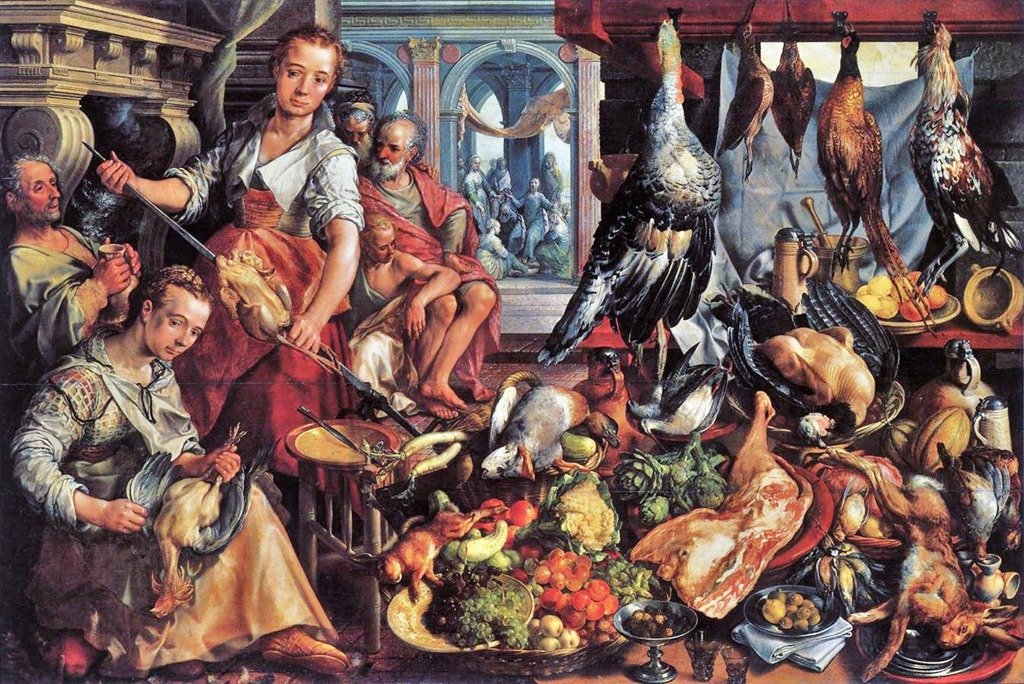

The Elizabethan era is a period in England that denotes the reign of Queen Elizabeth I. The era saw a growth in many factors—both political and social. Additionally, during the Elizabethan era, food played an important role. A typical individual’s diet was rich in meat and fish; however, Elizabethan food varied according to one’s social class.
Why Elizabethan Food & Drink Matters
Food in Elizabethan England was not only about survival. It also reflected wealth, religious observance, and social status. What people ate, when they ate, and how dishes were presented signified class and cultural values during Queen Elizabeth I’s reign. This article explains everyday meals as well as feasting traditions that shaped social life in 16th-century England.
Let us take a look at Elizabethan Food and Drink- Brief History & Key Facts.
1) In Elizabethan England, food varied according to one’s social class. The Elizabethans ate 3 meals a day: breakfast, dinner and supper. Breakfast was eaten as early as 6-7 a.m, dinner was consumed at midday and supper was had between 5-8 p.m.
Historians note that the Elizabethan meal schedule reflected agricultural rhythms and daylight rather than modern work patterns. Eating the main meal at midday helped people sustain physical labour during long working hours.

2) For the Elizabethans, food had to be visually appealing, hence they put in a lot of effort in its presentation
This was especially important during feasts when they went all out in decorating their meals. Feasts were a way for the rich to show off their wealth. For example, the Elizabethans reared peacocks for their consumption and used their feathers to decorate the cooked food. Additionally, they sculpted their foods into various shapes to make them look unique.
Food presentation during feasts was deliberately theatrical. Scholars interpret these displays as performances of power, where abundance and visual excess reinforced social hierarchy and loyalty to elite households.

3) Food consumed by the rich during the Elizabethan era
The major difference between the meals consumed by the wealthy and the poor was that the former consumed more meat. In fact, the wealthy consumed meat in such large quantities that they frequently complained of stomach problems. The meat they ate included beef, veal, pork, lamb, mutton, and poultry such as chicken, duck, goose and pigeon. They even consumed game meat such as rabbit, venison, woodcock, and many other types of birds.
The wealthy also ate cheese at the end of the main course, along with nuts such as walnuts and chestnuts. Desserts included fruit, honey, pastries, puddings, biscuits, gingerbread, different types of cakes, and tarts. Modern medical historians suggest that the rich Elizabethan diet, heavy in red meat and sugar, contributed to chronic digestive issues and gout, conditions frequently recorded among the nobility.

4) The use of refined sugar
The wealthy used a lot of refined sugar for preparing their desserts. It was imported from the Americas and was very expensive. Sugar was also used for making marzipans, jams and other sweets. The wealthy consumed so much sugar that their teeth would turn black! Moreover, this became a status symbol and people started purposely blackening their teeth so it looked like they were affluent enough to purchase sugar.
Historians consider this as one of the earliest examples of conspicuous consumption in England, where excess itself conveyed status.

5) Elizabethan food during special occasions
During special occasions, wealthy Elizabethans served a variety of meat. In fact, guests even asked for a sample before choosing a dish of their choice. The food was flavourful and included exotic spices like cloves, pepper, saffron and nutmeg. Common flavours included vinegar, fennel and salt. Additionally, even flowers such as violets and marigolds were added to give a distinct flavour. Moreover, meat and fish were frequently cooked in ale, almond milk and wine. They also had a good sense of fashion.
The use of imported spices reflected England’s expanding global trade networks. These ingredients connected Elizabethan dining tables to markets in Asia, the Middle East, and the Americas.

6) What did the poor eat during the Elizabethan era?
During the Elizabethan era, the poor ate whatever meat they could find, such as rabbits, hens, pigeons, and fish caught from the nearby water bodies. However, being a luxury for them, they consumed meat only on special occasions. The poor mainly ate cheese, bread, milk, porridge and fruit.
The type of bread eaten during the Elizabethan era depended on one’s social class. The poor ate the cheapest one available i.e Carter’s bread; a dark brown or black bread which was a mixture of rye and wheat. The middle class consumed ravel—also known as yeoman’s bread—made of wholemeal. While the wealthy ate the most expensive bread manchet, made of white flour.

7) The consumption of fish
Elizabethans regularly consumed fish. This was because Queen Elizabeth I decreed a law making it mandatory to eat fish on Wednesdays, Fridays and Saturdays. Disobeying it could land one in jail for up to 3 months. However, if one really wanted to eat meat they could buy a license that exempted them from the law.

8) Fruits and vegetables consumed during the Elizabethan era
Elizabethans consumed vegetables such as turnips, parsnips, carrots, lettuce, peas, cabbage, onions, leeks, spinach, radishes and garlic. Subsequently, potatoes were introduced in the 1580s CE by Sir Walter Raleigh. However, it was deemed an expensive delicacy.
The fruits consumed included cherries, lemons, raspberries, blackberries, melons, and strawberries. While more expensive fruit such as pomegranates and peaches were consumed by the rich. Although fruit was consumed during Tudor times, it was hardly eaten raw. It was usually baked into pies or boiled to make jams.

9) Elizabethan drink
As drinking water was considered unsafe, Elizabethans, including children consumed ale. The stronger ale was reserved for festive occasions. Additionally, most people consumed beer from hops as it was the cheapest drink available and could be stored for a long time.
Wines were expensive as they were imported from Greece, France, Madeira and other countries. As a result, it was drunk on formal occasions and mainly by the rich. Milk was also consumed, although only by the children and the old.

10) Cooking food during the Elizabethan era
Cooking a meal was quite arduous during the Elizabethan era. People had to prepare a meal from scratch. Plus as there were no refrigerators, storage was a problem. The cooking was done on an open fire. Stews would be boiled in pans while meat would be roasted on a spit. The meat had to be rotated slowly to ensure even roasting. This was usually done by the ‘turnspit dogs’, that were specially bred to walk on a wheel—called a turnspit or dog wheel— to rotate the meat. These dogs also churned butter.
Elizabethans baked bread in an oven. However, only the rich households had their own oven. The poor used communal ovens. These ovens were so large that they could bake almost 20 loaves at once. People would take their loaves to the ovens, leave them there to be baked and collect them once done. And they could do the same for pies, tarts and other baked goods.

11) Preservation and Storage
The main methods of preservation were salting, pickling, desiccation and smoking. Additionally, large households stored their food in huge airtight chests. While hutches (boxes with air holes) were used for storing fresh foods like cheese. These containers were kept locked to prevent stealing.

12) Table etiquette
A meal table during the Elizabethan era consisted of a large wooden plate that had a hollowed-out centre for the food and a little dip in the corner for placing the salt and waste. As forks weren’t used at the time, diners brought their own knives. Before eating one had to wash hands and napkins were provided as well.
There was also a drinking cup, which would be ornate or a simple glass mug. Additionally, the host would sometimes read out a list of instructions to be followed. These included not picking your nose or passing wind at the table.

Common Myths About Elizabethan Food
Elizabethans ate mostly rotten meat — False; preservation methods were essential and widely used.
Vegetables were rare — Not true; many greens were eaten seasonally.
All classes drank strong ale all day — Most ale was low-alcohol ‘small beer’ for hydration.
The Elizabethan era is a period in England that denotes the reign of Queen Elizabeth I. The era saw a growth in many factors—both political and social. Additionally, during the Elizabethan era, food played an important role. A typical individual’s diet was rich in meat and fish; however, Elizabethan food varied according to one’s social class.
Think you’ve mastered the secrets of the 16th-century kitchen? > Only 5% of history buffs can pass our ultimate Elizabethan Diet Quiz. From “turnspit dogs” to sugar-blackened teeth, let’s see how much you really remember!
Take the Elizabethan Diet Quiz Now →
Enjoyed the article? You may also like The Viking Diet- What did the Vikings eat?
Simple bread, ale and vegetables for lower classes; roasted meats and pies for the wealthy.
It was imported and expensive, becoming a status symbol among the rich.
Yes! safer than water, so even children drank weak ale daily.
Through salting, pickling, drying and smoking before refrigeration was available.