
Introduction
Presidential photographs are more than memorabilia. They are snapshots of how power was presented, challenged, and sometimes quietly exposed.
This photo essay brings together 15 unusual and iconic presidential images, from the earliest surviving photograph of a former president to Cold War era pop culture encounters. Each image has a story behind it, and those stories often reveal more than speeches ever could.
1) Theodore Roosevelt next to a killed jaguar during a hunt on the Taquari River in Brazil, 1913

This picture was taken after Roosevelt left office, but it captures the persona he spent a lifetime building. He was not just a president, he was a performer of toughness.
The 1913 Brazil expedition was dangerous and physically punishing. Roosevelt framed it as proof that he was still capable of heroic endurance, and the jaguar image became part of that mythology. Less discussed is that he also saw himself as a naturalist, and specimens collected on expeditions like this often ended up in American scientific institutions.
2) Theodore Roosevelt dressed as a girl at age 2: the “breeching” traditionThis photo feels bizarre to modern viewers, but it’s a real 19th-century custom. The practice was linked to breeching, the moment when a young boy first began wearing breeches or trousers. Until then, boys commonly wore gowns or dress-like clothing, often until about age six or seven depending on family tradition.
What makes the image so striking is the contrast. Roosevelt later embodied a rugged public masculinity, yet his childhood photo reminds you how easily “identity” is shaped by fashion norms and era.

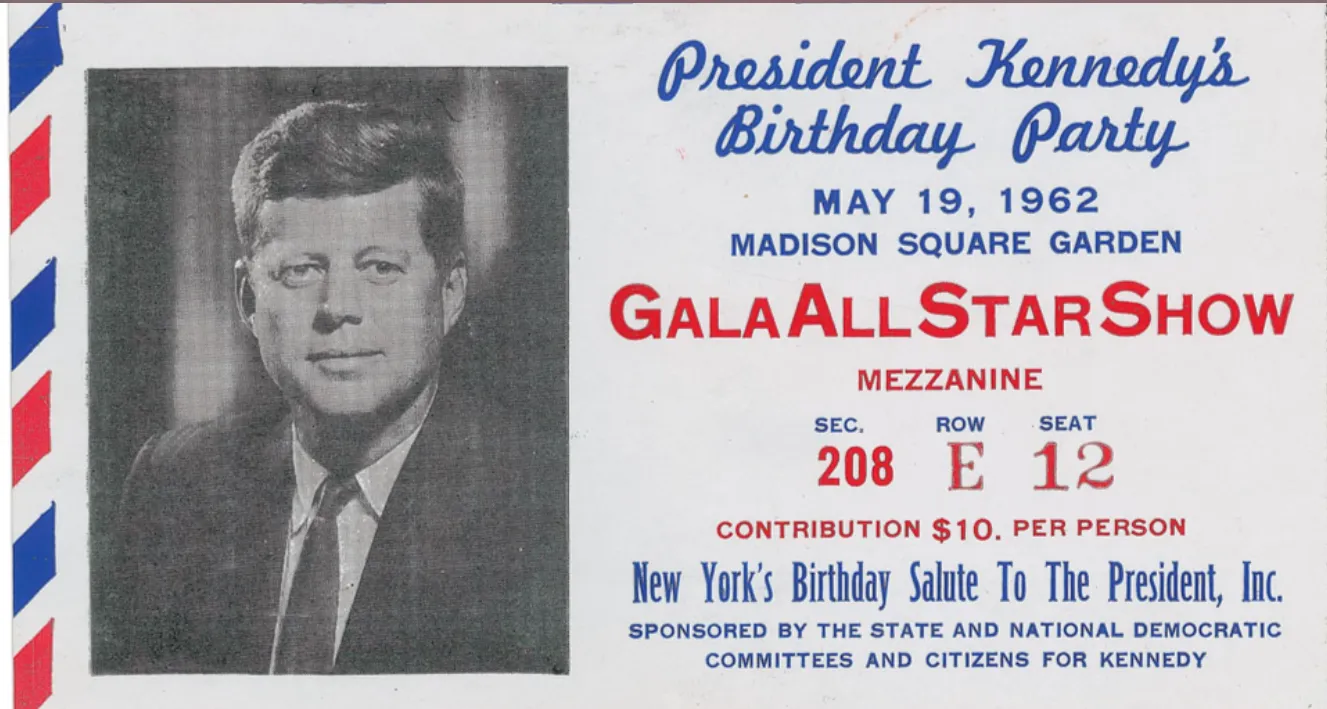
3) John F. Kennedy’s 1962 Madison Square Garden birthday invitation
This isn’t a portrait, but it’s pure presidential history. Kennedy’s presidency was the moment when American politics became fully entangled with modern celebrity culture.
The Madison Square Garden birthday event became iconic not just because of who attended, but because it reflects a media age where presidents were no longer distant figures. They were cultural events. Kennedy’s presidency marked a turning point where image, messaging, and political branding became inseparable, a shift that would later define many of the most famous US presidential campaign slogans.

4) Warren G. Harding shaking hands with Babe Ruth
Presidents have long used sports as a national language. A handshake with Babe Ruth was not random, it was a photo that linked a president to the most famous athlete of the era.
Harding is often remembered through scandal, but this picture shows how presidents sought popularity through symbolic “normal American life.” Baseball worked as public reassurance in a time of huge social change

5) National Woman’s Party members ask Harding’s aid for an Equal Rights bill
This is one of the most historically valuable images in the set because it captures activism up close, not as an abstract movement.
After winning suffrage, the National Woman’s Party pushed for legal equality through an Equal Rights Amendment. The photo shows the early shape of modern lobbying: organised, persistent, and willing to confront political power face-to-face.

6) Calvin Coolidge named “Chief Leading Eagle” by Sioux representatives, 1927
Coolidge’s reputation was quiet and reserved, which makes ceremonial images like this stand out. It also reflects a complicated political reality: presidents often participated in symbolic ceremonies even while federal policies continued to pressure Native communities through assimilation and land policy.
This is why the image matters. It shows how the presidency performed unity publicly while American society remained deeply unequal.

7) Franklin D. Roosevelt: the “Day of Infamy” speech, 1941
This is Franklin D. Roosevelt, and the moment is tied to one of the most searched phrases in American history: “a date which will live in infamy.”
The photo captures the instant the U.S. shifted into full-scale war mobilisation. It’s also a reminder that presidential images can mark irreversible turning points, not just personalities.

8) Harry Truman leading callisthenics aboard the USS Missouri, 1947
Truman’s public image was built around practicality, not glamour. That’s why this photo is so effective: it shows a president in a plain, almost everyday moment, yet placed inside the machinery of U.S. military power.
This is also where American photography differs from authoritarian propaganda. Dictatorships used images to project perfection. American presidential photos often aim for relatability, even when they’re carefully staged.

9) Dwight D. Eisenhower throws the first pitch of the 1954 season
The first pitch is political theatre, but it’s subtle and effective. Eisenhower’s leadership style was calm and controlled, and ceremonial appearances reinforced stability during Cold War uncertainty.
This kind of photograph also shows how presidents borrowed national rituals to appear connected to ordinary life, even while dealing with extraordinary global stakes.

10) John Quincy Adams: the earliest surviving photograph of a U.S. president, 1843
This is one of the most important “photo history” facts on the page. John Quincy Adams was photographed in 1843, long after his presidency, and this image is often treated as the earliest surviving photograph of a U.S. president.
It matters because it marks the shift from idealised painted authority to photographic realism. Adams appears as an aging man, not a symbol, and that transition changed political image-making forever.

This looks like a quirky celebrity moment, but it reflects something broader: the White House becoming a cultural stage.
By the 1970s, presidents had to appear comfortable around entertainment figures because politics and mass media were inseparable. Nixon’s awkwardness in cultural spaces is part of why this photo remains so memorable.

12) Lyndon B. Johnson and Martin Luther King Jr. during the Voting Rights Act era, 1965
This photo matters because it captures how change actually happens: through pressure, negotiation, and politics, not just moral speeches.
The Voting Rights Act became one of the most consequential civil rights laws in U.S. history. The image is powerful precisely because it is not dramatic. It’s institutional history in a single frame.

13) Apollo 11 quarantine: Nixon speaks through the glass barrier
This is one of the strangest presidential images because it combines triumph with fear. The Apollo 11 crew were quarantined after returning from the Moon because officials worried, however unlikely, about unknown contamination.
The quarantine lasted 21 days, and Nixon speaking through glass captures that Space Race anxiety perfectly. It’s not just a celebration photo. It’s a picture of a world unsure what it has just brought back to Earth.

14) Nixon’s V-sign after resigning following Watergate
This gesture is why the photo never dies. A victory sign after resignation can read as defiance, denial, habit, or performance. That ambiguity is what makes it so psychologically memorable.
It also captures a broader truth about power: even when office is gone, public persona often lingers. Nixon’s fall reinforced a growing public awareness that the private lives and hidden actions of presidents could directly shape public trust, a theme explored further in accounts of US presidential affairs and scandalous facts.

15) An iconic picture of U.S. President Gerald Ford dancing with Queen Elizabeth II in 1976.
This photograph was taken during the United States Bicentennial celebrations in 1976, a year loaded with historical symbolism. Only two centuries earlier, Britain and its American colonies had fought a war to separate. Now, the American president and the British monarch were sharing a dance at a state dinner in the White House.
The image quietly captured how far the relationship had evolved. Ford, a president often associated with healing and stability after Watergate, used the moment to emphasise reconciliation and alliance rather than rivalry. For Queen Elizabeth II, the visit reinforced Britain’s close diplomatic ties with the United States during the Cold War.
What makes the photograph endure is its informality. It shows global power expressed not through speeches or treaties, but through a human gesture, marking the transformation of former enemies into long-standing partners.

16) Michael Jackson and Ronald Reagan: when pop culture met the Cold War
This photo is a time capsule of a very specific era: the White House using celebrity moments to communicate social messaging, and celebrities using political visibility to signal legitimacy.
Whatever your politics, the image is historically useful. It shows how the presidency became a stage where entertainment, influence, and national identity overlapped, especially in the media-heavy late Cold War period.

Sources
-
Library of Congress, U.S. presidential and historical photograph collections
-
Smithsonian National Portrait Gallery, presidential photography and portrait holdings
-
Encyclopaedia Britannica, biographical entries on U.S. presidents
The earliest widely cited surviving photograph of a U.S. president is John Quincy Adams in 1843, taken after he left office.
James K. Polk is often credited as the first president photographed while in office, with surviving images dating to 1849.
Because of breeching, a 19th-century tradition where young boys wore gown-style clothing until they began wearing trousers, often around age six or seven.
Officials feared unknown contamination after the Moon landing, so the crew were isolated for 21 days as a precaution, creating the famous Nixon “glass barrier” photo.
Roosevelt was also a naturalist, and specimens from expeditions like this were often preserved for scientific study, including transfers to major U.S. institutions.
In the modern era, presidents like Barack Obama and Donald Trump were photographed constantly due to digital media, but JFK is often considered the first true “television president.”