

Introduction
French history is filled with powerful monarchs who shaped Europe, but not all rulers were successful. Some lost wars, others bankrupted the state, and a few presided over the complete collapse of royal authority.
Rather than focusing on cruelty or scandal alone, this article examines the worst kings and queens of France through the consequences of their rule. In each case, failure came with a cost measured in lost territory, economic collapse, and social unrest. These rulers represent only a portion of the monarchy that governed the country across centuries, many of whom are explored in greater context in French kings and queens who ruled France.
Why are some French monarchs remembered as failures?
Historians rarely judge monarchs by personality alone. French rulers are remembered poorly when their reigns resulted in:
-
Military defeat and occupation
-
Crushing taxation and peasant revolts
-
Political paralysis or civil war
-
Loss of legitimacy and public trust
In several cases, these failures directly reshaped French society for generations.
John II of France – The king whose capture broke the realm

John II, remembered as Jean le Bon (“John the Good”), ruled during the height of the Hundred Years’ War. His personal bravery was unquestioned, but his leadership proved disastrous.
In 1356, he was captured by the English at the Battle of Poitiers. The ransom demanded for his release was three million gold crowns—roughly two to three times the annual revenue of the entire French state.
To pay it, taxes were raised sharply, triggering the Jacquerie peasant revolt, one of the bloodiest uprisings in medieval France. John II’s military failure translated directly into widespread suffering for ordinary people.
Charles VI of France – Madness and civil war

Charles VI became known as Charles the Mad. He suffered recurring psychotic episodes, including the belief that he was made of glass. To prevent himself from “shattering,” he reportedly wore iron ribs sewn into his clothing.
These episodes rendered him incapable of ruling, creating a political vacuum that led to the Armagnac–Burgundian Civil War. Rival noble factions tore France apart while English forces exploited the chaos.
The internal collapse under Charles VI paved the way for foreign occupation and near-total loss of sovereignty.
Philip IV of France and the destruction of the Knights Templar
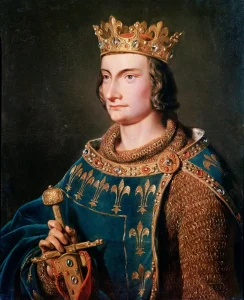
Philip IV, known as Philip the Fair, ruled with cold efficiency. Facing financial strain, he targeted powerful institutions that could not easily resist him.
In 1307, he ordered the arrest of the Knights Templar, accusing them of heresy. Their wealth was seized, and the order was ultimately destroyed.
While this temporarily strengthened royal finances, it damaged France’s reputation, destabilised credit systems, and demonstrated how royal power could be weaponised against institutions—an early warning of absolutist excess.
Louis XV: How the Seven Years’ War bankrupted France

Louis XV inherited one of Europe’s strongest states and left it financially exhausted.
The Seven Years’ War (1756–1763) resulted in catastrophic losses, including Canada and major colonial possessions. France emerged heavily in debt, its global influence diminished.
The economic damage of his reign directly weakened the monarchy his grandson would later inherit.
Louis XVI – The collapse of royal authority
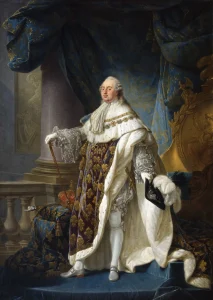

Louis XVI inherited a bankrupt state, rising food prices, and an inflexible political system. Though personally conscientious, he lacked decisiveness.
Public trust collapsed further after the Affair of the Diamond Necklace. Though Louis XVI and Marie Antoinette were innocent, the scandal convinced the public that the royal family was corrupt and deceptive.
Unable to manage reform or revolution, Louis XVI was executed in 1793, ending centuries of monarchy.
Marie Antoinette – A queen without power, but not without blame

France never had a ruling queen due to Salic Law, which barred women from inheriting the throne. Marie Antoinette was a queen consort, not a monarch.
Nevertheless, her foreign birth, lavish image, and association with scandal made her a lightning rod for revolutionary anger. She became the symbol of a system already collapsing under its own weight. Although she never ruled in her own right, Marie Antoinette joined a wider group of influential medieval women whose power was often symbolic rather than political famous women of the Middle Ages.
Why France had no queens regnant
French succession law followed Salic Law, which prohibited women from inheriting the throne. This explains why failures of the monarchy are almost entirely associated with kings, while queens like Marie Antoinette were judged symbolically rather than politically.
Sources
Charles VI, who suffered from recurring mental illness, including the belief that he was made of glass.
Yes. He was admired for personal honour, but his military defeat and massive ransom caused economic collapse and peasant revolts.
A combination of financial bankruptcy under Louis XVI, Enlightenment political ideas, and repeated food shortages led to revolution.
No. While out of touch, she lacked political power. Public anger focused on her as a symbol rather than a policymaker.