

A spelunker is a person who explores and studies caves. They are known to navigate through the smallest of spaces during their explorations. One such spelunker was John Edward Jones.
In November 2009, John Edward Jones, a 26-year-old medical student, entered Nutty Putty Cave in Utah with his brother and friends. What was meant to be a brief recreational caving trip became one of the most tragic and haunting cave accidents in modern history.
Trapped upside down in an unmapped section of the cave, Jones would remain alive for over 24 hours while rescue teams fought a losing battle against gravity, physics, and time.
Let us take a look at Nutty Putty Cave- John Edward Jones And His Tragic Descent.
1) The Background
John Edward Jones was a 26-year-old medical student and a family man. Additionally, he wasn’t an amateur spelunker as he had gone on many such explorations before. When he was younger, he explored such caves with his father and his brother. Moreover, he also volunteered as a trapped victim for Utah Cave Rescue, an organisation founded by his father.

2) The Nutty Putty Cave
The Nutty Putty Cave was known for its notoriously narrow spaces. They were first explored by Dale Green in 1960 who named them for their clay. The hydrothermal cave is located south-west of Utah lake and 55 miles from Salt Lake City.
3) John Edward Jones decides to explore the Nutty Putty Cave
John was visiting his family for the holidays. He was with his wife and his 13-month-old daughter. As his family members were ardent spelunkers they decided to explore the Nutty Putty Cave to bond together. At the time John was 6’0″ and weighed around 200 pounds. He hadn’t been spelunking in many years. Even though he was taller than most explorers he was whip-thin and seemingly had the perfect stature for spelunking.

4) John, his family members and nine other friends entered the Nutty Putty Cave at around 8 p.m on the evening of November 24, 2009. The group was split into two: the children and few adults explored a less dangerous part of the cave, while the others decided to explore the cave a bit further.

5) Things started going downhill pretty fast
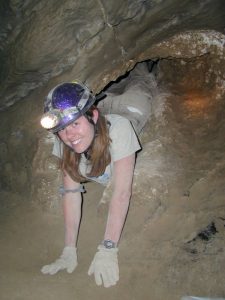
About an hour into the exploration, John decided to find the entrance to the Birth Canal, a narrow path through which spelunkers must navigate very carefully. He subsequently found an entrance which he thought was the one and crawled through it. He started crawling using his fingers, hips and stomach but soon realised that he had made a grave mistake.
The narrow space he had crawled through was barely 10 inches across and 18 inches high, as a result, John had hardly any space to breathe. At that moment he could only go further in as there was no option to turn around. However, the crevice engulfed him and he could not move any further.
Additionally, even though the Nutty Putty Cave was very popular, it was not fully mapped. Hence John was stuck in a crevice that was in unchartered territory.

6) His brother Josh was the first to find him
Josh tried to pull his brother out to no avail. In a tragic turn of events, as he was pulling at John’s calves, John slid even further down the shaft. What’s worse is that now he was stuck upside down with one hand beneath him and the other wedged above.
As the boys were devout Mormons, they started to pray. John fervently prayed for guidance and to save him for his wife and kids.
7) Josh then navigated towards the entrance to call for help, however, by then John was trapped 400 feet into the cave and 100 feet below the Earth’s surface.
8) The first rescuer on the scene was Susie Motola, who arrived at around 12:30 a.m on November 25. By this time, John had been trapped inside the Nutty Putty cave for three and a half hours. Motola then spoke to John and introduced herself, even though all she could see of him were his pair of shoes.
John spoke to her saying, “Hi Susie, thanks for coming, but I really, really want to get out”.

9) Over the next 24 hours, more than 100 rescuers feverishly worked to free John. According to rescuer Shawn Roundy, “it was very narrow, very awkward, and difficult to get rescuers down there”. He further stated that the rescuers faced various difficulties.
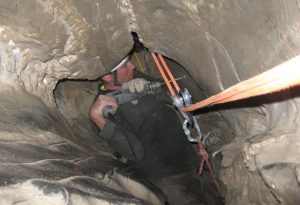
10) Ultimately their best option was to use a rope and pulley system to rescue John Edward Jones from the Nutty Putty Cave
Initially, that option seemed to have been working fine. After setting up the system, the rescuers managed to pull John up. Their progress was slow and they could only pull him a foot at a time. Things started to look very promising. Additionally, the rescuers also got the opportunity to feed John through IV tubes.
However, a tragedy struck and one of the pulleys suddenly broke. According to Roundy, the pulley came loose at its anchor point due to the clayish-rock of the cave. This marked the end of the rope and pulley operation and John was back where he was initially trapped.
To make matters graver, all this time, John was stuck upside down in the cave which was putting tremendous pressure on his heart and body. Moreover, his physical condition was deteriorating by the minute and he was having difficulty maintaining consciousness.
11) Why John Edward Jones Could Not Be Rescued
John Jones was not trapped by a collapse, but by geometry. After entering a narrow passage he believed was the “Birth Canal,” he slid headfirst into a chute that narrowed sharply and sloped downward.
Once wedged, gravity worked relentlessly against him. His body weight pressed his chest and diaphragm downward, making breathing increasingly difficult. Every attempt to pull him out forced his body deeper into the narrowing rock.
Rescue teams attempted to rig a pulley system, but the cave’s tight angles made leverage almost impossible. At one point, a rope anchor failed, dropping Jones further into the passage and eliminating the last viable extraction option.
Medical experts later explained that prolonged inversion caused cardiac strain and restricted blood flow, ultimately making survival impossible regardless of rescue effort.
12) Just before midnight, John stopped responding
A medical professional then crawled close enough to pronounce him dead due to cardiac arrest and suffocation. Ultimately, rescue personnel had spent 27 hours trying to save John.

13) Nutty Putty Cave and its dangerous history
John Edward Jones wasn’t the first person who got trapped in the Nutty Putty Cave. Before him, in 2004, two boys had nearly lost their lives in separate incidents in the same place where John was trapped. In one of the cases, the rescuers took 14 hours to free a 16-year-old kid using several complex pulleys.
After the incidents, officials closed the cave for safety reasons. And it had only been reopened for six months when John and his family decided to explore it.

14) The Aftermath
Ultimately, John Edward Jones’ body was never recovered from the cave. The officials deemed it too dangerous for its retrieval. As a result, that particular crevice is his final resting place. After a week of his tragic death in the Nutty Putty Cave, the cave was sealed permanently for good. Additionally, a plaque is put upon its entrance to commemorate John’s memory.

15) The Last Descent
The Last Descent is a 2016 survival drama, which is based on the 2009 rescue attempt of John Edward Jones in Nutty Putty Cave. The feature film is directed by Isaac Halasima and showcases the terrible ordeal faced by John. It essentially shows us a glimpse of the varied emotions he must have experienced while being trapped.
John Edward Jones’s death was not the result of recklessness, but of a series of small, irreversible misjudgments compounded by an unforgiving environment. His story has since reshaped cave safety standards and led to the permanent closure of Nutty Putty Cave.
Today, his tragedy stands as a reminder that even familiar places can become lethal when conditions turn against the human body.
Enjoyed the above article? You may also enjoy Marvin Heemeyer’s Killdozer Rampage
Yes. John Edward Jones was alive for more than 24 hours after becoming trapped. He remained conscious for much of the rescue effort and was able to communicate with rescuers and family members.
John Edward Jones was trapped upside down for approximately 27 hours before he died.
Yes. At one point, a complex rope and pulley system managed to lift John several inches. However, an anchor failure caused him to fall back into the passage, eliminating the final viable rescue option
Medical experts concluded that he died from cardiac arrest caused by prolonged inversion, which restricted blood flow, strained his heart, and impaired breathing. This condition is sometimes referred to as positional asphyxia or inversion syndrome.
Nutty Putty Cave was sealed in 2009 following John Edward Jones’s death due to safety concerns. The cave’s narrow, unmapped passages were deemed too dangerous for public access.
No. His body remains inside Nutty Putty Cave because recovery was deemed too dangerous. The cave was sealed, effectively turning it into a memorial site.
Experts believe that even with modern equipment, the physical constraints of narrow caves and the effects of prolonged inversion would still make such rescues extremely difficult and potentially impossible.