

Throughout history, humankind has come across various objects and artifacts. Some have filled us with wonder, however, some have baffled us due to their strange nature. Below we have compiled a list of the strangest artifacts found on Earth.
Let us take a look at the 12 strangest artifacts found on Earth.
1) Antikythera mechanism
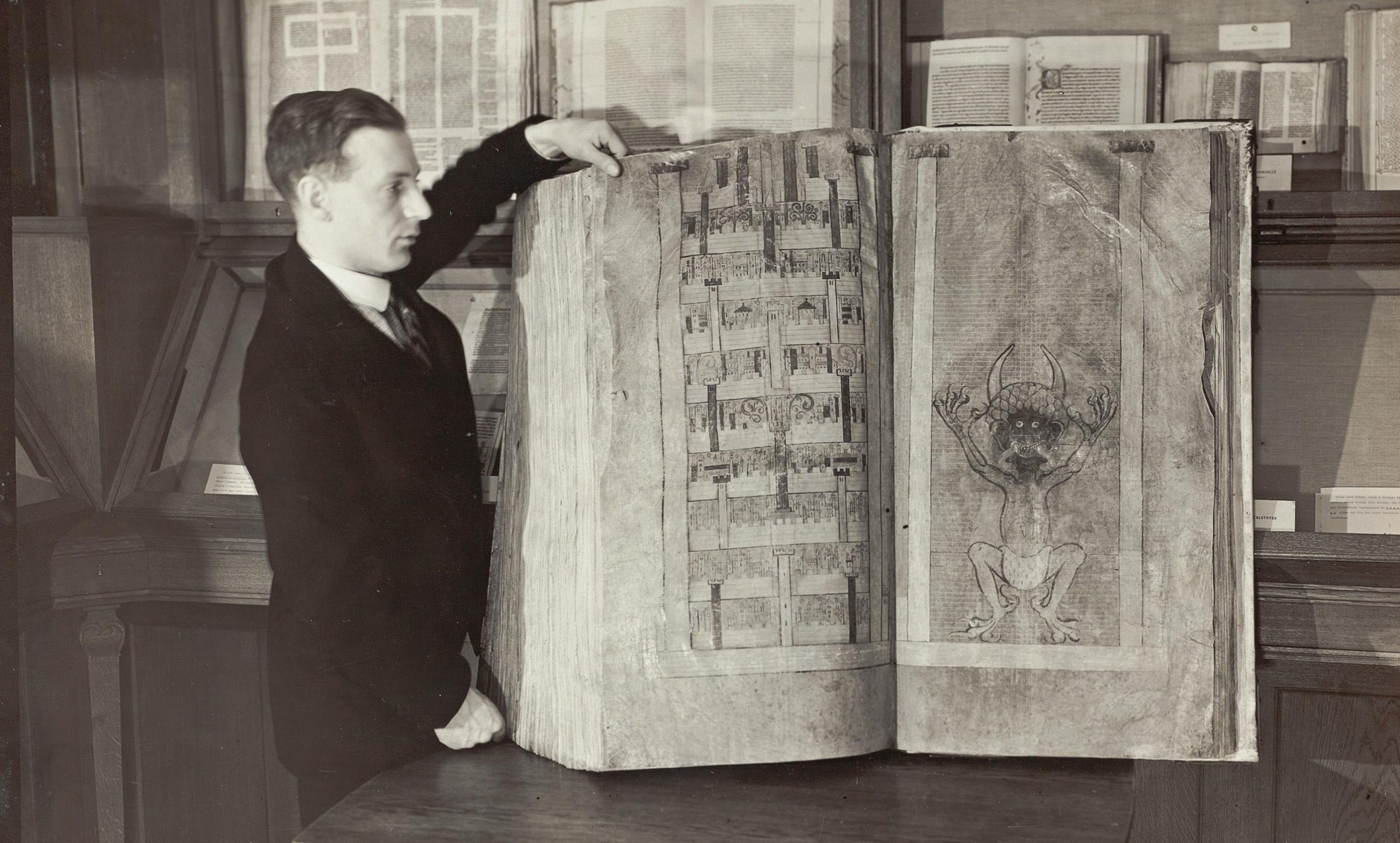
Antikythera mechanism a.k.a the ‘first analogue computer’, is an ancient Greek device that calculates and displays astronomical phenomena. Its discovery took place in 1901 when a diver sifted through the wreckage of a ship near the island of Antikythera. The astronomical device is currently dated to around 100 BCE, give or take 30 years.
It contains the first known set of scientific dials. Additionally, radiographic images shed light that the remaining fragments contained more than 30 gear wheels. These followed the positions of the moon and the sun and predicted astronomical events such as solar eclipses. Moreover, the device also allegedly calculated the positions of the 5 classical planets.
The strange fact about this artifact is that it used a complex mechanism that was unheard of during the ancient times. The technology used for the device was only seen later in the 14th-century medieval clocks.
2) The Codex Gigas- The strange artifact known as the Devil’s bible
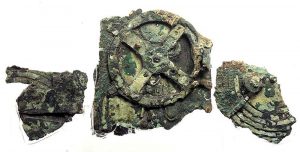
The Codex Gigas a.k.a the Devil’s Bible is one of the strangest medieval artifacts in the world. It dates back to the early 13th century and is famous for two reasons: its massive size and its unique representation of the Devil. The book stands 3 feet tall, is whale bound and is made up of 160 donkey skins. What’s even more astonishing is that the codex was written by a single scribe!
According to National Geographic, it would take one individual working 24/7 continuously for 5 years to recreate the contents of the book (excluding the illustrations). Hence, realistically it would have taken the scribe at least 25 years to create the Codex Gigas from scratch.
3) The London hammer
In 1936, a couple was walking along the course of the Red Creek near the town of London, Texas when they noticed a curious rock with wood embedded in it. They took the strange artifact home and later cracked it open. To their surprise, they discovered a hammer of sorts. They subsequently turned it over to archaeologists. After testing, it was revealed that the rock encasing the hammer dates back to more than 400 million years ago! This baffled scientists, however, Christian creationists labelled the hammer as monumental proof of a pre-flood society. Today, the artifact is on display at the Creation Evidence Museum in Texas.

4) Maine penny
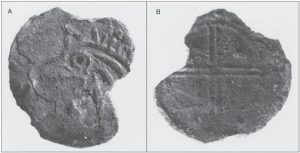
In 1957, Guy Mellgren discovered a coin at the Goddard Site, Maine. Initially, the coin was misidentified as a British coin, however, archaeologists later revealed that it was in fact a Norse coin. Dating back to the reign of Olaf Kyrre King of Norway (1067–1093 AD) the coin is evidence for Viking contact with North America centuries before Columbus. What baffles people most is how did the coin end up in Maine when the only known Viking settlements were in Newfoundland.
5) Object of Aiud- A controversial and strange artifact
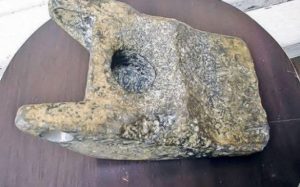
Also known as the Wedge of Aiud, it is one of the most controversial and strange artifacts of our time. It was discovered in Aiud, Romania in 1974 allegedly during digging on a construction project, along with two mastodon bones in 35 feet of sand. The object is claimed to be at least 11,000 years old. What perplexes most people is that although the wedge is made out of aluminium, the metal itself was not discovered until the 1800s!
Some theorise that the metal was a part of an alien spaceship while others state it was made on Earth for an unknown purpose. Additionally, the ones that examined the artifact claim that the formation of the wedge is not natural. A fact that further fuels conspiracy is that since 1995, the artifact is no longer on display for the public and is kept in an undisclosed location.
6) Ulfberht swords
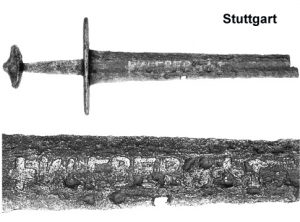
The Ulfberht swords are a group of 170 medieval swords that date back to the 9th and 11th century. The swords are named such as they all carry the inscription Ulfberht in bold letters. A peculiar fact is that these swords are forged via a technology that did not exist until the Industrial Revolution of the 1800s. According to historians, a sword like the Ulfberht is highly complex and difficult to make. Additionally, no other sword could surpass this sword for another 500 years!
7) The Voynich Manuscript- A strange artifact that is yet to be decoded
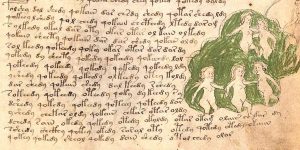
This fifteenth-century codex is one of the most mysterious books in the world. Rediscovered in 1912 by rare books dealer Wilfrid Voynich, the codex is full of fantastical drawings and is written in an unknown language. The manuscript has enticed historians for many years and they have tried in vain to crack its secrets. The strange artifact consists of floating castles, disembodied heads, jellyfish-like creatures and naked women bathing. Many claimed to have decoded the book, however, the claims were unfounded. Today, the Voynich Manuscript remains a mystery.
8) The Shroud of Turin- A strange artifact that is a mystery to both science and religion
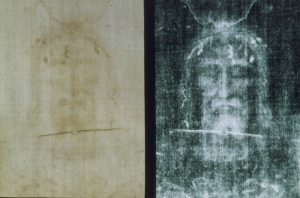
Most of us have heard of the famous Shroud of Turin that allegedly wrapped Jesus Christ’s body in the tomb. The Shroud gained scientific scrutiny when a photographic negative of the fabric unexpectedly revealed the image of a bearded man with a wounded body. Subsequently, a study in the 70s revealed that the image truly showcases a crucified man. However, the study’s conclusions also seemed to hint that the Shroud’s origins were beyond the understanding of science.
Finally, in 1988, scientists shed light on the mystery when they carbon-dated the fabric. The carbon dating revealed that the fabric originated in 1260-1390 CE- more than a thousand years after Jesus is believed to have died. Thus according to science, the mystery was solved, however, this wasn’t the case. Since then many have contested the carbon dating results. The number one reason being that for the body to vanish and create an image on the fabric, a lot of heat and light must have been projected onto the fabric. Thus throwing off the carbon dating result. In the end, the Shroud of Turin is a mystery to both science and religion.
9) Ata- The six-inch mummy
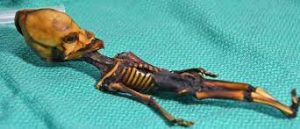
Ata, a six-inch tall skeleton was found naturally mummified in the Atacama Desert of Chile. Despite its small size, tests revealed that it has the bone density of a 6-8-year-old child. It even has hardened teeth with the addition of striking anomalies: 10 ribs instead of the usual 12, giant eye sockets and a long pointed skull. Its small structure led many to believe that it was an alien. However, scientists dispelled this theory by stating that she was human and belonged to the local population. Further stating that her form was a result of genetic mutation.
10) The Baghdad battery
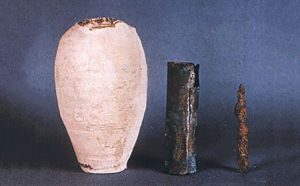
A battery is a 19th-century discovery right? Well, not quite. What if I told you about a battery that is 2,000 years old! In Iraq, 1938, Wilhelm Konig discovered an interesting clay pot in the ruins of a Parthian village. Inside was a copper cylinder containing an oxidized iron rod. According to him, these materials together were meant to produce an electrical charge. Known as the Baghdad battery, it is believed that this ancient battery might have been used for electroplating objects with gold. However, the question remains that how was this technology lost…and the battery not rediscovered for another 1,800 years?
11) Roman Dodecahedron
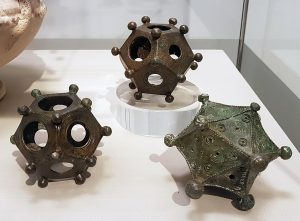
Roman Dodecahedron is a name given to small hollow objects that were found all across Europe. They are made out of bronze and have a dodecahedral shape. The strange fact is that there is no mention of this artifact in any of the pictures or texts of the time. Some speculate that they are candlesticks, while others state they are religious artifacts. However, the actual use of the Roman Dodecahedron remains a mystery.
12) Stone spheres of Costa Rica
The idea of spherical stones is ludicrous, however, these strange artifacts were found in Costa Rica. In the 1930s, workers who were clearing land in the Diquís Valley of Costa Rica came across almost perfectly round stone spheres. They varied in size, with the largest balls being over two meters in diameter and weighing over 16 tons. The artifacts were obviously man-made. However, no one is sure how they were made and for what purpose.
But according to archaeologist John Hoopes, “the spheres were made by reducing round boulders to a spherical shape through a controlled fracture, pecking, and grinding”. Furthermore, the stone spheres are likely a creation of an extinct civilisation that existed in the area between 700 CE and 1530 CE.