MuseumFacts

Home Blog Page 2

Nutty Putty Cave- John Edward Jones And His Tragic Descent

A spelunker is a person who explores and studies caves. They are known to navigate through the smallest of spaces during their explorations. One such spelunker was John Edward Jones who decided to explore the Nutty Putty Cave in Utah. However, things did not go as smoothly as he expected and ultimately he met a tragic end in the very same cave.

Let us take a look at Nutty Putty Cave- John Edward Jones And His Tragic Descent.

1) The Background

John Edward Jones was a 26-year-old medical student and a family man. Additionally, he wasn’t an amateur spelunker as he had gone on many such explorations before. When he was younger, he explored such caves with his father and his brother. Moreover, he also volunteered as a trapped victim for Utah Cave Rescue, an organisation founded by his father.

A picture of John Edward Jones- Nutty Putty Cave
John Edward Jones

2) The Nutty Putty Cave

The Nutty Putty Cave was known for its notoriously narrow spaces. They were first explored by Dale Green in 1960 who named them for their clay. The hydrothermal cave is located south-west of Utah lake and 55 miles from Salt Lake City.

3) John Edward Jones decides to explore the Nutty Putty Cave

John was visiting his family for the holidays. He was with his wife and his 13-month-old daughter. As his family members were ardent spelunkers they decided to explore the Nutty Putty Cave to bond together. At the time John was 6’0″ and weighed around 200 pounds. He hadn’t been spelunking in many years. Even though he was taller than most explorers he was whip-thin and seemingly had the perfect stature for spelunking.

A picture of the entrance to the Nutty Putty Cave
The entrance to the Nutty Putty Cave

4) John, his family members and nine other friends entered the Nutty Putty Cave at around 8 p.m on the evening of November 24, 2009. The group was split into two: the children and few adults explored a less dangerous part of the cave, while the others decided to explore the cave a bit further.
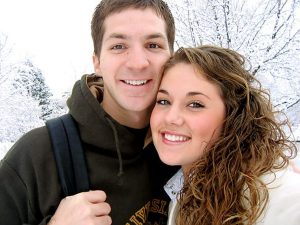
A picture of John Edward Jones and his wife=Nutty Putty Cave
John with his wife Emily Dawn Jones

5) Things started going downhill pretty fast

About an hour into the exploration, John decided to find the entrance to the Birth Canal, a narrow path through which spelunkers must navigate very carefully. He subsequently found an entrance which he thought was the one and crawled through it. He started crawling using his fingers, hips and stomach but soon realised that he had made a grave mistake.

The narrow space he had crawled through was barely 10 inches across and 18 inches high, as a result, John had hardly any space to breathe. At that moment he could only go further in as there was no option to turn around. However, the crevice engulfed him and he could not move any further.

Additionally, even though the Nutty Putty Cave was very popular, it was not fully mapped. Hence John was stuck in a crevice that was in unchartered territory.

6) His brother Josh was the first to find him

Josh tried to pull his brother out to no avail. In a tragic turn of events, as he was pulling at John’s calves, John slid even further down the shaft. What’s worse is that now he was stuck upside down with one hand beneath him and the other wedged above.

As the boys were devout Mormons, they started to pray. John fervently prayed for guidance and to save him for his wife and kids.

7) Josh then navigated towards the entrance to call for help, however, by then John was trapped 400 feet into the cave and 100 feet below the Earth’s surface.

A picture of a caver
Caver Cami Pulham crawling out of the path known as the Birth Canal in Nutty Putty Cave. This was the path, John had assumed he had found. (C: Jon Jasper/jonjasper.com)

8) The first rescuer on the scene was Susie Motola, who arrived at around 12:30 a.m on November 25. By this time, John had been trapped inside the Nutty Putty cave for three and a half hours. Motola then spoke to John and introduced herself, even though all she could see of him were his pair of shoes.

John spoke to her saying, “Hi Susie, thanks for coming, but I really, really want to get out”.

A picture of the crew
Rescuers work to free John from the cave (C: Al Hartmann | The Salt Lake Tribune)

9) Over the next 24 hours, more than 100 rescuers feverishly worked to free John. According to rescuer Shawn Roundy, “it was very narrow, very awkward, and difficult to get rescuers down there”. He further stated that the rescuers faced various difficulties.
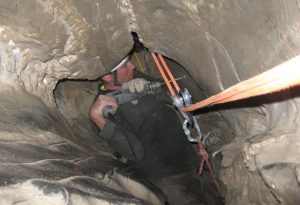
A picture of one of the rescue crew members
One of the rescuers in the cave (C: UCSSAR.org)

10) Ultimately their best option was to use a rope and pulley system to rescue John Edward Jones from the Nutty Putty Cave

Initially, that option seemed to have been working fine. After setting up the system, the rescuers managed to pull John up. Their progress was slow and they could only pull him a foot at a time. Things started to look very promising. Additionally, the rescuers also got the opportunity to feed John through IV tubes.

However, a tragedy struck and one of the pulleys suddenly broke. According to Roundy, the pulley came loose at its anchor point due to the clayish-rock of the cave. This marked the end of the rope and pulley operation and John was back where he was initially trapped.

To make matters graver, all this time, John was stuck upside down in the cave which was putting tremendous pressure on his heart and body. Moreover, his physical condition was deteriorating by the minute and he was having difficulty maintaining consciousness.

11) Just before midnight, John stopped responding

A medical professional then crawled close enough to pronounce him dead due to cardiac arrest and suffocation. Ultimately, rescue personnel had spent 27 hours trying to save John.

A picture of Caver Kory Kowallis
Caver Kory Kowallis in the crawl to the aptly named Scout Trap path in the cave

12) Nutty Putty Cave and its dangerous history

John Edward Jones wasn’t the first person who got trapped in the Nutty Putty Cave. Before him, in 2004, two boys had nearly lost their lives in separate incidents in the same place where John was trapped. In one of the cases, the rescuers took 14 hours to free a 16-year-old kid using several complex pulleys.

After the incidents, officials closed the cave for safety reasons. And it had only been reopened for six months when John and his family decided to explore it.

A picture of a caver at the entrance of the Nutty Putty cave where John Edward Jones got trapped
Caver Emily Vinton Maughan at the entrance of the Nutty Putty Cave (C: Jon Jasper/jonjasper.com)

13) The Aftermath

Ultimately, John Edward Jones’ body was never recovered from the cave. The officials deemed it too dangerous for its retrieval. As a result, that particular crevice is his final resting place. After a week of his tragic death in the Nutty Putty Cave, the cave was sealed permanently for good. Additionally, a plaque is put upon its entrance to commemorate John’s memory.

A picture of a plaque of John Edward Jones- Nutty Putty Cave

14) The Last Descent

The Last Descent is a 2016 survival drama, which is based on the 2009 rescue attempt of John Edward Jones in Nutty Putty Cave. The feature film is directed by Isaac Halasima and showcases the terrible ordeal faced by John. It essentially shows us a glimpse of the varied emotions he must have experienced while being trapped.

Enjoyed the above article? You may also enjoy Marvin Heemeyer’s Killdozer Rampage

korean-war-in-pictures

After World War II, Korea split into North Korea and South Korea respectively. The Korean War was a military conflict fought between the two. Additionally, the Soviet Union, the United Nations with the United States and China also got involved in the war. Subsequently, the Korean War ended with Korea divided into two hostile territories. We have compiled a list of pictures that depict the Korean War.

Let us take a look at The Korean War- in pictures.

1) An undated picture from North Korea’s official Korean Central News Agency shows captured American troops marching down a street during the Korean War.

A picture of captured American troops marching down a street during the Korean War

2) South Korean WACs march through Pusan, the main United Nations’ fort city in Korea, on September 12, 1950.

A picture of South Korean WACs- Korean War pictures

3) A picture depicting troops digging into bunkers atop Old Baldy in Korea in 1952.

A picture depicting troops digging into bunkers atop Old Baldy in Korea in 1952

4) American soldiers in South Korea camouflage their weapons carrier while keeping an eye out for the enemy. July 12, 1950.

A picture of a comouflaged weapon- Korean War pictures

5) A picture depicting three communists captured by the United States Navy off the coast of Korea. May 10, 1951.

A picture depicting three communists captured by the USS Manchester off the coast of Korea, May 10, 1951

6) A picture depicting captured North Korean girls marched to a train that will take them to a prisoner of war camp at Pusan. Taegu, South Korea, October 8, 1950.

A picture depicting captured North Korean girls- Korean War pictures

7) A U.S. tank follows prisoners of war as they march down a village street. September 26, 1950.

A picture of a U.S. tank- Korean War pictures

8) A child sits in the ruins of his home destroyed by fire in Suwon, South Korea, on February 3, 1951.

A picture of a korean child sitting in ruins- Korean War pictures

9) A picture depicting a U.S. Marine (right) with captured North Koreans on September 20, 1950.

A picture depicting a U.S. Marine (right) with captured North Koreans- Korean War pictures

10) A picture depicting North Korean soldiers and their tanks in Seoul during the Korean War.

A picture of North Korean combatons in Seoul

11) American forces and their tank landing ships unload at Inchon on September 15, 1950.

A picture of Tank landing ships in Inchon

12) U.S. troops position a howitzer near the Kum River during the Korean War.

A picture of a howitzer

13) A picture depicting combat in the streets of Seoul during the Korean War.

A picture depicting combat in the streets of Seoul during the Korean War.

14) A picture of Chinese troops crossing the frozen Yalu River during the Korean War.

A picture of Chinese troops crossing the frozen river

15) A picture from North Korea’s official Korean Central News Agency shows North Korean combatants advancing during the Korean War.

A picture of North Korean Combatants advancing during the Korean war

16) Korean refugees wait in line to board a vessel in Hungnam harbour, North Korea on December 21, 1950, as they flee the advancing Chinese and North Koreans.

A picture of North Korean refugees

17) Another picture depicting refugees waiting to evacuate at Hungnam.

A picture of refugees waiting to evacuate at Hungnam

18) A picture depicting smoke rising from the ruins of the village of Agok in the northern region of South Korea, August 1950.

A picture depicting smoke rising from the ruins of the village of Agok

19) Paratroopers from the 187th RCT jump from aircraft near the North Korean towns of Sukchon and Sunchon. October 20, 1950.

A picture of American paratroopers

20) Chinese communist troops surrender to Charlie Company, 7th Marines, south of Koto-ri, on December 9th, 1950.

A picture of Chinese troops surrendering to American forces

21) American GIs and Korean troops stack up a large pile of empty artillery and mortar shell casings at a collecting point near the front on June 18, 1953.

A picture of a large pile of mortar shells

22) A young Korean girl carries her brother on her back as she passes by a stalled tank. Haengju, Korea, June 9, 1951.

A picture of a girl carrying her brother on her back

23) A picture depicting General William K. Harrison (left) and General Nam II (right) signing the armistice agreement which brought the Korean War to a close. Panmunjom, July 27, 1953.

A picture depicting General William K. Harrison (left) and General Nam II (right)

24) Four U.S. Marines just off the fighting line on the Western Korean front read the good news in an official handout that armistice to end the war was going to be signed soon. Panmunjom, July 26, 1953.

A picture of Four U.S. Marines
(C: George Sweer)

25) A picture depicting PFC Donald Jones of Topeka, Kansas reading a sign put up on the south limit of the demilitarized zone in Korea on July 30, 1953.

A picture of an American soldier reading a sign

Photo credit: U.S. Navy / AP / Korean Central News Agency)

Enjoyed the above article? You may also enjoy The Battle of Somme- in pictures

Peloponnesian War- A Conflict That Reshaped Ancient Greece

Athens and Sparta were two of the most prominent city-states of Ancient Greece. They subsequently went to war from 431 to 405 B.C. The Peloponnesian War ultimately resulted in the victory of Sparta, thus establishing it as the leading power in Ancient Greece. The war was also instrumental in the utter devastation of Athens and signalled the end of the Golden Age of Ancient Greece. Read about the effects, causes and consequences of the Peloponnesian War.

Let us take a look at the Peloponnesian War- A Conflict That Reshaped Ancient Greece.

1) The cause of the Peloponnesian War

The Peloponnesian War essentially started after the end of the Persian Wars in 449 B.C. In order to defeat the Persians, the Greeks had utilised the combined leadership of Athens and Sparta. However, after Greece’s victory, the two sides were unable to maintain their unity and ultimately the differences between the two drove Ancient Greece apart. The Greeks had divided loyalties. Hence as soon as the Persians left, the Greeks started having internal conflicts.

The Athenians subsequently formed the Delian League. The League was essentially an alliance of city-states and islands that vowed to continue the war against the Persians until they no longer posed a threat to their alliance. Eventually, the Athenians gained dominance of the Delian League. And this constituted the Golden Age of Athens.

At the same time, Sparta, the head of the Peloponnesian League started fearing the growing power and influence of the Athenian empire. Their fear of Athen’s ambitions is one of the main causes of the Peloponnesian War.

A picture of the acropolis-Peloponnesian War

2) Athens and Sparta had fought before in a major conflict known as the Great Peloponnesian War

The Great Peloponnesian War was the first major conflict between Athens and Sparta and their allies. The scuffle lasted for 15 years and subsequently, the signing of the Thirty Years’ Peace Treaty in 445 B.C. ended the war.

A picture of Spartans fighting

3) However, due to various conflicts, the Thirty Years’ Peace Treaty became strained

In 440 B.C., one of Sparta’s allies Corinth urged the Spartans to declare war on Athens simultaneously as Corinth was suppressing a revolt on the island of Samos. However, at the time Sparta refused to engage in battle. But ultimately battle between the two was inevitable.

4) The ancient city Epidamnus was facing domestic issues which led to Corinth’s involvement. However, Corinth’s enemy Corcyra targeted Epidamnus and seized it in a naval battle. Although Corinth retreated, it began rebuilding its fleet and planning its revenge.

A picture of ships

5) Renewed hostilities began in 433 B.C. when Athens allied itself with Corcyra

As tensions began to build, Corcyra officially sought help from Athens. Although Athens initially debated the idea, their most influential leader Pericles suggested a defensive alliance with Corcyra. Subsequently, fighting ensued, and the Athenians then proceeded to violate the Thirty Years’ Peace Treaty.

6) The Battle of Sybota was a naval battle between Greek city-states Corcyra and Corinth and it became an immediate catalyst for the Peloponnesian War.

A picture of a naval fleet

7) Eventually, Sparta was drawn into the conflict. They were hesitant to enter war directly but were convinced by Corinth to do so. However, before they took action, they sent three delegations to Athens to avoid war, however, they all failed. Ultimately, in 431 B.C., a Spartan ally, Thebes attacked an Athenian ally Plataea and open war ensued.

A picture of the demolished Athenian walls-Peloponnesian War

8) The Archidamian War (431–421 B.C.)

The subsequent years of fighting are divided into two periods; the first 10 years being the “Archidamian War”. During that time, the Spartan King Archidamus II led an army into Attica, the region around Athens. The Spartans aimed to liberate the states under Athenian rule by decimating their defences and tearing down their structure.

As the Spartans surrounded Athens in a siege, Pericles declined to fight them near the city’s walls and instead urged the Athenians to make full use of their naval superiority. When Pericles returned from his naval campaigns in 430 B.C., a plague had ravaged the city, killing nearly two-thirds of the population. Ultimately he himself fell victim to the plague and succumbed. This was a huge set back for the Athenians. Simultaneously, the Spartans also suffered some major losses at sea.

A picture of Spartan King Archidamus II-Peloponnesian War
Spartan King Archidamus II

9) Peace of Nicias

After many years of open warfare, Sparta extended an olive branch which Athens accepted. In 423 B.C., both sides signed an agreement of peace stating that Athens and Sparta would defend each other for the next 50 years. However, the treaty barely lasted 8 years.

10) The second phase of the Peloponnesian War (413–405 B.C.)

The second phase of the Peloponnesian War began when the Athenians decided to help their allies in Sicily against Syracuse invaders. They launched a huge attack on Syracuse, resulting in retaliation from the Spartans. Thus the hostilities renewed between the two.

11) Who won the Peloponnesian War?

Learning from its past conflict, the Spartans established a fleet of warships to beat the Athenian navy. However, it would be another decade of fighting before the Spartan general Lysander defeated the Athenian armada at Aegospotami. This devastating defeat led to the Athenian surrender and consequently ended the Peloponnesian War.

A picture of the Peloponnesian War-Peloponnesian War
(C: Chronicle/ Alamy)

12) Consequences of the Peloponnesian War

The main consequence of the Peloponnesian War was the fall of Athens. With that, it signalled the end of the Golden Age of Ancient Greece. Sparta eventually took over the Athenian empire. Additionally, for some time Athens was ruled by tyrants until it became a democracy again. Although Athens was considerably weakened, it played an active role in Greek politics. The rivalry between the two finally concluded when both were conquered less than a century later and made part of the kingdom of Macedon.


Enjoyed the above article? You may also enjoy 20 Interesting Facts About Ancient Greece.

The Dirigibles That Once Roamed The Skies- in pictures

Airships a.k.a dirigibles were widely used during the 1920s and the 1930s. They were large passenger carriers that used hydrogen to lift them. However, the use of hydrogen was unsafe and many airships like the Hindenburg met a ghastly end. Ultimately the numerous accidents and large losses of life led to their discontinuation. The pictures below show the mighty dirigibles that once roamed the skies.

Let us take a look at The Dirigibles That Once Roamed The Skies- in pictures.

1) A picture of a dirigible flying above the White House in Washington, District of Columbia, in 1906.

A picture of an airship flying above the White House

2) A picture depicting the French military airship Republique leaving Moisson for Chalais-Mendon, in 1907.

A picture depicting the French military airship “Republique”

3) Due to the stormy wind from the Atlantic, the 700-foot U.S. Navy’s airship Los Angeles flipped on its nose at Lakehurst, New Jersey in 1926. Fortunately, the aircraft slowly righted itself and there were no serious injuries to the crew aboard.

A picture of the tilted Los Angeles

4) The German passenger-carrying dirigible Graf Zeppelin flying over the city of Jerusalem, April 26, 1931.

A picture of German Graf Zeppelin

5) A picture depicting the dirigible USS Macon.

A picture of the dirigible USS Macon

6) A picture depicting USS Los Angeles, moored to the USS Patoka.

A picture depicting USS Los Angeles

7) The German commercial passenger carrier Hindenburg flies near the Empire State Building over Manhattan, on August 8, 1936.

A picture of the German passenger carrier Hindenburg

8) A picture depicting a zeppelin airship, August 4, 1908.

A picture depicting a zeppelin airship

9) A picture depicting the dirigible Graf Zeppelin flying low over Tokyo before proceeding to Kasumigaura Airport on August 19, 1929.

A picture depicting Graf Zeppelin

10) An aerial view of the U.S. Navy’s USS Akron over Washington, District of Columbia, in 1931.

A picture of the USS Akron

11) A picture depicting the dirigible USS Akron flying off the Panama Canal Zone on March 15, 1933.

A picture depicting the dirigible USS Akron

12) A picture depicting the R33-Class airship, March 1919.

A picture of the R33

13) The R33-Class airship making an experimental flight from Bedfordshire to Pulham, 1925.

A picture of the R33-Class airship

14) The Graf Zeppelin in the Akron airship shed.

A picture of the Graf Zeppelin in the Akron airship shed

15) The U.S. Navy essentially built the USS Macon for scouting. Here the airship is seen sailing over lower Manhattan, on October 9, 1933.

A picture of the USS Macon

16) A picture depicting the moored airship R101. Unfortunately, on her maiden voyage, the craft crashed and burned in France, en route to India on October 5, 1930. The crash essentially ended the budding British airship program.

A picture depicting the moored airship R101

17) A picture depicting passengers entering the R101.

A picture of British members of Parliament (MPs) entering an airship

18) A picture of passengers dining on the dirigible Hindenburg.

A picture of diners on the Hindenburg

19) The Hindenburg flies over New York City on May 6, 1937, en route to Lakehurst, New Jersey, from Germany.

A picture of the Hindenburg

20) Unfortunately, the Hindenburg burst into flames as it tried mooring at Lakehurst, New Jersey. The gruesome incident claimed 36 lives. Additionally, the Hindenburg Disaster was instrumental in ending the era of the airship.

A picture of the Hindenburg Disaster

(Photo credit: Library of Congress / U.S. Navy / AP)

Enjoyed the above article? You may also enjoy Construction of the Golden Gate Bridge- in pictures

10 Interesting Facts About Michelangelo That You Need To Know!

Michelangelo Buonarroti is one of the most famous sculptors of the High Renaissance period. Popularly known as the Il Divino (the divine one), he was a highly respected artist and was also considered as the archetypal Renaissance man. We have compiled a list of interesting facts about Michelangelo that you need to know!

Let us read 10 Interesting Facts About Michelangelo That You Need To Know!

1) An interesting fact about Michelangelo is that before his rise to fame, he was a forger

In the early years of his career, Michelangelo sculpted a now-lost cupid statue in the style of the Ancient Greeks. Upon seeing it, Lorenzo de’ Medici told Michelongalo that it would be more profitable if he were to make it “appear to have been buried”. Further stating that he would then send it to Rome and pass it off as an antique. Ultimately Cardinal Raffaele Riario bought the piece. The cardinal soon realised that it was a fake and got a refund. However, he was so impressed by the sculpture, that he invited Michelangelo to work in Rome. The young artist would work in the city for the following years, eventually carving the Pietà, which made him famous.

A picture of the Pietà-interesting facts about Michelangelo
Pietà

2) He used an inferior marble to carve David

Although famous sculptors were known to use high-quality marble for their carving, Michelangelo did the opposite. He carved his famous David statue using a rejected and ‘unworkable’ block. The story goes that the slab was carved around 1464 with plans to be used by the sculptor Agostino di Duccio, who wanted to make a giant figure for one of the piers of the Florence cathedral. However, he abandoned that project two years later. After lying unused for 10 years it was then taken by sculptor, Antonio Rossellino, who discarded it as well. Meanwhile, the block had deteriorated and grown rough.

Michelangelo stepped in in 1501 and began working on the block. He ultimately carved David which became one of his most recognised works. However, reports say that due to the poor quality of marble, the statue is degrading at a faster rate than most marble statues.

A picture of David-interesting facts about Michelangelo
David

3) An interesting fact about Michelangelo is that he was a poet as well

Michelangelo, though best known for his sculptures, was also a poet who wrote over 300 poems. He was pretty humble about his poetry and deemed them “something foolish”. His poetry made use of extensive wordplay and revolved around a range of subjects including love, spirituality and the human soul. While his poems were never formally published during his lifetime, they were widely distributed and enjoyed by 16-century Rome’s literati.

A picture of Michelangelo's poems-interesting facts about Michelangelo

4) Michelangelo exacted creative revenge against someone who badmouthed his work

During the time Michelangelo was working on his masterpiece The Last Judgment, Pope Paul III went to visit the Sistine chapel with his entourage. Among them was the pope’s Master of Ceremonies Biagio da Cesena who after observing the fresco expressed his disdain for it. Moreover, he did not keep his opinion to himself. Biagio wrote a letter to the pope stating that the fresco had too many nude figures and it is not meant for a chapel but meant for a tavern.

Michelangelo heard about this criticism and responded by inserting Biagio in the fresco. He essentially depicted Biagio in hell as Minos, a judge of the dead in the underworld, whose body is wrapped in the coils of a snake. 

After Biagio heard about the outrageous depiction, he rushed to complain to the pope. The furious man wanted the pontiff to order Michalenagelo to strike off the likeness. However, Paul III quipped that once Biagio had been placed in hell, not even he, as pope could intervene. 

A picture of Minos-interesting facts about Michelangelo
Minos

5) Michelangelo depicted himself in his most famous works

Michelangelo rarely signed his works and left behind no documented self-portraits. However, he did insert stylised depictions of his face in his works. The most famous one being in his 1541 Sistine Chapel fresco “The Last Judgment,” in which saint St. Bartholomew is holding the flayed skin of a man whose face resembles the artist. Michelangelo also depicted himself as Saint Nicodemus in his Bandini Pietà and art historians also believe that he may have depicted himself in his final painting, the Crucifixion of Saint Peter.

A picture of Michelangelo as the flayed man
Michelangelo depicted himself as the flayed man held by St. Bartholomew

6) His sharp tongue got his tongue broken

Michelangelo had a volatile and critical nature. In his youth, he was sent to live and study in the home of Lorenzo de’ Medici. Michelangelo soon gained recognition for his steady hand with the chisel and paintbrush. And consequently became the envy of all classmates. One fellow pupil in particular—Pietro Torrigiano—could not stand his talent and in a fit of jealousy or due to Michelangelo’s sharp tongue punched him in the nose, leaving it permanently crooked. Torrigiano subsequently boasted that Michelangelo will carry his mark with him to the grave.

A picture of Michelangelo
Michelangelo (C: The Metropolitan Museum of Art, New York, Gift of Clarence Dillon, 1977)

7) An interesting fact about Michelangelo is that he worked for nine different Catholic popes

Another interesting fact about Michelangelo is that he worked for nine different Catholic pontiffs from Julius II to Pius IV. He did a variety of work for the Vatican including carving sculptures and painting the ceiling of the famous Sistine chapel. However, his relationship with the pontiffs was not always smooth sailing. In one case he spent three years working on a marble façade for Leo X, only for him to nix the project. Additionally, he also had a particularly tempestuous relationship with Pope Julius II.

However, Michelangelo later developed more friendly relationships with other pontiffs, most notably Pope Paul III, who defended his work “The Last Judgment” after church officials criticised its many nude figures.

A picture of Michelangelo in his studio

8) He was a workaholic

Michelangelo had a great love for his art and that was evident as he spent most of his time working. There was an instance when he was so immersed in his craft that he forgot to take off his boots for many days, and when he finally did take them off, his skin peeled off with the boots.

Michelangelo lived a comparatively long life. The artist spent most of his golden years overseeing the construction of St. Peter’s Basilica in the Vatican. Even though he was feeble, he supervised it by sending drawings and designs to trusted foremen. However, ultimately sculpting was his true love and he continued carving away in his home studio until the very end. In fact, he was still working on the Rondanini Pietà only days before he died at the age of 88. The marble sculpture essentially depicts Jesus in the Virgin Mary’s arms

A picture of Rondanini Pietà
Rondanini Pietà

9) Michelangelo’s personal life

Michelangelo never married and not much is known about his personal life. However, he did write numerous romantic sonnets to a young nobleman Tommaso dei Cavalieri. Additionally, he also expressed strong affection for a widow named Vittoria Colonna and the two wrote sonnets to each other.

10) His most famous sculptures have been victims of vandalism 

In 1972, a mentally unstable geologist Laszlo Toth attacked the Pietà and consequently broke off Madonna’s nose and forearm as well as part of her eyelid and veil. The restoration took 10 months before the sculpture could be put on display again. In a similar incident, a part of David’s foot was hammered off in 1991. 

A picture of the apprehended Laszlo Toth
Laszlo Toth apprehended for vandalising the Pietà

Enjoyed the above article? You may also enjoy 10 Famous controversial art pieces of all time

Construction of the Golden Gate Bridge- in pictures

One of the most recognised symbols of San Francisco, California is the Golden Gate Bridge. According to Frommer’s travel guide, the bridge is the most beautiful, and the most photographed, bridge in the world! Additionally, at the time of its opening in 1937, it was the tallest and biggest suspension bridge in the world. To commemorate the architectural wonder, we have compiled a series of pictures that depict the construction of the Golden Gate Bridge.

Let us take a look at the Construction of the Golden Gate Bridge- in pictures.

1) Workers put up the first section of a large safety net that will extend from shore to shore beneath the bridge.

A picture of the large safety net- Construction of the Golden Gate Bridge

2) A worker walking on one of the catwalks being built for the construction of the cable.

A picture of a worker on the catwalk- Construction of the Golden Gate Bridge

3) A view of the under-construction tower of the Golden Gate Bridge.

A picture of the under-construction tower of the Golden Gate Bridge.

4) A picture depicting tourists viewing the construction of the Golden Gate Bridge, 1936.

A picture of tourists viewing the construction of the Golden Gate Bridge, 1936

5) A worker inspects the levee that connects Fort Point to the South Tower of the bridge.

A worker inspecting the levee- construction of the Golden Gate Bridge

6) Another picture depicting the huge safety net set up during the construction of the Golden Gate Bridge.

A picture of the huge safety net set up during the construction of the Golden Gate Bridge

7) A picture depicting men fishing on Baker Beach, with the under-construction bridge in the background.

A picture of fishermen

8) A United States Navy battleship sails under the cables of the under-construction bridge, 1936.

A picture of a United States Navy battleship

9) Workmen on the catwalks bundling the cables of the bridge.

10) A picture depicting the near-completed bridge.

A picture of the near-completed bridge

11) Workmen working on the cables of the bridge.

12) A picture depicting the installation of the bridge floor during the construction of the Golden Gate Bridge.

A picture of the roadbed installation- construction of the Golden Gate Bridge

13) A picture depicting a worker standing on the main cables of the bridge.

A picture of a worker on the cables

14) A picture depicting the South Tower during the construction of the bridge.

A picture of the South Tower

15) The setting up of the bridge floor.

A picture of the setting up of the bridge floor

16) Workmen working on the cables of the bridge.

A picture of men on the cables

17) The bridge opens up for pedestrians on 27 May 1937.

A picture of the opening of the bridge

18) A picture depicting the inaugural drive across the bridge, 1937.

A picture of the inaugral drive- construction of the Golden Gate Bridge

19) Military aircraft fly over the Golden Gate Bridge during the opening day gala.

A picture of the military planes

20) A picture depicting the official grand opening of the Golden Gate Bridge on May 29, 1937.

A picture of the grand opening- construction of the Golden Gate Bridge

Enjoyed the above article? You may also enjoy the Construction of the Hoover Dam- in pictures

Top 10 Inventions Of Leonardo da Vinci

Leonardo da Vinci is one of the greatest artists of the High Renaissance period. One of his most famous paintings is the Mona Lisa, which hangs at the Louvre Museum today. In addition to being an artist, Leonardo was a master inventor as well. We have compiled a list of Leonardo da Vinci’s inventions that heavily impacted history. Read the below text to find out what did Leonardo da Vinci invent.

Let us take a look at the Top 10 Inventions Of Leonardo Da Vinci.

1) The machine gun

The answer to the question ‘what did Leonardo da Vinci invent?’ has a lot of answers. Leonardo invented various things. The first on our list is the machine gun. In an attempt to increase the firepower of a traditional cannon, Leonardo da Vinci devised a multi-barreled cannon that could be rotated to fire a line of muskets whilst another was being loaded. Additionally, its fan-shaped design allowed the machine to widen its field of fire and attack the advancing troop as effectively as possible. Ultimately, Leonardo’s concept was used commercially as a machine gun in the 19th century.

A picture of the machine gun-Leonardo da Vinci's inventions

2) Leonardo da Vinci’s invention of the mechanical knight

Also known as Leonardo’s robot, the mechanical knight was one of his unique inventions. The knight was essentially a humanoid automaton designed and possibly constructed by Leonardo around 1495. And it was described as being clad in German-Italian medieval armour. The astonishing fact about the robot was that it could stand, sit, raise its visor and independently manoeuvre its arms. Additionally, it had an anatomically correct jaw. The robot system was operated by wheels and gears which were connected with the help of a pulley through a cable system. Ultimately the design was patented by Mark Rosheim in the year 2002 after he successfully constructed a version of this humanoid automaton using Leonardo’s sketches.

A picture of the mechanical knight-Leonardo da Vinci's inventions

3) The parachute

Another invention attributed to Leonardo da Vinci is the parachute. He had sketched and designed it in the 15th century. However, his design was quite different from the modern parachute. Leonardo’s parachute design consists of a sealed linen piece of cloth held open by a wooden pyramid structure, about seven metres long. According to him, it allowed man to “throw himself down from any great height without sustaining any injury”.

Leonardo’s idea was far ahead of his time and he did not have the right technology to test his invention. However, 500 years later, in the year 2000, Leonardo was proved right when Adrian Nicholas tried his parachute design and safely floated down. After his ride, he even stated that it was smoother than modern parachutes.

A picture of the parachute-Leonardo da Vinci's inventions

4) The ornithopter a.k.a the flying machine

Inspired by the birds, Leonardo da Vinci designed the ornithopter which was essentially an aircraft that flies by flapping its wings. Leonardo had grasped that the average human was too heavy to fly with just wings attached to them. Hence he sketched out the design of the ornithopter; a device in which the pilot lies down on a plank and pedals two large wings using manually operated levers and a system of pulleys. Once in the air, the wings would flap, much like a bird’s.

A picture of the Ornithopter a.k.a the Flying Machine-Leonardo da Vinci's inventions

5) What did Leonardo da Vinci invent? – The Aerial screw

Leonardo da Vinci drew and designed several aerial machines, including the aerial screw. It consisted of a spinning linen aerial screw designed to compress air to induce flight. The design essentially outlines the idea of a contemporary helicopter. Additionally, Leonardo’s notes also suggest that he constructed small flying models of the aerial screw, however, due to limited technology he could never build a full-size working version.

A picture of the Aerial screw-Leonardo da Vinci's inventions

6) Viola organista- Leonardo da Vinci’s musical invention

The musical instrument viola organista is also another one of Leonardo da Vinci’s invention. Leonardo presumably wanted to create a universal instrument that combined the sound qualities of a harpsichord, viola da gamba and an organ. Hence he came up with the concept of viola organista. The organ functions by pulling the instrument strings with the help of a keyboard and string mechanism towards a moving wheel which is wrapped with horsehair. This makes the strings vibrate and produce a sweet sound. Although Leonardo conceptualised the design, he never brought it into existence. However, it garnered a lot of interest after his death and many musicians invented various versions of the instrument.

A picture of the Viola Organista

7) Scuba gear

While staying in Venice, in the 1500s, Leonardo designed the scuba gear as part of an elaborate plan to attack the Ottoman ships that were attacking Venice at the time. Leonardo’s scuba gear consisted of a leather diving suit that was equipped with a bag-like mask that went over the diver’s head. The mask consisted of breathing holes, glass goggles and an inflatable wineskin to enable sinking and floating. Additionally, the diving suit also incorporated a pouch for the diver to urinate in. Leonardo considered the technology too dangerous to describe fully. Stating that “evil men would use it for assassinations and wrongfully sink ships”.

8) Leonardo da Vinci’s invention of the armoured vehicle was a prototype for modern tanks

The armoured vehicle is another one of Leonardo da Vinci’s invention. While working under the patronage of the Duke of Milan, Leonardo came up with a concept that many would describe as the prototype for modern tanks. The armoured vehicle was equipped with an array of light cannons and was to be operated by four men. Additionally, its covering was inspired by a turtle’s shell and was made of wood and reinforced with metal plates.

However, the impressive machine had an error: the gears of the design were in a reversed order. This essentially made the vehicle unworkable. However, according to some sources, this was a deliberate mistake as Leonardo did not want his design falling into wrong hands and used irresponsibly.

A picture of the armoured vehicle

9) Leonardo da Vinci’s invention of the self-propelled cart is the ancestor of the modern automobile

Leonardo da Vinci’s inventions were indeed ahead of their time and one such invention was the self-propelled cart. The cart was capable of moving without a push and many consider it to be the world’s first robot. The cart was powered by two symmetric coiled springs and it also featured steering and brake capabilities. The moment the brake was released, the car was propelled ahead. Additionally, the steering was pre-programmed to go either straight or at pre-set angles.

The cart’s design and its exact workings were so complex that it baffled scholars until the late 20th century. In 2006, an Italian institute brought the concept into existence and to everyone’s surprise, the cart actually worked! Furthermore, many experts note that it looked similar to the Mars Land Rover.

A picture of the self-propelled cart

10) Leonardo da Vinci’s anemometer

Ultimately our lists only answer a fraction of the question ‘what did Leonardo da Vinci invent?’. As the man invented a plethora of things during his lifetime. The last invention on our list is Leonardo’s anemometer. An anemometer is essentially a device that measures wind speed and direction. According to historians, it was Leonardo’s fascination with flight that inspired him to innovate the anemometer. Although he did not actually invent the device, he made several variations to the existing design by Leon Battista. Leonardo’s innovation essentially made it easier to measure wind force.

A picture of Leonardo Da Vinci's anemometer

Enjoyed the above article? You may also enjoy 20 great Ancient Egyptian inventions that changed the world

15 Interesting Facts About The Crusades

The Crusades were essentially a series of religious wars initiated and sometimes conducted by the Roman Catholic Church in the medieval period. The crusaders went on several church-sanctioned campaigns; the most important ones were reclaiming the Holy Land from Islamic rulers. As Crusades have a vast history, we have compiled some interesting facts about them.

Let us take a look at 15 Interesting Facts About The Crusades.

1) In 1095, Pope Urban II declared the First Crusade

In 1095, Byzantine Emperor Alexios I Komnenos requested military support from the Roman Catholic Church in his conflict with the Turks. Pope Urban II supported his request and encouraged faithful Christians to take up arms and march to Jerusalem. Subsequently, earning the name the People’s Crusade.

An image of a pope standing at a pulpit and passionately preaching to a crowd. The pope's expressive gestures and confident demeanor captivate the audience. The scene depicts the historical context of the Crusades, where the pope played a crucial role in rallying faithful Christians and inspiring them to embark on holy military campaigns. This image symbolizes the religious fervor and influential leadership of the papacy during the Crusades, emphasizing the power of persuasive rhetoric and the mobilization of believers for a sacred cause."

2) Does the Arab-Muslim world hold a grudge?

Surprisingly, the answer is no. In fact, the Arab-Muslim world hadn’t even come across the word ‘crusade’, until European scholars and historians began to reference these historical conflicts. Most Arabic societies had long forgotten about these wars as they had happened centuries ago. It was only during the decline of the Ottoman Empire that the term resurfaced, sparking curiosity and prompting a reexamination of these centuries-old wars from a new perspective.

An image of a pope standing at a pulpit and passionately preaching to a crowd. The pope's expressive gestures and confident demeanor captivate the audience. The scene depicts the historical context of the Crusades, where the pope played a crucial role in rallying faithful Christians and inspiring them to embark on holy military campaigns. This image symbolizes the religious fervor and influential leadership of the papacy during the Crusades, emphasizing the power of persuasive rhetoric and the mobilization of believers for a sacred cause."

3) The Crusades weren’t just Christianity vs Islam battles

Although we see the Crusades as a struggle between Christians and Muslims, they in fact involved clashes with other communities as well; especially the Jews and Pagans. In fact, during the People’s Crusade, the crusaders massacred numerous Jewish communities. And the event subsequently earned the name Rhineland Massacre.The tragic event serves as a somber reminder of the violence and religious intolerance that permeated some aspects of the Crusades.

 Knights on horseback in crusade-themed armor, ready for battle during the Crusades.
Valiant knights adorned in their battle gear, embodying the spirit of the Crusades and prepared to defend their faith on horseback.

4) An interesting fact about the origin of the word ‘Crusades’

The word ‘Crusades’, wasn’t used when the wars first started. Sanctioned by the church, the Crusades were simply military expeditions. They got their current meaning in the late 18th century. The root of the word goes back to the 16th-century French word croisade, which essentially means ‘marked with the cross’.

A picture of Crusaders- interesting facts about the Crusades

5) The earlier words for ‘crusade’ were iter(journey), and peregrinatio(pilgrimage).

In the early days, before the term ‘crusade’ came into use, these holy endeavors were referred to as ‘iter,’ meaning a journey, and ‘peregrinatio,’ signifying a pilgrimage. These terms reflected the belief that undertaking a crusade was not only a military campaign but also a spiritual quest, emphasizing the importance of both the physical journey and the devotion to a sacred cause.

6) Nobody realised the purpose of the Crusades for ages

The ironic thing is that initially, nobody realised the purpose of the Crusades. This was because, during the medieval ages, there was lots of fighting among different communities. So when the crusaders invaded the Levant, most people thought this was just another raid.

However, when the Christians stayed back and ruled their new territories as Christendom, the magnitude of the situation dawned upon the locals. Additionally, it wasn’t until 1105, that the conquered Muslims started talking about waging jihad in response, and it was in 1144 that they actually initiated it.

A picture of knights

7) Contrary to popular belief the Crusades weren’t entirely carried out by the Catholics

During the medieval ages, most Europeans were Catholics, so many people associate the Crusades with them. However, the Catholic crusaders were often joined by members of the Eastern Orthodox Church, Armenian Christians, Russian Christians and Greek Christians.

A picture of knights- interesting facts about the Crusades

8) Christopher Columbus was a crusader?

Columbus was a devout Christian. And according to a theory, he might have been a crusader. The theory states that when Columbus exploited the regions of the Caribbean, he was accumulating funds to finance a new crusade driven by his fervent religious beliefs and the desire to reclaim holy sites. While this theory remains speculative, it adds an intriguing layer to Columbus’ motivations and actions during his expeditions.

A picture of Christopher Columbus

9) An interesting fact about the ‘Tafurs’, the infamous hungry crusaders

‘Tafurs’, derived from the Latin word “tafursus” meaning beggar, were a notorious group among the crusaders. These individuals, who had sworn to a life of poverty, possessed no personal belongings and survived solely on meager sustenance like grass and roots. Astonishingly, historical accounts suggest that some of them even resorted to cannibalism in their extreme conditions, making them one of the most peculiar and enigmatic factions of the Crusades.

10) ‘Deus vult!’ The official battle cry of the crusaders

According to the Gesta Francorum Chronicle, the battle cry of the First Crusade was “Deus vult” or “God wills it.” This powerful phrase echoed through the ranks of the crusaders, inspiring their zeal and determination in reclaiming the Holy Land. Interestingly, the impact of this battle cry was so profound that it transcended the First Crusade and became a rallying cry for numerous subsequent Crusades, symbolising the fervent religious motivation behind these military campaigns.

A picture of knights on a ship
(C: Bibliothèque Nationale/ Bridgeman Images)

11) The First Crusade was the only successful one

The First Crusade was initiated for taking back the Holy Land of Jerusalem from the Muslim Seljuk Empire. The crusaders were successful in their campaign. A major reason for this was that during that time the Muslims were disunited and were highly suspicious of each other. This internal fragmentation weakened their defense and made it easier for the crusaders to seize important territories, marking a turning point in the history of the Crusades.

12) The crusaders plundered a Christian city

An interesting fact about the Fourth Crusade is that it targeted a Christian city called Zara. Due to the failure of the previous Crusades, Pope Innocent III declared a new crusade. Within the next two years, about 35,000 men gathered for the cause. Many of these men needed funds to be able to travel. Additionally, most of them hailed from Venice. Innocent asked the Venetians to give him access to their ships to transport the crusaders, in return for payment. However, they weren’t able to raise funds!

The question arose of how to raise funds. The answer came in the form of the city of Zara. The city had revolted against Venetian rule in 1183 and declared itself part of the Kingdom of Hungary.

To kill two birds with one stone, the Venetians ordered the crusaders to plunder the city for its riches. The pope was highly against this but the crusaders did not pay him any heed. They went on to pillage, plunder and rape the inhabitants of Zara. Shockingly the Fourth Crusade did not stop here. The crusaders then went on to plunder and sack another Christian city- Constantinople.

A picture of Crusaders plundering Constantinople- Interesting facts about Crusades

13) Another fact about the Fourth Crusade is that it was instrumental in creating a strong separation between Catholics and Orthodox Christians. Additionally, the crusade dealt an irreversible blow to the Byzantine Empire and ultimately led to its decline and fall.

The crusaders’ diversion from their original goal of retaking Jerusalem led to the siege and looting of Constantinople, resulting in the empire’s decline and eventual fall. This unforeseen consequence highlights the complex and far-reaching impacts of the Crusades on both religious and political realms.

A picture of knights

14) The Children’s Crusade

The Children’s Crusade of 1212 was an unfortunate event that took place during Europe’s crusade frenzy. Essentially a huge group of 30,000 young adults took the crusaders’ vow and set out to reclaim the Holy Land. However, this was not an official crusade and was not sanctioned by the pope.

Ultimately the crusade was a failure. Additionally, none of the children ever made it to Jerusalem as most of them died or were sold into slavery.

A picture of the Children's Crusade- Interesting facts about Crusades

15) Knights Templar

The last interesting fact about the Crusades is that they employed the services of the Knights Templar. Who subsequently became its best warriors. The Knights Templar are also instrumental in managing the economic infrastructure throughout Christendom. Additionally, they made several financial innovations that were a precursor to early banking.

A picture of the Knights Templar

Enjoyed the above article? You may also enjoy 110 Important historical facts that you must know!


David Ghantt And The Ridiculous Loomis Fargo Heist

Bank heists are ideally supposed to have meticulous planning right? Well, we bring to you a bank heist so ridiculous and poorly planned, that you will think ‘I can plan a better heist!’. We are talking about the 1997 Loomis Fargo heist. It was committed by David Ghantt and the heist subsequently inspired the comedy movie ‘Masterminds’.

Let’s take a look at David Ghantt And The Ridiculous Loomis Fargo Heist.

1) David Ghantt is underpaid and unhappy

David Ghantt worked as a vault supervisor for the armoured cash vehicles at the Charlotte, North Carolina branch of Loomis, Fargo & Co. Ironically even though he worked for a company that moved millions of dollars every day, he was relatively underpaid. After years of working hard, the realisation hit him that he was working “75-80 hrs a week for $8.15 an hour” which left him feeling “unhappy”.

A picture of David Ghantt- Loomis fargo heist
David Ghantt

2) A joke that gave birth to an idea

David Ghantt struck up a friendship with Kelly Campbell, a coworker who saw eye to eye with him. They both made jokes about their work and how they would rather rob the place than continue with their underpaid job. They soon realised that their joke was not a far-fetched idea.

One day, Campbell met up with Steven Chambers, an old high school classmate and a small-time crook. He then broached the possibility of a robbery to Campbell; who subsequently introduced Ghantt to Chambers.

As Ghantt was fed up with his underpaying job, he was receptive to the idea and the three started planning a heist.

A picture of Loomis Fargo armoured cash vehicle
Loomis Fargo armoured cash vehicle

3) Ghantt, Campbell and Chambers come up with a plan

Their plan was fairly straightforward: Ghantt was to remain in the vault after his shift on the night of the heist, October 4, 1997. Subsequently, he was to take out as much cash as he could and load it up in a van. Ghantt would then take a bulk of the cash, as much as could legally be carried across the border without questions, and flee to Mexico.

Meanwhile, Chambers would hold on to most of the cash and send Ghantt small amounts of money as and when required. Once the heat from the robbery died down, Ghantt would return back to the United States and the cash would be evenly split among all of the co-conspirators.

4) The Loomis Fargo heist

On October 4, 1997, at about 6:40 p.m, Ghantt successfully entered the vault and according to the plan starting loading up the cash in the van. However, he had not perceived the weight of a large sum of money. In the end, he carried as much as he could and just tossed it into the van. Ultimately, the sum amounted to $17 million. Next, he went to the manager’s office and took out the tapes from two security cameras. Finally, despite a few hiccups, Ghantt successfully made his way to Mexico with $50,000 in hand.

A picture of a van of cash
(Credit: Glen Wilson © 2014 Armored Car Productions, LLC)

5) Loomis Fargo heist investigation- David Ghantt is the prime suspect

The next morning, Loomis Fargo employees were unable to open the vault. Consequently, they called the police. As Ghantt was the only employee absent, he was marked as the obvious suspect.

The police’s suspicions were further confirmed once they viewed the security cameras. In his hurry, Ghantt had simply overlooked the third security camera. Upon viewing it the investigators saw exactly what had taken place that night.

A picture of still from the security footage that shows David Ghantt in the midst of the Loomis Fargo heist
A still from the security footage shows David Ghantt during the Loomis Fargo heist

6) An open and shut case

Within the next two days, investigators found an abandoned van with the security tapes and a staggering $3.3 million! The robbers left it behind as they simply didn’t have room for all that cash. This was all the evidence the authorities needed. Now they only had to track down Ghantt and his accomplices.

7) Ghantt and his co-conspirators made things pretty easy for the investigators

The bandits had such a sudden influx of cash that they didn’t know how to spend it. In fact, they got carried away and upgraded to a sudden lavish lifestyle. The irony is that before the Loomis Fargo heist they had all agreed to keep their spending to a minimum. However, they didn’t heed their own advice.

In less than a month after the heist, Chambers and his wife moved out of their trailer and relocated into a 7,000-square-foot, $635,000 mansion. They didn’t stop there, they then proceeded to buy luxury cars, big-screen TVs and other extravagant items.

As they had so much money, Chambers’ wife thought it would be a great idea to deposit a chunk of it into a bank. But as she didn’t want to seem suspicious, she just asked the teller, “how much could she deposit without attracting the attention of the feds”. Further stating that “it was not drug money”. The ludicrous thing was that the bundles of cash still had Loomis Fargo bands stuck on them.

A picture of a luxury car
The Chambers’ luxury car, one of their many extravagant purchases (Photo by Will Mcintyre/The LIFE Images Collection/Getty Images)

8) The Federal investigators had difficulty closing the case due to the sheer number of people involved. They knew they had to act fast and 6 months later in 1998, they found their silver lining.

9) Ghantt is short of funds

David Ghantt was living an equally luxurious life in Mexico. However, he was running short of funds. He needed more money, consequently, he called up Chambers and asked him to wire him some. What the men didn’t know was that the FBI was listening to their phone call.

A picture of David Ghantt

10) Meanwhile, Chambers planned to keep all the money for himself by eliminating Ghantt

Chambers essentially put a hit on Ghantt. However, the irony was that the same hitman who was sent to assassinate Ghantt ended up becoming friends with him.

A picture of Kelly Campbell
Kelly Campbell arrested

11) Finally, the FBI successfully tracked down Ghantt and arrested him at Playa del Carmen. The next day Chambers, Campbell and few other conspirators were arrested as well.

A picture of Steven Chambers and David Ghantt(back) arrested- Loomis Fargo heist
Steven Chambers and David Ghantt(back) arrested

12) Loomis Fargo heist- The aftermath

Ultimately, eight co-conspirators were indicted for the Loomis Fargo bank heist. In total, 24 people were convicted and all but one of the accused pleaded guilty. Also charged with money laundering were innocent relatives and friends who had co-signed safe deposit boxes. David Ghantt was sentenced to seven years in prison and Steven Chambers was sentenced to 11. Additionally, all the stolen cash was recovered or accounted for, except for $2 million.

After Ghantt’s release from prison, he took up a job as a construction worker. He was eventually approached to be a consultant for the 2016 movie ‘Masterminds’, which is based on the Loomis Fargo heist.

Ultimately, even though the film is a slightly exaggerated version of the actual events, it is not far from reality.

Enjoyed the above article? You may also enjoy The Legend of the Green Man: Raymond Robinson

15 Intriguing Facts About The Middle Ages

The Middle Ages or the medieval period was an era in Europe’s history that lasted from the 5th century to the late 15th century. It witnessed several historic events which were instrumental in shaping the Western world. We have compiled a list of intriguing facts about the Middle Ages that you must know!

Let us take a look at 15 Intriguing Facts About The Middle Ages.

1) People followed strange customs during the Middle Ages

Christianity influenced most of the medieval customs. However, some customs were derived from older religions. Some curious traditions found in different parts of medieval Europe were rolling burning barrels down a hill on Midsummer’s Eve and throwing wheat over a newlywed couple’s heads.

A picture of a medieval town

2) You didn’t have to get married ‘in’ Church

Getting married in the church seems like a tradition that has been around for ages. However, it wasn’t always so. In the Middle Ages, it wasn’t customary to get married in the church. Those who wanted their marriage solemnised would usually do it at the church gate or the churchyard. Contrary to popular belief, couples did not need a priest nor did they have to follow any religious rituals to get married.

However, the Medieval Church wanted to enforce the tradition of getting married in one and since the 12th century, they declared that marriage was a formal sacrament. This declaration then gave birth to the rituals and traditions we follow today.

A picture of a wedding during the Middle Ages- Facts about the Middle Ages

3) Getting a divorce in the Middle Ages

An intriguing fact is that during the Middle Ages, few reasons granted a divorce. One of them was if either man or woman were not of legal age; 12 for the girl and 14 for the boy. Other reasons were if either the husband or the wife had previously made a religious or monastic vow or was not Christian, the marriage would be annulled.

A picture of a couple-Intriguing Facts About The Middle Ages

4) Authors didn’t write their books during the Middle Ages

Another intriguing fact about the Middle Ages is that theologians and intellectuals seldom wrote their thoughts on paper. They essentially hired a scribe. The authors deemed the task of writing as laborious. Hence they dictated their thoughts to scribes who noted them down.

A picture of people reading

5) An intriguing fact about the Middle Ages is that people weren’t as religious as portrayed

The Middle Ages are filled with examples of extreme religiosity. Especially since the Catholic Church dominated much of Europe. However, God and religion wasn’t the entire focus of the general population. In fact, several sceptics did not believe in the religious teachings of the church. And many people believed that the soul was ‘nothing but blood’ and just vanished after death.

Ultimately, not everyone accepted Christianity in the Middle Ages. Christianization was a slow process. And even towards the end of the Middle Ages, people still observed ‘pagan rituals’ and held to the beliefs of their ancestors even while practising Christian rites and rituals.

6) Popes lived longer while the rest of the population had a much shorter lifespan

The average lifespan has increased steadily over the years. This is attributed to better food, medicine and standard of living. In the Middle Ages, a person’s average life span was only 32.2 years. Additionally, the life spans varied in different classes of society.

However, the landholder, the monks of the Christian church, and the Vatican members had a longer life span. These individuals were better fed, clothed and sheltered and had better medical aid as well. Additionally, various steps were taken before a cardinal could enter the Conclave, m making longevity a requirement for being elected pope.

A picture of a pope -Intriguing Facts About The Middle Ages

7) According to the Domesday Book of 1086, 74% of the population of the English countryside were enslaved. People who belonged to the lower hierarchy such as the serfs, bordars and cottars were all bound in servitude for life. They needed their lord’s permission for every major decision- including marriage.

A picture of the domesday book-Intriguing Facts About The Middle Ages

8) The Crusades were a part of the religious frenzy during the Middle Ages. Their purpose was to take back the Holy Land from the Muslims. However, the Fourth Crusade was different from the rest. It was because the crusaders attacked the Christian city Constantinople. Ultimately it was the very same Crusade that contributed to the decline of the Byzantine Empire.

A picture of the sack of Constantinople

9) Widespread antisemitism in the Middle Ages

Due to various factors, there was widespread antisemitism present during the Middle Ages. After the infamous massacre of the English Jews in the 12th century, King Edward I issued a royal decree that banished the entire Jewish population. Additionally, Jews did not return to England until the 1650s!

A picture of Jews in the Middle Ages-Intriguing Facts About The Middle Ages

10) Another intriguing fact about the Middle Ages is that King Edward III once banned the slaughtering of animals in London

This was because the stench of the blood and the animal guts would stink up the entire city. Additionally, the rotting meat was usually dumped in the River Thames. Talk about disgusting!

A piccture of King Edwrd III

11) Being a criminal during the Middle Ages

Let’s be honest, it wasn’t pleasant being a criminal during the Middle Ages. The punishments were often far greater and more brutal than the crime! However, not all punishments were violent, some were just weird.

In some cases, criminals had to wear scary animal masks and walk around in public. While in other cases criminals were sentenced to wear badges proclaiming their crimes for the rest of their lives.

A picture of medieval criminals

12) The Dancing Plague

Another intriguing fact about the Middle Ages is that many unexplainable incidents took place during that time. One such incident was the Dancing Plague. During the bizarre incident, around 400 people started dancing in the streets for no reason. Ultimately several died of dehydration or fatigue.

A picture of the dancing plague

13) Dead men do tell tales

People in the Middle Ages held the belief that the corpses of murder victims bled in the presence of their suspected murderer. This practice was ‘cruentation’. For this, they would place the suspect in contact with the corpse of their alleged victim. If the corpse bled, it proved the suspect’s guilt. Surprisingly, cruentation was legally practised and used as late as the 17th century.

14) Mental illness in the Middle Ages

Back in the Middle Ages, people were ignorant about lots of things. Especially mental illness and the treatment of mental illness. For them, demons possessed those suffering from mental illnesses. And the treatments included exorcism, bloodletting and drilling holes in the brain.

A picture of an exorcism

15) Hallucinogenic bread

During the Middle Ages, summer was a particularly hard time for the villagers as they often ran out of grain and the new crop couldn’t be harvested yet. Hence they often use old rye to make bread. Unfortunately, old rye got frequent ergot infestation; fungi that cause LSD like symptoms and in extreme cases-death!

A picture of a medieval market

Enjoyed the above article? You may also enjoy Famous medieval buildings and their history

10 Interesting Facts About Dr. Seuss That You Must Know!

Theodor Seuss Geisel a.k.a Dr. Seuss is a well-known children’s book author. He has written 60 books throughout his career which have spawned numerous adaptation in media. Apart from being a writer, he was also a political cartoonist, poet, animator and filmmaker. We have compiled a list of interesting facts about Dr. Seuss that you must know!

Let us take a look at 10 Interesting Facts About Dr. Seuss That You Must Know!

1) You can thank Prohibition for his pseudonym

When Geisel was a student at Dartmouth College, he was once caught drinking gin with a group of friends. During that time, consuming alcohol was illegal under Prohibition. As a result, he was asked to step down as the editor for the school’s humour magazine The Jack-O-Lantern. However, he continued to work for the magazine under the pen names Seuss and T. Seuss. He took up the pen name Dr. Seuss a few years later.

A fun fact is that the correct pronunciation of Seuss rhymes with ‘voice’ rather than ‘goose’, but Seuss eventually accepted the more popular pronunciation.

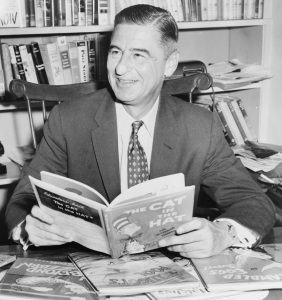
A picture of Theodor Seuss Geisel a.k.a Dr. Seuss
Theodor Seuss Geisel a.k.a Dr. Seuss

2) An interesting fact about Dr. Seuss is that his first book was rejected 27 times!

You read that right! Although he is one of the most celebrated authors today, his first children’s book ‘And to Think That I Saw it on Mulberry Street’ was rejected 27 times. In fact, for him, his 27th rejection signified the end of his writing career and he planned to burn the book once he got home. However, as he was walking dejectedly on Madison Avenue, he came across his Dartmouth friend Mike McClintock. By pure chance, McClintock had that very morning started a job as an editor in the Vanguard Press children’s section. This was the silver lining Geisel was looking for and within hours the two signed a contract. Subsequently, in 1971, Vanguard Press published Geisel’s first book, thus launching the author’s remarkable literary career.

“If I had been going down the other side of Madison Avenue, I’d be in the dry-cleaning business today”.- Dr. Seuss

A picture of Theodor Seuss Geisel a.k.a Dr. Seuss

3) During World War II, Dr. Seuss created propaganda cartoons for the army

In 1943, Theodor Geisel enlisted himself in the U.S. army. Here he was put in command of the animation department of the 1st Motion Picture Unit.  It was during this time that he contributed to the creation of the famous Private Snafu cartoon series. Throughout the series, Geisel started using limited vocabulary and rhymes— something also seen in his later works like ‘The Cat in the Hat’, which only used 236 words. Geisel subsequently left the army in January 1946 having achieved the rank of lieutenant colonel.

A picture of Private Snafu cartoon series

4) An interesting fact about Dr. Seuss is that he was a chain smoker

Geisel was essentially a chain smoker and spent many years trying to quit. To deal with his addiction he sucked on an unlit corn cob pipe that was filled with either radish or strawberry seeds. Whenever he was compelled to smoke he would water the seeds using an eyedropper. After about 3 days when a crop of radish greens or strawberry plants sprouted, he would return to cigarettes. He did this for many years however he could never break his addiction.

A picture of Geisel smoking
(C: Bryson/Time & Life Pictures/Getty Images)

5) Dr. Seuss cheated on his wife, which probably drove her to suicide

During her later years, Seuss’ first wife Helen Palmer was suffering from a series of illnesses. Ultimately she was fighting a losing battle. Depressed by her condition and possibly by suspicions of her husband’s affair with a close friend, Helen took her own life in October 1967.

Eight months later, Seuss married Audrey Dimond, the woman he had been having an affair with.

A picture of Helen Palmer and Theodor Geisel
Helen Palmer and Theodor Geisel

6) Dr. Seuss invented a daughter

It’s a popular myth that Seuss disliked children. However, little do people know that he and his first wife wanted children of their own—unfortunately, Helen could not have any. So what did Seuss do? Invent a child of course! When Seuss’ contemporaries bragged about their children, he would bring up the exploits of his own invented daughter Chrysanthemum Pearl. In one instance he boasted about her superhuman sewing skills and how she could make a mean oyster stew with chocolate frosting and flaming Roman candles. Additionally, he even gave a dedication to her in his book ‘The 500 Hats of Bartholomew Cubbins’, writing, “To Chrysanthemum Pearl, age 89 months, going on 90”.

A picture of Geisel reading his book
(C: Gene Lester/Getty)

7) Roosevelt traumatised Seuss for life!

Another interesting fact about Dr. Seuss is that he sold U.S. war bonds as a Boy Scout. In fact, he was one of the 10 best bond sellers in his group. As a result, he and his entire family were invited to attend a special ceremony that was held on May 2, 1918. Seuss was going to receive a special medal from former president Theodore Roosevelt. Unfortunately, the event organisers gave Roosevelt nine medals instead of 10, so when Seuss walked onto the stage, Roosevelt’s was out of medals. Not realising the error, Roosevelt remarked “What is this little boy doing here?”. Rather than explaining the situation, the Boy Scoutmaster whisked an embarrassed Seuss off the stage. Seuss later said that this incident caused his lifelong fear of public speaking.

A picture of Theodore Roosevelt
Theodore Roosevelt

8)  Dr. Seuss won two Academy Awards during his lifetime

Yes, you read that right! Seuss has won many accolades during his lifetime including two Academy Awards. The first was in 1947 for best documentary feature for ‘Design for Death’. And subsequently for the best animated short film with Gerald McBoing-Boing(1950).

A picture of Dr. Seuss

9) Dr. Seuss once wanted to test if his publisher was reading his works

Once Seuss believed his publisher would publish anything he had written. To test his theory, Seuss slipped in a contraceptive reference in the manuscript draft of Hop On Pop, which went like this:

“When I read I am smart
I always cut whole words apart,
Con Stan Tin O Ple, Tim Buk Too
Con Tra Cep Tive, Kan Ga Roo.”

As it turned out, his publisher was indeed reading his work and the line was cut from the final draft.

A picture of Geisel
(C: John Bryson/Contributor/Getty Image)

10) Six of his books ceased to be published due to racist and insensitive imagery

In March 2021, Dr. Seuss Enterprises announced that they would cease the publishing of six of his books due to the racist imagery that appears in them. The six books include ‘And to Think That I Saw It on Mulberry Street’, ‘If I Ran the Zoo’ and ‘McElligot’s Pool’. The company stated that “these books portray people in ways that are hurtful and wrong”. Further stating “Ceasing sales of these books is only part of our commitment and our broader plan to ensure Dr. Seuss Enterprises’ catalogue represents and supports all communities and families”.

A picture of the combo books
(C: REUTERS/Combo)

Enjoyed the above article? You may also enjoy 15 interesting facts about the Sedan chair

Yoshiko Kawashima- The Chinese Princess Who Spied For Japan

Yoshiko Kawashima was a Qing dynasty princess who descended from the Manchu ethnic minority in China. However, she wasn’t your ordinary royal as she served as a Japanese spy during the Second Sino-Japanese War. Due to her significant role in the war, she titled the Mata Hari of the Far East.

Let us take a look at Yoshiko Kawashima- The Chinese Princess Who Spied For Japan.

1) Yoshiko Kawashima- born as Aisin Gioro Xianyu, a Manchu princess

Born in 1907, Yoshiko Kawashima was born Aisin Gioro Xianyu. She was one of the 38 children born to Prince Shanqi, a Manchu prince related to the Qing Dynasty.

In 1911, the Chinese Revolution or the Xinhai Revolution ended China’s last imperial dynasty, thus establishing the Republic of China. Subsequently, her father’s Japanese friend Naniwa Kawashima adopted Aisin Gioro at the age of 8. She then went on to live at Naniwa’s Tokyo mansion. Here they rechristened her as Yoshiko Kawashima, a name she would use forever.

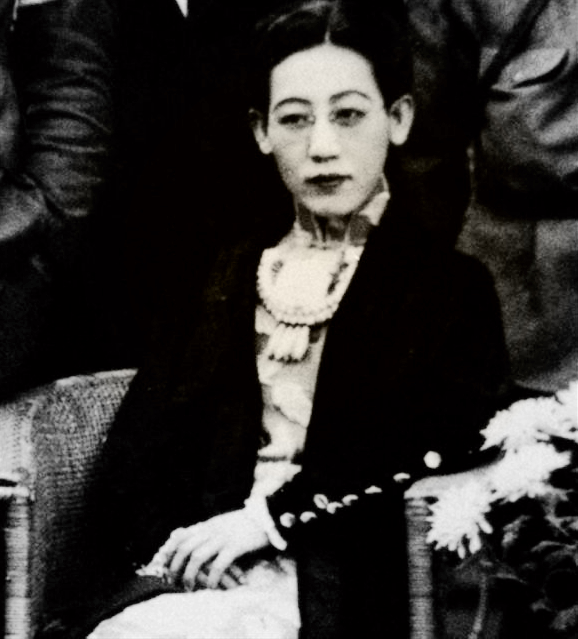
A picture of Kawashima
Yoshiko Kawashima

2) Yoshiko Kawashima was an unconventional princess

Kawashima broke all princess stereotypes. During her adolescence she rode a horse to school, cross-dressed as a man and even cut her hair into a bob and later a buzz cut. Additionally, Kawashima desired to be a third gender as well. These aspects made her stand out from Japan’s conservative society.

At the age of 20, her adoptive father arranged her marriage to Mongol prince Ganjuurjab. However, the marriage lasted only a few years and ended in divorce. She soon left her home and travelled to different places. In 1930, she landed in Shanghai.

A picture of Kawashima and the Mongol prince Ganjuurjab
Kawashima and the Mongol prince Ganjuurjab

3) While in Shanghai Kawashima became a part of the Japanese Kwantung Army

For a long time, Japan reserved special rights over Manchuria. Hence after the unification of China in the 1920s, they felt threatened about their position in the land. Consequently, the Japanese Kwantung Army in Manchuria decided to take matters into their own hands. The troops planted weak explosives along the Japanese-controlled South Manchurian Railway. They then accused Chinese saboteurs of this act and used it as a pretext to invade and control Manchuria. After the Japanese invasion of Manchuria, it was renamed Manchukuo. Finally, everything was under their control. Now they just needed to make it legitimate. For this job, they had the perfect candidate: Yoshiko Kawashima.

While in Shanghai, Kawashima met Ryukichi Tanaka, a military expert of the Japanese Army. Subsequently, she started working for military intelligence. It was her Mongolian and Manchurian connections that made her the army’s perfect recruit. She subsequently started working as a spy for General Kenji Doihara.

A picture of Kawashima cross-dressing as a man

4) The Japanese were finally ready to set up a Manchurian puppet state. They only needed a pliable imperial figurehead. This is where Kawashima came in as she was well-acquainted with the deposed Qing Emperor Puyi. She was thus instrumental in persuading him to become a figurehead ruler for Manchukuo.

A picture of a young Kawashima
A young Yoshiko Kawashima

5) Yoshiko Kawashima and her role in the Shanghai Incident of 1932

Although the degree of her involvement is debatable, Kawashima played a significant role in the Shanghai Incident of 1932.

According to Ryukichi Tanaka, who was also Kawashima’s long term lover, he was paid 20,000 yen by the Japanese Army to aggravate tensions between the Japanese and Chinese in Shanghai. He allegedly gave half the money to Kawashima with the instructions to pay people to stage violent riots and brawls. This plot ultimately worked and was instrumental in strengthening Japan’s position in China.

Kawashima and Ryukichi Tanaka (centre)

6) The Beauty in Men’s Clothing

The 1933 novel The Beauty in Men’s Clothing is based on the life of Kawashima. However, due to censorship rules, the book was presented as a fictionalised version of her exploits.

7) The Japanese approached Kawashima again; this time to lead an army

Kawashima took command of an army of 3,000-5,000 men while using the alias Jin Bihui. Subsequently, her army was tasked with helping repress Chinese resistance forces in Manchukuo. She was successful in her task and the Japanese were able to quell the rebellion and gain valuable land.

8) Kawashima returned to Tokyo

The people considered her a hero when she got back to Tokyo. She began to enjoy her stardom and attention. Additionally, she often exaggerated her exploits and even considered herself the Manchurian Joan of Arc.

9) However as more and more time went on, her popularity became an annoyance for the Japanese military

Yoshiko Kawashima soon became a popular and well-known figure, making appearances on radio broadcasts and even giving public speeches. The newspapers published several fictional and non-fictional stories of her deeds. However, her increased popularity was creating issues with the Japanese Kwantung Army, as for them her value as an asset had diminished. Additionally, her critical tone against the Japanese military’s policies in Manchukuo diminished her value as a propaganda symbol. Thus by 1940, Kawashima had faded from public sight.

A picture of a young Kawashima

10) She moved from place to place but ultimately settled down in Japanese-occupied Beijing

Towards the end of the 1930s, Kawashima had gotten addicted to opium and her mental state was slowly deteriorating. By 1945, she returned to Japanese-occupied Beijing and stayed there until the end of World War II.

A picture of Kawashima in uniform

11) After Japan’s formal surrender in September 1945, the Chinese forces regained all their lost territories including Beijing.

12) Yoshiko Kawashima- Capture| Execution| Death

Kawashima’s decision to live in Beijing probably wasn’t the best. The thing is Kawashima’s adoptive father had never formally registered her as a Japanese citizen and as per the records, Kawashima was a Chinese citizen who worked for the Japanese military in the invasion of the Chinese lands. And this was unacceptable for the Chinese.
The Chinese Forces then arrested Kawashima. During her trial, the people labelled her a hanjian, or ‘race traitor’. She was subsequently charged with treason and sentenced to be shot. On March 25, 1948, Yoshiko Kawashima was executed by a bullet shot into the back of her head.
A picture of Yoshiko Kawashima

Enjoyed the above article? You may also enjoy Nieves Fernandez- the silent killer during World War II

The Battle of Somme- in pictures

The Battle of Somme was one of the battles fought during World War I. It was fought between the armies of the British Empire and the French Third Republic against the German forces. The grisly battle took place from July to November 1916 and is deemed as one of the most bitter and costly battles of World War I.

Let us take a look at The Battle of Somme- in pictures.

1) On June 24, 1916, the Allied forces attempted to cut the barbed wire in front of the German lines. To do this they began a seven-day bombardment. Shockingly, over 1.5 million shells were fired during this time!

A picture depicting the shells fired during the Battle of Somme

2) A piper of the 7th Seaforth Highlanders walking with four men of the Australian 26th Brigade back from the trenches after the attack on Longueval.

A picture of men walking back from the trenches during the battle of Somme- in pictures

3) Men of the 1st Anzac Corps, some wearing German helmets, strike a pose for the camera after fighting near Pozieres Ridge.

A picture of the men of the 1st Anzac Corps- The Battle of Somme

4) A picture depicting a British troop dressing the wounds of a German prisoner near Bernafay Wood.

A picture depicting a British troop dressing the wounds of a German prisoner

5) Artillery fire lights up the sky during the attack on Beaumont Hamel during the Battle of Somme, July 2, 1916.

6) The men of the Royal Irish Rifles regiment rest during the beginning of the Battle of the Somme.

7) A 2-ton explosive detonates under the German front line at Hawthorn Redoubt. It was fired 10 mins before the assault at Beaumont Hamel. And it consequently left a crater 130 feet (40 m) across and 58 feet (18 m) deep.

A picture of the explosive detonated during the Battle of Somme

8) British 34th Division soldiers advance towards the German forces on the first day of the Battle of Somme, July 1, 1916.

A picture of the advancing British troops

9) A picture depicting wounded British troops walking back from the front lines.

A picture depicting wounded British soldiers walking back from the front lines.

10) A picture depicting troops from the Indian Cavalry Division of the British Indian Army, 1916.

A picture depicting troops from the Indian Cavalry Division of the British Indian Army, 1916.

11) French soldiers prepare to advance towards the German forces.

12) A picture depicting soldiers sitting in the trenches of the wood called Des Fermes in the Somme.

A picture depicting soldiers sitting in the trenches of the wood called Des Fermes in the Somme.

13) An aerial view of a French attack during the Battle of Somme.

A picture of an aerial view of a French attack during the Battle of Somme.

14) A French soldier looks over the edge of a trench, 1916.

A picture of a French soldier

15) A picture depicting the artillery depot behind German lines during the Battle of Somme.

A picture of an artillery depot

16) A picture depicting German soldiers carrying the Lewis gun equipment.

A picture depicting German soldiers carrying the Lewis gun equipment.

17) A picture depicting a German field telephonist communicating artillery requests from the front lines.

A picture depicting a German field telephonist communicating artillery requests from the front lines. 

18) German prisoners carry wounded British soldiers during the attack on Trones Wood.A picture of German prisoners carrying wounded soldiers during the Battle of Somme

19) A picture depicting men building barbed wire obstacles on the Somme, September 1916.

A picture depicting men building barbed wire obstacles on the Somme, September 1916.

20) A German cannon gets buried under uprooted trees in Louage Wood during an Allied attack, October 10, 1916.

21) A picture depicting British troops eating their rations in the Ancre Valley during the Battle of Somme.

A picture depicting British troops eating their rations in the Ancre Valley.

22) Gas-masked troops of the British Machine Gun Corps with a Vickers machine gun.

A picture of Gas-masked troops of the British Machine Gun Corps with a Vickers machine gun.

23) The 39th Siege Battery, RGA in action in the Fricourt-Mametz Valley.

A picture of a siege in action

24) Horses haul artillery forward in deep mud along the Lesboeufs Road outside Flers, November 1916.

A picture of horses hauling artillery

25) A picture depicting a German soldier walking through the ruined streets of Peronne, November 1916.

A picture depicting a German soldier walking through the ruined streets of Peronne, November 1916- the Battle of Somme

Enjoyed the above article? You may also enjoy Military Fashion during World War II- in pictures

20 Interesting Facts About Ancient Greece That You May Enjoy!

Ancient Greece was a very influential civilisation. It dominated much of the Mediterranean thousands of years ago. During the height of its power, Ancient Greece ruled much of Europe and Western Asia. It was also instrumental in establishing much of the foundation for today’s Western culture. Below we have compiled a list of 20 interesting facts about Ancient Greece that you may enjoy!

Let’s take a look at 20 Interesting Facts About Ancient Greece That You May Enjoy!

1) The Ancient Greeks came up with the concept of demokratia, or ‘rule by the people’, thus establishing the world’s first democracy. However, it lasted for only 185 years.

A picture of democracy in Ancient Greece

2) Ancient Greece condoned slavery. In fact, around 40% to 80% of Athens’ population were slaves!

A picture depicting slaves -Interesting Facts About Ancient Greece

3) Ancient Greeks did not call their land ‘Greece’

An interesting fact about Ancient Greece is that its inhabitants did not call it Greece. The Greeks called their nation ‘Hellas’ or ‘Hellada’. Additionally, its official name was the ‘Hellenic Republic’. The Ancient Romans came up with the word ‘Greece’ which was derived from the Latin word Graecia for ‘land of the Greeks’

A picture of the acropolis-Interesting Facts About Ancient Greece
(C: Frederic Edwin Church 1871-MET Museum)

4) Handshakes originated in Ancient Greece

Handshakes are now a common custom all over the world. However, the concept originated way back in Ancient Greece. Its earliest depiction is on an early 5th Century B.C. archaeological relief. It essentially showcases Hera, the wife of Zeus and the goddess of marriage, shaking hands with Athena, the goddess of war in Ancient Greek Mythology.

A picture of Hera shaking hands with Athena

5) Contrary to popular belief Ancient Greek statues were not always white. Once upon a time they were painted with vibrant colours, however, over time the colours faded to the monochrome we see today. Sculptures such as the ones seen in the Parthenon Frieze were once painted in a wide array of colours.

A picture of a colourful parthenon-frederic-edwin-church-1871-MET

6) The Ancient Greeks worshipped an unknown god

The Ancient Greeks worshipped twelve major gods. However, in addition to those twelve, they worshipped “Agnostos Theos”; which is “Unknown God”. The title was essentially a placeholder for any or all gods unknown to them.

A picture of Greek Gods

7) Another interesting fact in our list is that the term ‘idiot’ originated in Ancient Greece. In Ancient Greece, an idiot was essentially a person who didn’t participate in political or public arenas.

A picture of a assembly in progress
(C: libcom)

8) Another interesting fact in our list is that in Ancient Greece, the unibrow was a sign of beauty and intelligence

In Ancient Greece, the unibrow was considered a sign of great beauty and intelligence. In fact, women who didn’t possess natural ones would draw them with makeup.

A picture of a unibrowed greek woman
(C: Refinery29)

9) Peace before the games

The ancient Olympics is essentially a series of athletic games honouring Zeus. Due to its religious significance, the Ancient Greeks decreed that no wars would be permitted before the games. Initially, they declared a ceasefire for one month but subsequently extended it to 3 months.

Additionally, the territory of Elis disallowed all firearms. Adding instructions that no spectator, athlete or theoroi (the official ambassadors representing the various city-states) should be harmed in any way.

A picture of the ancient Olympics games-frederic-edwin-church-1871-MET

10) The significance of red lipstick

Another interesting fact in our list is that in Ancient Greece, prostitutes were recognised for their red lipstick. In fact, if they didn’t wear red lipstick they were punished. Additionally, non-working women were discouraged from wearing lipstick.

A picture of lipticks and other cosmetics around a marble bust
(C: MessyNessyChic)

11) The concept of the red carpet originated in Ancient Greece

The first mention of the red carpet was in the 5th Century B.C. play Agamemnon. The play essentially mentions a ‘crimson path’, that could only be walked upon by the gods.

A icture of the red carpet
(C: OZY)

12) According to Ancient Greeks, eating while lying down with others serving you is a sign of power and luxury. The elite usually practised this custom.

A picture of people eating food while reclining-Interesting Facts About Ancient Greece

13) Ancient Greeks added water to wine

Another interesting fact about Ancient Greece is that it was considered barbarian to drink undiluted wine. One had to dilute the beverage with water. This was because only the god of wine, Dionysus could drink undiluted wine and not get drunk. The Ancient Greeks believed that if mortal men drank undiluted wine, they could become violent and lose their minds. To avoid this fate, they added water to wine in the ratio of 3:1.

A picture of Dionysus-Interesting Facts About Ancient Greece
(C: Fine Art Images Heritage-Images)

14) Ancient Greeks used stones as toilet paper

Yes, you read that right! In Ancient Greece, people often used stones (pessoi) or fragments of ceramic(ostraka) to wipe.

A picture of ancient stones-Interesting Facts About Ancient Greece

15) Ancient Greeks were highly superstitious!

In fact, they held strange superstitions about food as well. Some wouldn’t eat fava beans as they thought they contained the souls of the dead.

16) Ostracism in Ancient Greece

Another aspect of Athenian democracy was ostracism(ostrakismos). Under ostracism, citizens could vote to exile a politician for 10 years. The voting took place once a year and citizens would nominate people who they felt threatened democracy. Additionally, this practice applied to common citizens as well.

A picture depicting a voting-Interesting Facts About Ancient Greece

17) The Spartans were great warriors however it wasn’t easy being one

Spartans boys began ‘agoge’, a state-sponsored training regimen at the age of 7 itself. The regimen is instrumental in transforming them into skilled soldiers. Additionally, the soldiers could not live with their families until they left their active military service at age 30.

A picture of a spartan-Interesting Facts About Ancient Greece

18) Another interesting fact about Ancient Greece is that slaves were traded for salt. That gave the rise to the common expression “not worth his salt”.

A picture of salt- Interesting Facts About Ancient Greece You May Enjoy!

19) The revolutionary astronomical hypothesis was first proposed by an Ancient Greek

Aristarchus of Samos was an Ancient Greek mathematician and astronomer who first proposed the theory that the planets orbit the sun. He also theorised that the stars are unmoving distant suns. Further stating that the size of the universe is much bigger than his contemporaries believed.

A picture of the solar system

20) State induced infanticide

The last fact in our list of 20 interesting facts about Ancient Greece is that all newborns in Sparta were shown to a council. These inspectors examined the babies for any physical defects. Subsequently, they abandoned the ‘unfit’ ones on a nearby hillside. Fortunately, Spartan slaves (Helots) managed to rescue some. Additionally, infants who passed the examination didn’t have it easy either. For example, to test their constitution, Spartans bathed them in wine instead of water.

A picture of spartans in battle

Enjoyed the above article? You may also enjoy 15 interesting facts about the Sedan chair and 16 interesting facts about the sporran


Nieves Fernandez- the silent killer during World War II

World War II was a large scale war that involved most of the major countries of the world. Consequently, both women and men were required to serve their country, on the home front as well as the war front. Women played a pivotal role during the war; one such woman was Nieves Fernandez, a Filipino school teacher who was instrumental in killing 200 Japanese soldiers.

Let us take a look at Nieves Fernandez- the silent killer during World War II.

1) Nieves Fernandez was just an ordinary school teacher in Tacloban City, Philippines. She was a beloved teacher and her students lovingly called her ‘Miss Fernandez’. She also owned a small wholesale business. However, her life was about to change drastically!

A picture of Nieves Fernandez
Nieves Fernandez and her husband (C: JollyJoker83 CC BY-SA 4.0)

2) When the Japanese arrived in the Philippines in 1941, they took full control of the region

Subsequently, on May 25, 1942, their forces arrived in Tacloban City which was the beginning of Leyte’s two-year occupation. They conquered lands and took away all the possessions of the natives. Additionally, nobody was allowed to own any business, and if anyone refused to comply, they were forced into submission through torture. Plus nobody was allowed to teach anything unless it was approved by Imperial Japan.

“When the Japs came, no one could keep anything, they took everything they wanted”.- Nieves Fernandez, Lewiston Daily Sun in November 1944.

Filipino and American forces surrender to Japanese troops

3) As Nieves Fernandez was a native of Tacloban City, she witnessed the inhumane treatment of the Filipinos by the Japanese. Subsequently, the Japanese took away Fernandez’s wholesale business and further threatened to take away her students. This was the last straw for her and that’s when she decided to take matters into her own hands.

A picture of Imperial Japan invading Philippines
(C: Flickr)

4) Nieves Fernandez- the lone assassin

The fearless Fernandez took on the persona of the ‘silent killer’; she would dress in an all-black ensemble and go barefoot in the forests and set up various ambushes for the Japanese troops. Her weapons were a bolo and a makeshift shotgun which she made out of a gas pipe.

At the same time, the Philippines had several guerrilla groups who were working to remove the Japanese forces from the region.

A picture of Nieves Fernandez
(C: South Seattle Emerald)

5) Fernandez’s simple yet effective weapons

During the war, many Filipinos got skilled at making weapons out of scraps. One such weapon was the deadly makeshift shotgun that was made out of ordinary gas pipes. These guns were called “latongs” or “paltiks.”

The ‘bolo’ was essentially a long knife or machete and was usually used by the Filipinos while farming or clearing vegetation. As it was easily available, it became an optimum weapon of choice for peasants and farmers. Hence, by using these improvised weapons, Fernandez was able to carry out ambushes on her own for two and a half years.

A picture of a makeshift shotgun
A makeshift shotgun made out of gas pipes (C: War Relics)

6) Nieves Fernandez eventually started working with Tacloban’s natives and decided to create her own guerrilla group. She rounded up 110 men and named them the Waray guerrilla. She took their command and consequently acquired the title ‘Captain Fernandez’.

A picture of a bolo
Bolo (C: Worth Point)

7) The Gas Pipe Gang

Although her group was small, they were highly efficient and deadly. Fernandez even taught her men how to kill using the bolo. Her method was to cut the carotid artery and the jugular, which efficiently and ‘silently’ killed the victim.

Hence it was due to her phenomenal bolo abilities that she got the title of the ‘silent killer’. The Japanese also called her the ‘crackshot’ for her remarkable shooting abilities.

Subsequently, American soldiers were shocked to learn that a woman commanded the team. The U.S. troops named Captain Fernandez’s group the ‘Gas Pipe Gang’ as they used makeshift gas pipe shotguns and handmade bombs loaded with gunpowder and old nails.

A picture of Fernandez demonstrating her killing method to an American soldier
Fernandez demonstrating her killing method to an American soldier

8) A bounty of 10,000 pesos

The fame of the silent killer spread far and wide and as a result, the Japanese issued a bounty of 10,000 pesos on her head. They were hoping that one of her acquaintances would betray her. Ultimately no one did.

9) However, everything wasn’t always so smooth sailing, and in one encounter against the Japanese, Fernandez was wounded and a bullet left a scar on her right forearm.

10) Captain Nieves Fernandez and her group played a significant role in freeing many prisoners of war

Additionally, they also sabotaged Japanese supplies and raided hundreds of enemy camps. Fernandez was also instrumental in freeing comfort women. According to Remedio Fallas, a former comfort woman and the author of The Hidden Battle of Leyte: The Picture Diary of a Girl taken by the Japanese Military, the guerrillas freed many young women. Further stating that the guerrillas annihilated Japanese troops in several villages.

11) A lasting legacy

Leyte was the first island in the Philippines to be freed from Imperial Japan. This was due to the combined efforts of the guerrilla groups and the American forces. Ultimately Captain Nieves Fernandez and her guerrilla group managed to kill 200 Japanese soldiers. Additionally, she holds the title of the first and only female guerrilla commander in the Philippines during WWII. Undoubtedly, Fernandez’s efforts played a significant role in the victory of the Allied forces in the Philippines.

A picture of guerilla groups and the American forces

Enjoyed the above article? You may also enjoy Lucretia- The woman who ended the Roman monarchy


15 Weird (Yet Deadly) Weapons in History

Since time immemorial, weapons have been an integral part of warfare. Consequently, humans have invented weapons as per the need of the hour. In the end, we invented destructive and effective weapons such as guns and tanks. However, some tried inventing weapons that seemed to have come out of a fictional novel! Let us explore such weird weapons in history, from lipstick guns to exploding rodents.

Let us take a look at the 15 Weird (Yet Deadly) Weapons in History.

1) Gauntlet dagger

The gauntlet dagger is a pretty straightforward weapon. It is also known as the punching dagger. The weapon encompassed a push dagger that extended from a leather or metal sleeve. It was designed for close combat and the bearer would essentially punch holes in his opponent.

A picture of a gauntlet dagger- weird weapons in history

2) The claw of Archimedes

This weird weapon in history was essentially an iron claw devised by the Ancient Greeks to defend the city-walls of Syracuse from naval attacks. The ancient weapon was sort of a crane equipped with a grappling hook. This mechanism allowed the weapon to partly lift the attacking ship out of the water and either cause it to capsize or suddenly drop. These devices were also used during the Second Punic War and were instrumental in sinking many Roman ships.

A picture of a The claw of Archimedes- weird weapons in history

3) The sun gun- A weird weapon that could destroy cities with the power of the sun

The Nazis planned to build an orbital weapon that would harness the heat from the sun. The concentrated heat would then be focused to burn cities and boil water sources. According to the plans, the space weapon would have been mounted on a satellite with a concave mirror attached to it. This would allow the weapon to focus the sun’s heat on a single target.

A picture of the sun gun

4) Anti-tank dogs

The Soviets came up with an ingenious weapon against the Germans during World War II. Essentially dogs were strapped with explosives and were sent on missions to destroy enemy equipment. The dogs were intensively trained and carried up to 12 kgs of explosives on their backs.

A picture of anti tank dogs- weird weapons in history

5) Exploding rats

During WWII, Britain’s Special Operations Executive(SOE) came up with various weird weapons, one of them included ‘exploding rats’. Essentially about 100 dead rats were sliced open and then stuffed with explosives. The plan was to strategically place them near specific boilers. Once someone noticed a dead rat next to the boiler, they would have tossed it into it- thus causing a huge explosion. However, the plan was never tested as the Germans intercepted the box of dead rats.

A picture of an exploding rat

6) Poison pen and flashlight gun

A poison pen sounds like something out of a spy novel right? However, this weird weapon exists in real life as well. The poison pen was one of the weapons found in the briefcase of a North Korean assassin in 2011. The device was essentially a Parker ballpoint pen that contained a poison needle; that paralysed and suffocated its victim.

Another weapon found was the flashlight gun. The unsuspecting flashlight was loaded with up to three bullets that were capable of firing accurately.

A picture of the poison pen and the flashlight gun

7) Vespa 150 TAP

The Vespa 150 TAP was specifically designed for the use of French paratroops. These ‘bazooka scooters’ were mounted with an M20 75mm recoilless rifle which was a light anti-armour weapon. According to sources the weapon could either be fired from the moving scooter or was dismounted and fired. During the war, the scooters would be parachute-dropped in pairs and were accompanied by a two-man team. Plus they were deployed with a trailer which was used to carry additional supplies and a lightweight stand for the M20.

A picture of a Vespa 150 TAP

8) Bat bombs

Another weird weapon developed during WWII was the bat bomb. The U.S. military essentially planned to strap bats with bombs and have them dropped onto the Japanese cities. However, due to complications in logistics, the plan was nixed.

A picture of a bat bomb

9) Acoustic Kitty

In an attempt to spy on the Russians, the CIA came up with a bizarre idea to use cats as spies. The project was titled ‘Acoustic Kitty’; where the cat was implanted with a microphone in its ear canal, a small radio transmitter at the base of its skull and a thin wire into its fur. This enabled it to record and transmit sound from its surroundings.

For its first official mission, it was supposed to eavesdrop on two men sitting in a park. The cat was released nearby, however, it wandered into the streets and was fatally hit by a passing taxi. The CIA held subsequent tests as well but they were a failure. Project ‘Acoustic Kitty’ was thus nixed.

A picture of acoustic kitty

10) ‘Who me?’ stink bomb

The Americans developed the stink bomb in an attempt to humiliate the Germans. The weapon was called ‘Who me?’ and was filled with noxious fluid. Although the bomb got the job done, it had one big drawback. The mixture was so foul-smelling that it was impossible to ‘bomb’ the target without contaminating everything in the area, the sprayer included.

A picture of stink bombs

11) Kiss of death

The kiss of death was a lipstick gun developed by the KGB during the Cold War. This weird weapon in history was a single-shot pistol that was disguised as a tube of lipstick.

A picture of lipstick gun

12) Fu-Go balloon bomb

The Fu-Go balloon bombs were developed to instil fear in the Americans. The Japanese would launch paper balloons that carried explosive devices. These balloons would then silently float all the way over to America. According to reports, by April 1945 about 1000 Fu-Go balloon bombs reached North America. However, due to the weather conditions, the balloons were rendered ineffective. Ultimately, despite so many launches, only one resulted in the loss of human life.

A picture of Fu Go balloon bomb- weird weapons

13) Bulgarian umbrella- A weird weapon that could shoot poisonous pellets at its victims

A Bulgarian umbrella was a poisonous umbrella that contained a hidden pneumatic mechanism. The mechanism allowed the user to shoot a poisonous pellet at a particular target. This umbrella was used during the assassination of a dissident writer. The man thought he had been stung by a bee and died four days later.

A picture of a bulgarian umbrella-weird weapons

14) Krummlauf

Krummlauf essentially translates to a curved barrel. It was a curved rifle designed by the Germans during WWII. The weapon included a periscope sighting device and was meant for shooting around corners. Ultimately, the weapon was a failure and had a very short lifespan.

A picture of a curved rifle-weird weapons

15) The harmonica gun

The gun is named so as it resembles the musical instrument. The harmonica gun is also known as the ‘slide gun’. It was a breechloader firearm and had a steel slide. Additionally, it contained several chambers bored in it and these were filled with projectiles.

A picture of a harmonica gun-weird weapons

Enjoyed the above article? You may also enjoy 8 Forgotten weapons you need to know about!

Masquerade Balls- Brief History & Key Facts

Masquerade balls are essentially events where individuals wear costumes with elaborate masks. Additionally, masquerade balls have existed since medieval times and have a fascinating history.

Let’s take a look at Masquerade Balls- Brief History & Key Facts.

1) Dating back to the 14th and 15th centuries, masquerade balls were a feature of Europe’s carnival season. During this time individuals would don costumes and masks and participate in elaborate parties and parades.

A picture of a masquerade ball in history

2) The masquerade ball fervour spread like a wildfire in France where most of these events were held by royalty.

A picture of a royal masquerade ball- history of masquerade balls

3) One such masquerade ball stood out in France’s history and that was the Bal des Ardents(The Ball of the Burning Men)

The notorious event was held by Charles VI of France in celebration of the marriage of the queen’s lady in waiting. The king and five other men essentially dressed as wild men; with a costume made of linen soaked with resin to which flax was attached. The costume was highly flammable. Subsequently, the king’s drunk brother allegedly threw a torch at one of the dancers and they all ended up catching on fire. Although the king was saved, the other dancers met a gruesome demise.

A picture of Bal des Ardents

4) Masquerade balls became associated with Italy in the 16th century

While some sources claim otherwise, it wasn’t until much later in the 16th century that the concept of masquerade balls entered Italy. However, that did not deter the Italian aristocracy from taking full advantage of the ball’s anonymity. The Venetian society especially attended and threw these balls. For them, it was a night to indulge in scandals and debauchery undetected. Hence secret financial transactions, scandals and inappropriate sexual behaviour filled the Venetian balls.

A picture of a woman and 2 carnival goers

5) With the fall of the Venetian Republic at the end of the 18th century the masquerade balls gradually diminished in numbers until they were nothing but a memory.

6) In the early 18th century, John James Heidegger, a Swiss count introduced the elaborate masquerade balls to England. He also threw the first semi-public masquerade ball in London; held at the Haymarket Opera House.

A picture of a masked party- history of masquerade balls

7) Subsequently, London’s public gardens such as the Vauxhall Gardens and Ranelagh Gardens transformed into gardens that were optimum for holding public masquerade balls. Additionally, the events became synonymous with unescorted women and unseemly behaviour and were deemed as “The Man of Taste”.

A picture of a masked party

8) Masquerade balls became highly popular throughout mainland Europe during the 17th and 18th centuries. However, they had their fair share of fatal events.

One such event was the 1792 assassination of the King of Sweden Gustav III. The king was at a ‘masked ball’ when he met his death at the hands of an assassin. The event was subsequently showcased in Giuseppe Verdi‘s opera A Masked Ball.

A picture of Gustave III's assassination
A still from Giuseppe Verdi’s opera A Masked Ball (C: Verdi)

9) Men and women usually wore puffy outfits with lace collars during the masquerade balls. These were called ‘Vandykes’; the term is derived from Flemish painter Anthony Van Dyke who is famous for portraying such outfits in his art.

10) The most important aspect of the masquerade ball is the mask

Masquerade balls masks were important because they hid the wearer’s identity. In this way, one could freely express their opinions and emotions without any judgement. The Venetian masks consisted of various materials including velvet and clay. Additionally, they were adorned with various ornaments such as feathers and coloured beads.

A french masquerade party- History of Masquerade balls

11) Various types of traditional masquerade masks are:

Bauta

The Bauta was a traditional and archetypal Venetian mask. Both women and men wear it. It’s typically white and people wore them extensively throughout the carnival period. What made it popular was that it lacked a mouth and only covered the upper half of the face. In this way it allowed the wearer to talk, eat and drink freely.

A picture of a bauta-masquerade ball history
(C: Bauta venicemaskball)

Colombina

Another popular masquerade ball mask is Colombina. These stunning masks are highly ornate and are decorated with jewels and feathers. They are popular today as well and are worn during various festivals and parties.

A picture of a Colombina-masquerade ball history
Colombina

Volto full face

As suggested by the name, the Volto is a full-face mask. It is essentially a white fine wax cloth mask and has a three-dimensional structure. Additionally, the mask is paired with a three-cornered hat which gave a little mystery to the wearer.

A picture of a Volto mask
Volto full face

Arlecchino

Arlecchino, also known as Harlequin, is a multicoloured masquerade ball mask. The wearer of the mask typically adorns multicoloured patchwork clothing.

A picture of the Arlecchino-masquerade ball history
Arlecchino

Dottore Peste

An instantly recognizable masquerade mask is the Dottore Peste or the Plague Doctor mask. Charles de Lorme, a 17th-century physician is often credited for the mask’s unusual name. He essentially wore this type of mask while treating plague sufferers.

A picture of the Dottore Peste
Dottore Peste

Pulcinella

Pulcinella is a dark coloured mask that has a sizeable hook nose that looks like a beak, and slanted eyes. Additionally, it has very little adornment or decoration and is traditionally worn with loose-fitting black overalls.

A picture of the Pulcinella
Pulcinella

Pierrot

A pierrot mask is similar to the Arlecchino. It is a full coverage white mask and represents a stock character of pantomime and Commedia dell’Arte.

A picture of pierrot
Pierrot

12) Today, masquerade balls are held in Venice and New Orleans. And during celebrations such as Halloween and Mardi Gras. However, they are not a part of our culture anymore and are more of a novelty.


Enjoyed the above article? You may also enjoy The Parthenon frieze- History| Interpretions| Facts

Salem Witch Trials- Brief History & Causes

The Salem witch trials of 1692 are a fascinating subject for many historians and scholars. The infamous hysteria seemed to have appeared out of nowhere and died down just as quickly. However, the question remains: What caused the Salem witch trials? Join us as we explore some of the possible reasons for one of the most notable cases of mass hysteria in American history.

Let’s take a look at the Salem Witch Trials- Brief History & Causes.

1) The background

In January 1692, 9-year-old Elizabeth (Betty) Parris and 11-year-old Abigail Williams began having violent fits which included uncontrollable screaming and muscle spasms. A local doctor diagnosed it as ‘bewitchment’. Additionally, other girls in Salem village also started displaying similar symptoms. Subsequently, the villagers blamed Parris’ Caribbean slave, Tituba. Her arrest took place in February 1692 along with two other women.

The three accused were brought to court for trial. However, despite being innocent Tituba confessed to witchcraft and alleged that other witches were acting alongside her in service of the devil against the Puritans. As a result, mass hysteria spread through the village and beyond into the rest of Massachusetts.

Like Tituba, several accused ‘witches’ confessed and named other women. As a result, the number of accused increased in number. Consequently, the local justice system could not keep up with the trials. To counter this, in May 1692, the newly appointed governor of Massachusetts William Phips established a special Court of Oyer(to hear) and Terminer(to decide) on witchcraft cases for Suffolk, Essex and Middlesex counties.

The Salem witch trials lasted from 1692 to 1693. During this period more than 200 people were accused of witchcraft; with 20 tried and executed.

A picture of the trials

2) Many cite the cause for the Salem trials as misogyny because after all most of the accused were women. However, men stood trial for wizardry as well.

One notable example was an 80-year-old farmer Giles Corey. He refused to stand trial after being accused of ‘wizardry’. He was consequently denied a quick death and was instead gruesomely ‘pressed’ to death by stones.

A picture of the trial of Giles Corey

3) Bizzarly the trials did not spare even animals. According to records, at least two dogs were executed due to their involvement in witchcraft.

So the question remains, what caused the Salem villagers to act this way? Let us take a look at some of the popular theories.

4) Convulsive ergotism

The physical afflictions of the ‘bewitched’ girls baffled historians. As a result, some tried to come up with a scientific hypothesis to determine the cause of the witchcraft delusion. Subsequently, a study published by professor Linnda R. Caporael cites that the cause for the hysteria was convulsive ergotism; a condition caused by the ingestion of grain contaminated with ergot, a type of fungus. Ergot essentially contaminates rye and other grains and produces hallucinatory, LSD-like effects in the afflicted. Plus it causes the victims to suffer from headaches, delusions, vertigo, vomiting and muscle spasms.

Additionally, rye was the most prevalent grain in the Massachusetts area at the time. And factors such as the damp climate and long storage period might have contributed to an ergot infestation of the grains. Historians have also cited other such similar medical conditions as the cause of the Salem witch trials, however, they remain only as possibilities.

A picture of the Salem witch trials- causes of the Salem witch trials

5) The little ice age- cold weather might have been a potential cause of the Salem witch trials

According to the theory cited in economist Emily Oster’s senior thesis at Harvard University in 2004, cold weather might have caused the Salem witch trials. The theory essentially states that the most active era of the witchcraft trials in Europe was in sync with a 400-year-long cold period known as the ‘little ice age’. Additionally, the year 1692 fell right in between an extremely cold spell that lasted from 1680 to 1780. The cold spell brought in economic deterioration and food shortages. Moreover, during that era, people believed in ‘witches’ who were known to cause physical harm and controlled the weather. Consequently, the hard weather fuelled anti-witch fervour.

In conclusion, due to the stark circumstances paired with bad weather and a bad harvest, most must have concluded it was the work of witches.

A pcture of an accused 'witch'- causes of the Salem witch trials of 1692

6) Boredom

Yes, you read that right! Another popular cause of the Salem witch trials is cited as boredom. During the time, Salem was a very religious place, where children were just expected to read the bible and do chores. The mass hysteria began when Betty Parris and her cousin Abigail Williams started showing symptoms of being ‘bewitched’; throwing fits and having violent muscle spasms.

However, some say they were playing a fortune-telling game. Their slave Tituba introduced it to them. As a result, it became their only leisure activity, however, they might have become consumed by superstition. Hence, their fear of the game, and the added guilt of playing it must have fuelled their violent behaviour.

A picture of a trial- causes of the Salem witch trials

7) Could hysteria itself be the cause of the Salem witch trials?

The ‘rapid spread of conversion disorder’ a.k.a mass hysteria is said to be another cause of the Salem witch trials of 1692. Mass hysteria essentially transmits the collective illusion of threats, whether real or imaginary through a population and society as a result of rumours and fear.

Some cite this as exactly what must have happened to the two young girls. The stress of living in such a strict and religious society might have affected them and induced stress-related physical symptoms. Their fear and hysteria, added with the diagnosis of ‘bewitchment’, might have triggered the same in the rest of the population. Consequently, paving the way for the infamous witch hunts.

A picture of men bringing in a witch-causes of the Salem witch trials

8) Post-Traumatic Stress Disorder(PTSD) from the Indian wars

The Indian attacks impacted most people in the Salem village in one way or another, thus creating an atmosphere of anxiety and stress; leaving most people afraid of further attacks. Additionally, some of the ‘victims’, accusing women of ‘bewitching’ were a witness of the earlier raids. So it’s been suggested that watching these attacks might have caused some to have PTSD, prompting them to make these accusations.

A picture of the Indian attacks- causes of the Salem witch trials
The Indian attacks

9) Ultimately, theories related to various factors have been cited, but none are the exact cause of the Salem witch trials of 1692. Hence the cause of this event remains shrouded in mystery.

10) Aftermath

In the following years after the trials, there would be individual and institutional acts of repentance by those who were involved in the trials. In January 1697, the General Court of Massachusetts announced that they would hold a day of fasting and contemplation for the tragedy of the trials; further stating that they were unlawful. Additionally, the Commonwealth of Massachusetts exonerated twenty-two of the 33 convicted individuals and even compensated their families financially.


Enjoyed the above article? You may also enjoy 6 Bizarre Events In History that will blow your mind!

George Stinney Jr.- Murder case| Execution| Justice

George Stinney Jr. was a 14-year-old African American child who was executed in the murder case of two white girls, Betty June Binnicker (11 years old), and Mary Emma Thames (7 years old) in 1944. Consequently, he became the youngest American and also the youngest person in the 20th century to be executed by electrocution. His trial and conviction essentially showcase the blatant racism in the justice system.

Let us take a look at George Stinney Jr.- Murder case| Execution| Justice.

1) Who was George Stinney Jr.?

George Stinney Jr. was born and brought up in Pinewood, South Carolina, United States. He belonged to the segregated sawmill town of Alcolu, where black and white people were separated by railroad tracks. Additionally, Stinney attended Alcolu’s school for black children where he was a student of 7th grade.

A rare picture of George Stinney
George Stinney Jr.

2) The incident

On March 23, 1944, two white girls Betty June Binnicker (11 years old), and Mary Emma Thames (7 years old) were riding on their bicycles in Alcolu. They were in search of flowers. On their way, they halted near George Stinney Jr.’s house where they spotted Stinney sitting with his sister Aime. The two sisters then asked them where they would get maypops, the yellow edible fruit of passionflowers. Reportedly, that was the last time the girls were seen alive.

Subsequently, news broke that the girls had disappeared. After which hundreds of Alcolu residents, including Stinney’s father, set out to search for the missing girls. However, they were not found that day. The next day a search party discovered the mutilated dead bodies of the two girls lying in a soggy ditch.

A picture of Betty June Binnicker
Betty June Binnicker

3) The autopsy report

Subsequently, Dr Asbury Cecil Bozard examined the dead bodies and concluded that the girls had met with a violent death. However, there was no clear sign of a struggle. Additionally, the girls had multiple head injuries; with a hole boring through Thames’ skull and Binnicker receiving at least seven blows to her head.  Bozard further stated that a “round instrument about the size of the head of a hammer” was used to attack the girls.

A picture of Mary Emma Thames
Mary Emma Thames

4) George Stinney Jr. is arrested

Even though there were rumours that the girls had a stopover at a prominent white family’s house, the police never investigated them nor did they search for a white killer. After receiving reports that the girls had stopped at Stinney’s house, the law enforcement officers arrested George Stinney Jr. and his older brother Johnny. Although they released Johnny, they kept 14-year-old George in custody.

A picture of George Stinney Jr.

5) Police officers claimed to have received a murder confession from George Stinney Jr.

Subsequently, George Stinney Jr. was interrogated in a small room in the absence of his attorney, his parents and witnesses. After the interrogation, police officers stated that they had received a confession from Stinney saying that he had killed Binnicker and Thames. The reason being that he wanted to have sex with one of the girls and as he failed to do so, he killed them both.

H.S. Newman, one of the police officers made a handwritten statement  “I arrested a boy by the name of George Stinney Jr. He then made a confession and told me where to find a piece of iron about 15 inches long. He said he put it in a ditch about six feet from the bicycle”.

A picture of the coroner's report
Coroner’s report declaring that the two young girls died at the hands of George Stinney Jr. and that he should be arrested

6) Amid rumours of mob lynching, Newman refused to reveal where Stinney was being detained. Additionally, the boy’s parents had no information about his whereabouts as well.

A picture of the soggy ditch where the girls' dead bodies were discovered
The soggy ditch where the girls’ dead bodies were discovered

7) A sham trial is held

Stinney’s trial began almost a month after the girls’ death. The Clarendon County Courthouse appointed Charles Plowden as his lawyer. However, Plowden did little to nothing to defend Stinney. During a trial that lasted only two hours, Plowden failed to call any witnesses to the stand or present any evidence which would convince the jury of George Stinney Jr.’s innocence. The only significant evidence against him was his alleged confession, although a written record of his confession was not produced.

Additionally, by the time the trial began, Stinney had not seen his parents in weeks and during the trial almost 1,500 strangers surrounded him. The child was virtually alone. Moreover, no African Americans were allowed inside the courthouse.

A picture of George Stinney Jr.'s fingerprints
George Stinney Jr.’s fingerprints

8) An all-white jury deliberates the case for only 10 minutes

An all-white jury deliberated the murder case for only 10 minutes before pronouncing George Stinney Jr. guilty of rape and murder, plus they didn’t recommend mercy for him. As a result, Judge P.H. Stoll of Kingstree pronounced Stinney’s death sentence on April 24, 1944.

A picture of Stinney walking into the execution chamber
Stinney walking into the execution chamber

9) Protests and campaigns to save Stinney

However, George Stinney Jr.’s execution was not without protest, and as the date of his execution progressed, various campaigns and protests started across South Carolina. In an attempt to save the young boy’s life, protestors petitioned Governor Olin Johnston; demanding mercy for Stinney. Additionally, the protestors sent hundreds of letters and telegrams to the governor’s office and they all demanded clemency. However, it was all in vain and in the end, Stinney could not be saved.

A picture of a petition
A petition to save Stinney’s life

10) George Stinney Jr.’s execution

On June 16, 1944, George Stinney Jr. was set to be executed at the South Carolina State Penitentiary in Columbia. He walked into the execution chamber in loose-fitting overalls with a bible tucked under his arm. At the time of his execution, he was 5’1″ and weighed 95 lbs.

Before executing him, the prison authorities asked him if he had any last words. To which he replied “No sir”. The prison doctor then questioned him “You don’t want to say anything about what you did?”, again, he replied “No sir”.

Stinney was then strapped to an adult size electric chair and covered with a mask that was too big for him. Officials then turned on the switch. The first jolt of electricity caused the mask to slip from Stinney’s face, to reveal his teary-eyed expression. Subsequently, after two more jolts of electricity, Stinney was declared dead.

14-year-old George Stinney Jr. became the youngest American and also the youngest human in the 20th century to be executed by electrocution.

A picture of an electric chair

11) Justice is delivered after 70 years

In 2014, George Stinney Jr. was finally exonerated. His siblings stated that his confession was coerced and that he had a solid alibi; stating that he was with his sister Aime watching the family’s cow. They also stated that a man named Wilford Hunter, who claimed to be Stinney’s cellmate said that Stinney maintained his innocence till the end.

Finally, justice was delivered on Dec 17, 2014, as Judge Carmen T. Mullen vacated Stinney’s murder conviction. Further calling the death sentence a “great and fundamental injustice.”

After his exoneration, Stinney’s sister, Katherine Robinson said, “It was like a cloud just moved away”. Further saying that “when we got the news, we were sitting with friends… I threw my hands up and said, ‘Thank you, Jesus!’ Someone had to be listening. It’s what we wanted for all these years.” 

A picture of Aime Ruffner
George Stinney’s sister Aime Ruffner

Enjoyed the above article? You may also enjoy The Mysterious Death of Elisa Lam

Constantinople during the 1890s- in rare colour pictures

Constantinople was the capital of the Ottoman Empire from 1453 to 1922. Subsequently, after the fall of the Ottoman Empire, it would be renamed Istanbul about 30 years later. The below pictures were produced using the Photochrom process; which applies artificial colour to black and white pictures. These colour pictures depict the Ottoman Empire towards the end of the 19th century.

Let us take a look at Constantinople during the 1890s- in rare colour pictures.

1) Yeni Cami mosque, also known as the New Mosque depicted behind the Eminönü bazaar.

A picture of the Yeni Cami mosque in Constantinople in colour

2) Imperial gate, Topkapi Palace, the main residence and administrative headquarters of the Ottoman sultans.

A picture of the Imperial gate, Topkapi Palace

3) Dolmabahçe Palace, which served as the main administrative centre of the Ottoman Empire.

A picture of the Dolmabahçe Palace

4) A colour picture of Sultan Bajazid’s mosque in Constantinople. Ottoman Sultan Bayezid I built it between 1391–1395.

A colour picture of Sultan Bajazid’s mosque in Constantinople.

5) A colour picture depicting the harbour of Constantinople.

A colour picture depicting the harbour of Constantinople.

6) A picture of the Scutari district, a residential area in Constantinople.

A picture of the Scutari district, a residential area in Constantinople.

7) A picture depicting the Koca Sinan Pasha complex. It was built by Koca Sinan Pasha, who was also known as the ‘conqueror of Yemen’.

A picture depicting the Koca Sinan Pasha complex

8) Bakers and cooks selling their wares on the Rue de Stamboul.

A picture of Bakers and cooks selling their wares on the Rue de Stamboul

9) A picture depicting the Galata Bridge, which is located at the northern shore of the Golden Horn.

A picture depicting the Galata Bridge, which is located at the northern shore of the Golden Horn- colour pictures contantinople

10) A picture depicting the neighbourhood of Fenerbahçe, which is located on the Asian side at the shore of the Marmara.

A picture depicting the neighbourhood of Fenerbahçe- colour pictures Constantinople

11) A colour picture depicting Constantinople in its waning days, before the fall of the Ottoman Empire.

A colour picture depicting the glorious Ottoman Empire Constantinople.

12) A picture depicting the Golden Horn waterway, a major urban waterway and the primary inlet of the Bosphorus.

A picture depicting the Golden Horn waterway, a major urban waterway and the primary inlet of the Bosphorus.

13) A picture depicting the Seraskierat(War Ministry). It was located in an old district on the European side of the city.

A picture depicting the Seraskierat(War Ministry)- colour pictures Constantinople

14) A colour picture depicting a mosque and the street market in Constantinople.

A colour picture depicting a mosque and the street market in Constantinople.

15) A picture depicting the Fountain of Sultan Ahmed III. It was built by the Ottoman Sultan Ahmed III in 1728 in Ottoman rococo architecture.

A picture depicting the Fountain of Sultan Ahmed III

16) A colour picture depicting the Galata Bridge and a view of Pera, an old district of Constantinople.

A colour picture depicting the Galata Bridge and a view of Pera, an old district of Constantinople.

17) A picture depicting the New Mosque at night.

A picture depicting the New Mosque in the night.

18) A picture of the Eyüp Sultan Cemetery: one of the largest and oldest cemeteries. Additionally, it hosts the graves of various Ottoman sultans and their subjects.

A picture of the Eyüp Sultan Cemetery

19) A picture depicting street barbers at work near the Seraskierat.

A picture depicting street barbers at work near the Seraskierat.

20) A picture depicting the Bosphorus, Rumeli and Anadoluhisarı.

A picture depicting the Bosphorus, Rumeli and Anadoluhisarı.

Enjoyed the above article? You may also enjoy Pre-war Nazi Germany- in colour pictures

Add to Collection

No Collections

Here you'll find all collections you've created before.