MuseumFacts

Home Blog Page 3

Kendrick Johnson- Accident or Murder?

Kendrick Johnson was a 17-year-old high school student. On January 11, 2013, he was tragically found dead rolled up in a gym mat. Even though the circumstances of his death were suspicious, it was ruled as an ‘accident’. His parents however did not believe that and continued to investigate his death. The further they investigated the more stranger it got. Was his death really an accident or was it a cover-up for something sinister?

Let us take a look at Kendrick Johnson- Accident or Murder?

1) Background

Kendrick Johnson was a 17-year-old student at Lowndes Highschool in Valdosta, Georgia. According to his classmates, he was a sweet quiet boy and wanted to become a professional football player.

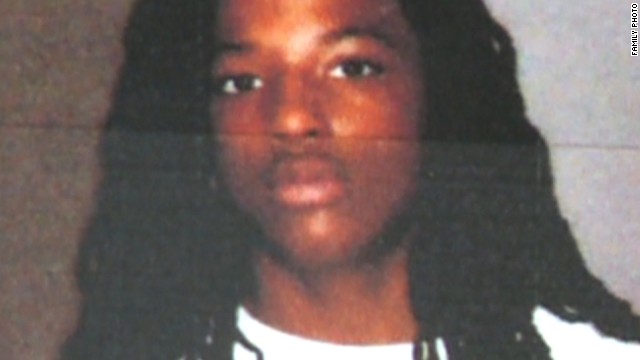
A picture of Kendrick Johnson
Kendrick Johnson

2) Lowndes Highschool had two gymnasiums: an old gym and a new one. Many large wrestling mats were kept in the corner of the old gym. These mats were 6 feet tall and around 3 inches wide. Kendrick and many other students often used the rolled-up mats to store their things to avoid paying locker fees.

A picture of Lowndes Highschool
Lowndes Highschool

3) On January 10, 2013, Kendrick Johnson did not return home from school. His parents subsequently reported him missing at midnight.
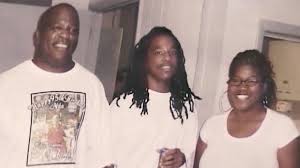
A picture of the Johnson Family
Kendrick Johnson with his mother and father, Kenneth and Jackie Johnson

4) Kendrick Johnson’s death

On the morning of January 11, 2013, a couple of students noticed socks sticking out of one of the rolled-up mats in the old gym. One of them then approached it. Upon noticing Johnson’s body, he tried pulling it out to no avail. Subsequently, after taking the help of a teacher, the mat was unrolled to reveal Johnson’s body positioned vertically. A student called 911 and the school subsequently went into lockdown. Johnson’s parents were informed and later it was found that his body was in an inverted position for 21 hours. As he was upside down, the blood would have rushed to his head. He would have eventually begun to bleed out of his facial orifices, and as a result, his face was bloated with pooled blood.

Officers investigating the case quickly ruled it as an accident. According to them, Johnson was reaching out for one of his shoes and subsequently fell in the mat and died of  “positional asphyxia”. After the mat was unrolled, Johnson was seen with one arm stretched above his head and the other down at his waist. He was positioned as though he was struggling to reach for his shoe. It came to notice that the mat was 6 feet tall and Johnson was 5’10”. Plus when the mat was rolled up it was 14 inches in diameter and Johnson’s shoulders were 19 inches. He might have scrunched his shoulders to fit in, but his family subsequently debunked this theory.

A picture of the body in the mat
Johnson’s body in the mat. The mat was initially discovered standing upright

5) Streaks of blood were also found on a wall nearby. But after testing, it was concluded that they didn’t belong to Johnson. Additionally, a pair of orange and black sneakers and a hoodie were found just a few yards away from the body. However, the investigators did not take it in as potential evidence.

6) Additionally, the shoe that lay on the ground below Johnson, the one he was presumably reaching for was lying on top of a pool of blood. However, what baffles most people is that there was no blood on the shoe itself.

A picture of Johnson

7) Even though Kendrick Johnson’s death was ruled as an accident, his parents were not convinced

They were suspicious of the authorities who quickly concluded there was no foul play involved. Further saying that if it was an accident, wouldn’t anyone hear his cries for help in a highschool of over 3,000 students? Hence, his parents were convinced that his death was not taken seriously due to his race. Kendrick Johnson was black and the investigating offers were all white. Unfortunately, in 2013, racism in Valdosta, Georgia was very much prevalent. Additionally, the family’s attorney said that if Johnson had been white, the case would have been handled differently.

A picture of Johnson with his mom

8) The Johnson family subsequently hired a private pathologist to carry out a second autopsy

The second autopsy revealed that Kendrick Johnson had suffered haemorrhaging on the right side of his neck. Hence the likely cause of his death was blunt force trauma. Additionally, it was revealed that some of Johnson’s organs were missing and they were replaced with newspaper stuffing.

The Georgia Bureau of Investigation subsequently stated that the organs were put back in the body after the first autopsy. Then the body was sent to the funeral home. However, Lowndes County Coroner Bill Watson stated that many of Johnson’s organs were deemed too badly decomposed to be preserved and had to be disposed of. According to him, this was done during or immediately after the autopsy.

Harrington Funeral Home in Valdosta, which handled Johnson’s body, said that it received the body without organs. Additionally, they replace missing organs with paper or sawdust, as it is a common practice while embalming.

Whatever may have been the case, the organs were lost and could not be tested during the second autopsy. This further aroused suspicions that Kendrick Johnson’s death was not an accident but a cover-up.

A picture of Kendrick Johnson

9) Due to new evidence coming to light Matthew Moore, the U.S. Attorney for the Middle District of Georgia declared a formal review of the case.

10) The missing surveillance footage

CNN who gained access to the school’s security footage hired forensic video analyst Grant Fredericks to analyze more than 290 hours of material from all 35 cameras inside and outside of the gym. However, the videos provided very little insight as to what exactly took place that day. The cameras which faced the mats were blurry and erratic. In the end, all Fredericks was able to find was a little more than 18 minutes of video showing Johnson throughout the school on January 10. In one footage he is seen walking towards the gym and others show him jogging within the gym.

However, one thing is clear, that he entered school at 7:31 a.m. and was last seen at 1:09 p.m., walking into the gym where he was found dead the next day. Furthermore, at least an hour of surveillance footage is missing right at the time which would have shed light on what happened that day. According to Fredericks “(The surveillance video has) been altered in several ways, primarily in image quality and likely in dropped information, information loss”.

A picture of the security footage
Surveillance footage that shows Johnson entering the gym

11) The suspects in Kendrick Johnson’s murder

Subsequently, in 2014, Kendrick Johnson’s family filed a wrongful death suit against Lowndes Highschool officials. They alleged that Johnson had been bullied by a white student which went neglected by the school, perhaps due to his race.

Ebony.com published an article alleging that Johnson was killed by two white brothers. Though they used pseudonyms in their article, these were thinly veiled and the description of the brothers closely resembled Brian and Brandon Bell. The magazine claimed that they had murdered Kendrick because of a fight they had almost a year earlier which had escalated.

Furthermore, the Johnsons also accused the brothers’ father, Rick Bell, an FBI agent at the time, of covering up the murder. They stated that he manipulated the school and the investigators involved in the case.

12) In 2015, the Johnsons filed a $100 million lawsuit against 38 people; including local, state and federal law enforcement officials and three classmates

Among the respondents is Rick Bell whom the suit accuses of ordering his two sons to attack Kendrick along with a classmate and two other unnamed people. However, the Johnsons did not have any hard evidence to back up any of these claims and they subsequently had to drop the suit. They were consequently sued for more than $850,000 in attorney fees and more than $1 million in defamation charges.

A picture of Kendrick Johnson

13) In 2016, the Department of Justice declared that they would not be filing any criminal charges against anyone in relation to Kendrick Johnson’s death. Further stating that “there is insufficient evidence”. Hence according to the feds, the case was officially closed.

14) However, Johnson’s parents were not satisfied with the verdict and continued their search for the truth.

15) In 2018, Kendrick Johnson’s body is exhumed again and a third autopsy is carried out

The third autopsy only confirms the findings of the second autopsy. Johnson’s cause of death was ‘non-accidental blunt force trauma to his right neck’. The family subsequently submitted the autopsy and other findings to the Lowndes County Sheriff’s Office and is hoping to get the case re-opened. Additionally, in 2019, they also filed a lawsuit against the funeral home.

Since then there have not been any developments in the case, but we shall be on the lookout.


Enjoyed the above article? You may also enjoy The Mysterious Death of Elisa Lam

The Terrible Human Zoos of the West- in pictures

As the name suggests human zoos were essentially exhibitions where the main attraction was human beings. In the early 19th and 20th centuries, the western world was obsessed with ‘primitive natives’. Consequently, this obsession fueled a market for human zoos which displayed indigenous people. People were brought from all around the world and were put in zoos across Europe and the United States. Essentially thousands of indigenous individuals from Africa, Asia, and the Americas were the subjects for these exhibitions.

Let us take a look at The Terrible Human Zoos of the West- in pictures.

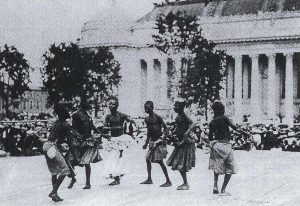
1) Congolese Pygmy men dance on an open stage at the 1904 St. Louis World’s Fair.

A picture of Congolese Pygmy tribe natives

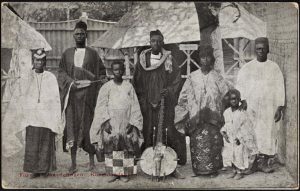
2) A picture depicting unidentified African natives on display at a human zoo in Oslo, Norway, 1914.

A picture of unidentified natives on a display at a human zoo

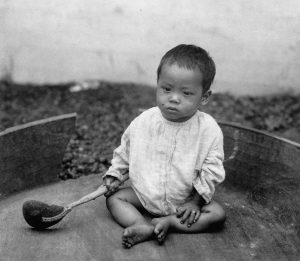
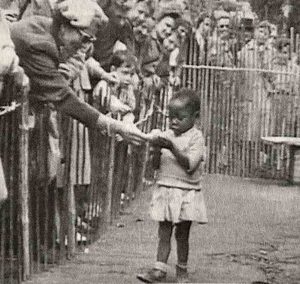
3) Additionally, even the native children were on display at these terrible human zoos. The below child was among others at the World’s Columbian Exposition in Chicago, Illinois, 1891.

A picture of a child displayed at a human zoo

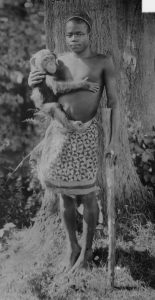
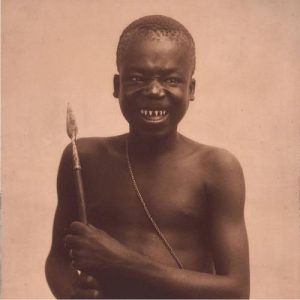
4) Ota Benga, a Belgian Congo pygmy exhibited at the New York’s Bronx Zoo in 1906.

A picture of human zoo exhibit Ota Benga

5) Another picture of Ota Benga. The Westerners cruelly labelled him as the ‘missing link of evolution’.

A picture of Ota Benga

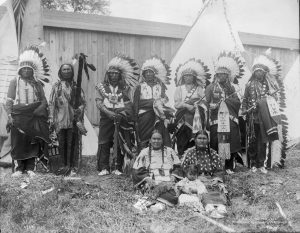
6) Indian Chief Yellow Hair and his council exhibited at a human zoo at the 1904 St. Louis World’s Fair, Missouri.

A picture of the chief and his clan

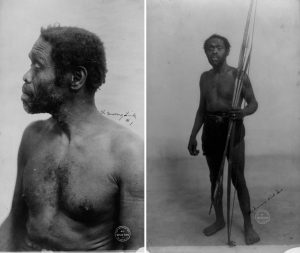
7) This unidentified African native was on display at the 1904 St. Louis World’s Fair, Missouri. The words ‘the missing link’ are written on both photographs.

A picture of an African man

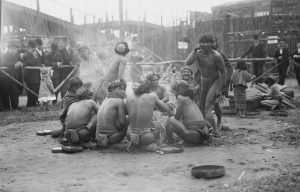
8) Filipinos gather in a circle while hordes of Americans watch them from behind barriers in Coney Island, New York, circa. early 20th century.

A picture of filipinos at a human zoo

9) An African girl is on display at the 1958 Brussels World’s Fair, Belgium. She was part of an exhibition that featured a ‘Congo Village’.

A picture of an African girl

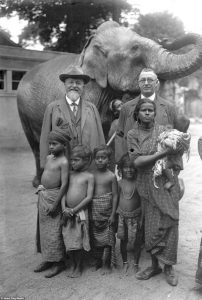
10) The below picture depicts German zoologist Lutz Heck(left) posing with an elephant and an African family he brought to the Berlin Zoo, in Germany in 1931.

A picture of a German zoologist and an African family

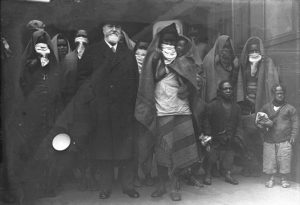
11) A picture of professor Lutz Heck with members of the African Sara-Kaba tribe. The natives will soon be on display at a human zoo in Berlin. Additionally, the women have covered their mouths to hide their lip plates.

A picture of a German zoologist and the members of an African tribe

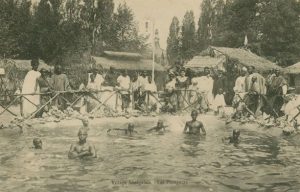
12) A human zoo displaying a ‘Senegalese village’ at the Brussels World’s Fair, Belgium in 1958.

A picture of a human zoo

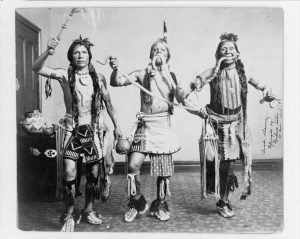
13) Native American men perform a snake dance for the enjoyment of the audience at the 1904 St. Louis World’s Fair.

A picture of the snake dance

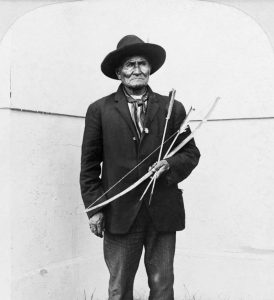
14) Apache hero Geronimo was also on display at the 1904 St. Louis World’s Fair.

A picture of Geronimo

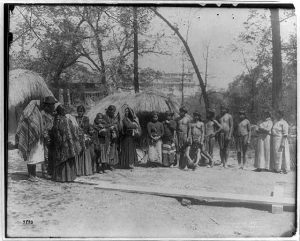
15) One of the major attractions of the 1904 St. Louis World’s Fair was the Igorot ethnic group. The below Filipino family poses in front of replicas of their traditional homes at the event.

A picture of a filipino family

Enjoyed the above article? You may also enjoy 19th century London street life- in pictures

Marvin Heemeyer’s Killdozer Rampage

Marvin Heemeyer was an American welder who is best known for rampaging a town with his ‘killdozer’. His killdozer was essentially a modified bulldozer that wreaked havoc in Granby, Colorado on June 4, 2004.

Let us take a look at Marvin Heemeyer’s Killdozer Rampage.

1) The Background

Heemeyer moved into Granby, Colorado in the early 1990s. Here he bought a few acres of land and started his own muffler repair shop. According to the locals, he was a jovial blue-collar worker.

A picture of Marvin Heemeyer
Marvin Heemeyer

2) Marvin Heemeyer negotiates with the Docheff family

In 1992, Heemeyer bought 2-acres of land from the Resolution Trust Corp for a price of $42,000. However, he subsequently agreed to sell it to the Docheff family, which wanted to build a concrete batch plant on the property.  He initially agreed to a price of $250,000, but further increased it to $375,000. Ultimately at some point, he charged approximately $1 million. As the price was too steep, the Docheff family terminated the deal.

3) In 2001, the town’s zoning commission decided to authorize the construction of the concrete plant and consequently zoning the land on the edge of Heemeyer’s property for its use

A furious Heemeyer objected to the rezoning. He argued that the dust, noise and added traffic would diminish the value of his adjacent property. Additionally, he also held a grudge against the plant operator Cody Docheff. Moreover, like Heemeyer others opposed the town’s decision as well, however, according to the town manager Tom Hale, they gradually accepted the decision and moved on. But most locals agree that Heemeyer still opposed to the idea. He subsequently filed a lawsuit against the town but that failed.

The town board and Heemeyer clashed again that year when Heemeyer was levied with fines totalling $2,500. The fines were levied for various offences including “junk cars on the plot and not being hooked up to the sewer line”. The latter one was apparently the last straw for Heemeyer and he could not take it anymore. He felt screwed by the town and decided to take matters into his own hands.

A picture of Heemeyer

4) Marvin Heemeyer possessed a 61.5-ton Komatsu bulldozer. According to his family, he bought it several years ago; maybe for occasional construction purposes. This device would ultimately be his ‘revenge machine’.

5) Marvin Heemeyer begins the construction of his killdozer

Heemeyer possessed a 6,000 sq foot metal building between his muffler shop and Docheff’s now-established concrete plant. On December 2, 2003, he sold off the shop and the adjacent metal building. However, the terms of that sale included a leaseback agreement that allowed Heemeyer to use a walled-off 2,000 sq foot section of the metal building until June 1, 2004. This section ultimately became his bulldozer garage. And without telling anyone about his plans, Heemeyer deeded his house to a friend and retreated to the garage to work on customizing his revenge machine. Subsequently, his machine was popularised as the ‘killdozer’.

A picture of Marvin Heemeyer's killdozer
Marvin Heemeyer’s Killdozer (C: Craig F. Walker/The Denver Post/Getty Images)

6) Heemeyer began his customization work, apparently at night, in a space stocked with everything from a portable cement mixer to movie DVDs. According to a Denver Post report, the movies included ‘A Man Apart’, a thriller which had an eerily fitting tag line “Nothing left to live for, everything to fight for”.

A picture of One of the rifles outfitted in the cab
One of the rifles outfitted in the cab (C: Grand County Sheriff’s Office)

7) The killdozer’s construction is complete

The expert welder started by outfitting the bulldozer with armoured plates, which would protect the driver against explosives and small firearms. He had created the armour himself, using a conglomerate of concrete poured between sheets of steel. This subsequently created plates over a foot thick. Additionally, he set up video cameras on the exterior of the bulldozer, so that he could monitor the situation from inside. Multiple layers of shatter-resistant plastic protected these cameras. Plus, he also mounted a system that used jets of air to blow dust and debris away from the lenses.

He also installed fans and an air conditioner to keep himself cool during his rampage. Finally, he mounted three gun ports which were outfitted with a .50 calibre rifle, a .308 semi-automatic and a .22 long rifle. Their barrels pointing to the front, rear and right side respectively. According to the authorities, once he’d sealed himself in, there was no way he could get out.

A picture of the machine's interiors
Inside the killdozer (C: Brian Brainerd/The Denver Post/Getty Images)

8) On June 4, 2004, Marvin Heemeyer’s killdozer is complete and ready to wreak havoc

He was now ready to exact his revenge on the town that wronged him. On June 4, 2004, he put two handguns in the machine and climbed inside the cab. According to reports, before entering, he greased the surface of the armoured plates to discourage attempts to climb aboard. He then drove the machine through the side of the metal building and set out for town.

A picture of a still of the machine bulldozing a building
A still of the machine bulldozing a building

9) Marvin Heemeyer’s killdozer rampage

His first target was obviously Docheff’s Mountain Park concrete plant. He bulldozed the company’s administration building into rubble and then took down the entire rear of the nearby batch-plant building. Once he was satisfied with the damage he had caused he moved to other businesses and buildings. In the end, Heemeyer had bulldozed the Town Hall, a newspaper office, a playground, a former judge’s widow’s home, a hardware store and other buildings.

Heemeyer then finally proceeded to bulldoze the Gambles hardware store. However here he ran out of luck as the store had a small basement and his machine was leaking various fluids. Either the machine’s engine failed or Heemeyer got wedged between the basement and store and couldn’t get out, or both. But after 2 hours and 7 minutes, Heemeyer’s rampage had stopped. Subsequently, after surrounding the machine, the SWAT team heard a single gunshot.

Marvin Heemeyer had shot himself dead with his .357 calibre handgun.

A picture of a truck that sustained damage due to Marvin Heemeyer's rampage
A truck that sustained damage due to Marvin Heemeyer’s killdozer rampage

10) A hero or a villain?

Folks often consider Heemeyer a hero because, despite the nearly $7 million in property damage done to the town, not a single human besides Heemeyer was killed. However, the authorities base it on mere luck. Today, he has a devout following in anti-government online communities. Some see Heemeyer as a hero who stood up against the government while many others see him as a troubled man who chose violence and destruction when life didn’t go his way.

As for the infamous killdozer, it was taken apart and sold for scrap.


Enjoyed the above article? You may also enjoy Rose Bundy- the child of a serial killer

9 Highly Effective Ancient Egyptian Weapons

Ancient Egyptians were pioneers in many fields, one of them being weapons. Egypt’s history is divided into three kingdoms and two intermediate periods. Ancient Egypt was at the peak of its military power during the New Kingdom. During this time, they improvised and upgraded their weapons and created the highly effective weapons listed below. These weapons were instrumental in leading the Egyptian army to victory during battles.

Let us take a look at the 9 Highly Effective Ancient Egyptian Weapons.

1) Javelin

The first in our list of Ancient Egyptian weapons is the javelin. The javelin was an offensive weapon that was light in weight. They were carried by the Egyptian light infantry and was an alternative to a spear or a bow and arrow. The javelin was highly effective in close combat as Ancients Egyptians would use the weapon to thrust at the enemy behind their shield. Additionally, they could also launch the armour piercing javelin at the enemy lines or chariots.

A picture of a javelin- Ancient Egyptian Weapons

2) Battle-axe

During the Old Kingdom, Ancient Egyptians utilised the traditional Egyptian axe; which had a round or semicircular blade of stone or copper attached to a wooden stick. However, during the First Intermediate Period, it was upgraded into a crescent-shaped weapon made of bronze. The new design subsequently increased the length of the cutting edge. The Egyptian warriors usually carried the battle-axe on their shoulder.

A picture of the battle axe-Ancient Egyptian Weapons

3) Mace-ax

According to historian Paul Elliot, the mace-axe is a purely Egyptian weapon. The Ancient Egyptians used this weapon starting as early as 6,000 B.C. Initially, they used simple maces that had a wooden shaft and a stone head. Later during the New Kingdom, they improvised on the design and the heads were made of bronze and copper. The deadly weapon would have been wielded with two hands to break enemy swords and bash through even the strongest bronze armour. However, the Egyptian battle-axe subsequently replaced the mace.

A picture of the mace-ax- Ancient Egyptian Weapons
(C: Ancient Military)

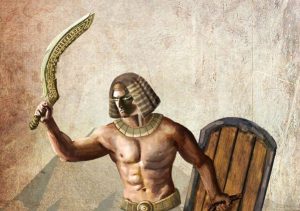
4) Khopesh- one of the most distinctive Ancient Egyptian weapon

Khopesh is one of the most distinctive Ancient Egyptian weapons. It is essentially a curved sword. Khopesh in Ancient Egyptian translates to ‘leg’ or ‘leg of beef’. The blade is shaped like a sickle and is only sharp on the exterior side.

Various Egyptian pharaohs are depicted carrying the khopesh and some have even been found in royal tombs. For example, the Ancient Egyptians buried the boy king Tutankhamun with two khopeshes. The Ancient Egyptian weapon fell out of use around 1300 B.C.

A picture of a man wielding a khopesh

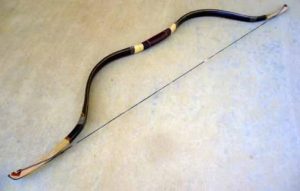
5) Composite bow

Initially, the Ancient Egyptians used a simple self bow made of horn or wood. However, after battling the Asiatic Hyskos, the Ancient Egyptians adopted the composite bow. The composite bow was far more superior to the self bow and could hit a target at a distance of 250 m. The bows were long, around 5 feet in length. and were made from layers of different materials such as wood, horn and sinews. And they used animal glue to carefully cement the materials together.

The strings of the weapon were made from the animal gut and the arrows were fashioned from bronze-tipped woody reeds. Additionally, the Ancient Egyptians fletched the arrows with three feathers to improve their accuracy. Furthermore, the bow had a characteristic double-curve which became triangular when strung.

A picture fo a composite bow- Ancient Egyptian weapons

6) Chariots- Ancient Egyptian weapons that were the pride of the Egyptian army

Chariots were essentially the pride of the Ancient Egyptian army. According to archaeologist Joost Crouwel, chariots were not a sudden invention but were developed out of earlier vehicles that were mounted on disk or crossbar wheels. The early usage of chariots was mainly for transportation purposes, however, they were first used as a weapon by the Hyksos. Later when Ancient Egypt was at the peak of its wealth during the New Kingdom, the armies deployed swarms of heavily armed chariots during battle. The chariots, however, broke down a lot due to the uneven grounds, as a result, they were in constant need of repairs. The chariots were hence expensive and high maintenance weapons, but important nevertheless.

The Ancient Egyptians used the chariots mainly for the archers. An archer would stand on the chariot and shoot arrows at the enemy. The driver a.k.a the charioteer essentially controls the chariot. Additionally, it was the charioteer’s job to ensure that the archer got the best shooting position.

According to ancient battle records, the Egyptian army deployed large chariot formations of almost 100 teams. Moreover, the warriors riding on the chariot used a range of weapons including the javelin, the composite bow and khopesh.

A picture of chariots

7) Body armour

According to archaeological evidence, Ancient Egyptian soldiers wore very light armour. They were essentially simple textile wraps cemented by animal glue. However this was not the case for the charioteers, both the warrior and the driver wore an elaborate and protective armour made out of bronze scales.

The pharaohs were also an exception, for example, Ramses II is depicted fighting as a charioteer wearing scale armour with sleeves that covered the entire torso. The horses pulling the chariot were armoured as well. According to relief paintings, both Ramses II and Tutankhamun are driving chariots with horses wearing armour with bronze scales.

A picture of Egyptian body armour

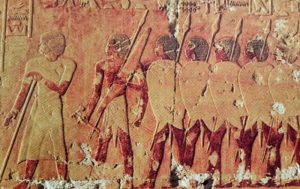
8) The bronze-tipped spear and the shield

Ancient Egyptians either used the spear as a close combat weapon or a projectile weapon. The spearmen of the Egyptian army were armed with a bronze-tipped spear in their right hand and a wooden shield in their left. They would then advance towards the enemy in a tightly packed formation. The length of the spear allowed them to attack the enemy while deflecting attacks with their shields. The bronze tip had the added advantage of piercing through the enemy’s armour.  Additionally, there were two types of spears; one that was made for throwing and thrusting and one that was fitted with an axe blade and used for cutting and slashing.

Initially, Egyptian speartips were wooden and ineffective. Subsequently, the Syrians showed them how to forge spears with bronze tips. The Egyptian shields were essentially wooden planks that were bound with glue and animal hides. These turned into a strong defence when the infantry closed ranks in a phalanx formation.

A picture of the Ancient Egyptian army carrying the weapons- shields and spears

9) Short sword

Ancient Egyptians did not actually use swords, although they did use daggers and short swords. They essentially used two types of short swords. The first was shaped like a dagger and had a sharp point. It was very useful at a very close range. While the second was longer with flat sides and had a sort of ‘butter knife’ point. This weapon was for slashing at the enemy from a short safer distance and was strong enough not to bend when brought down hard on a shield.

A picture of short sword

Enjoyed the above article? You may also enjoy the 13 most effective Ancient Roman weapons

8 Forgotten weapons you need to know about!

Weapons are essentially devices that can be used with the intent to inflict harm or damage. Additionally, weapons can be used for self-defence, law enforcement, hunting, crime and warfare. We have compiled a list of forgotten weapons you need to know about, these include the puckle gun and the punt gun.

Let’s take a look at 8 Forgotten weapons you need to know about!

1) Puckle gun

Invented by James Puckle, the puckle gun or the defence gun is one of the earliest weapons to be referred to as the ‘machine gun’. The puckle gun is essentially a tripod-mounted, single-barreled flintlock revolver. The unique aspect of the gun is that it had two versions. It was designed to fire round bullets at Christians and square bullets at Muslim Turks. The square bullets were more detrimental than the round ones. The patent even stated that it would “convince the Turks of the benefits of Christian civilization”.

In 1717 a prototype was shown to Great Britain’s Board of Ordnance who were not sold by it, subsequently, it was rejected for government use. One reason being that it was inferior in fire rate and the flintlock mechanism was too undependable. However, Puckle patented the gun and then set up a company in 1721 to market it. Furthermore, the gun was quite ahead of its time and could not overcome the handicap of 18th-century flintlock technology. As a result, the puckle gun attracted only a few investors and ultimately wasn’t a commercial success.

A picture of the puckle gun
Puckle gun

2) Punt gun

A punt gun is a type of weapon which was designed to be fired from a punt(a small skiff boat). It is essentially a huge shotgun that was used to hunt large numbers of waterfowl as efficiently as possible. According to records of the 19th and early 20th century, these guns killed more than 90 birds at once. Additionally, the guns packed so much power that when fired, the boat would actually be blown back several feet.

However, punt guns were quite detrimental to the duck population and their numbers began to drastically decline.  As a result, by the mid-19th century, the United States passed a series of federal laws that banned the punt gun, along with punt boats. Today, they are more of a collector’s item, with less than 100 in use around the world. However, they are still used in the United Kingdom, though only for ceremonial purposes. Additionally, there are restrictions in its usage, most of which insist upon smaller barrel sizes and lesser ammunition.

A picture of the punt gun- forgotten weapons
Punt gun

3) Karl-Gerät- A deadly Nazi forgotten weapon

Karl-Gerät, literally translated as ‘Karl-device’ was a self-propelled siege howitzer. It was designed and built by the Rheinmetall corporation during World War II. It subsequently became the largest self-propelled gun ever built. This intimidating gun was called many nicknames such as Thor, Odin and Loki.  This enormous weapon was used in combat as well. In fact, it saw significant action during the Warsaw Uprising and participated in the Battle of Bulge and Battle of Remagen. Ultimately, seven Karl-Gerät howitzers were manufactured. However, due to their immense size, their capabilities were limited. Furthermore, each gun had to be accompanied by a crane, a two-piece heavy transport set of railcars, and modified tanks to carry shells. After WWII, these weapons were seized and scrapped.

A picture of the Karl-Gerät
Karl-Gerät

4) The bouncing bomb

The bouncing bomb or the HighBall was designed by Barnes Wallis. It was cylindrical and measured 60 inches long and 50 inches in diameter. As suggested by the name, it was a 9,000-pound motorized bomb designed to bounce to a target across the water in a calculated manner. When it reached above its target, it would sink below the surface and explode. This forgotten weapon was used in WWII during Royal Air Force’s Operation Chastise. Here they dropped bombs that would bounce into German dams and explode underwater.

A picture of the The bouncing bomb- forgotten weapons
The bouncing bomb

5) Schwerer Gustav

Schwerer Gustav, also known as Great Gustav was a railway gun. It is also one of the largest guns ever created. Plus it holds the title of the heaviest mobile artillery ever built. Schwerer Gustav was built before the occupation of France and was built to penetrate the fortified walls of the French Maginot Line. This impressive weapon was 107 feet long, 23 feet wide and 38 feet tall. It weighed over 1,350 tonnes and was operated by a crew of 250 soldiers. Additionally, another 2,500 were employed to lay down the tracks for its movements. Furthermore, two flank battalions were given the task of protecting it from air attacks.

However, France surrendered quickly and it obviated the need for the weapon. In the end, the mighty weapon saw little action. It was used once during the siege of Sevastopol and once during the Warsaw Uprising. The weapon was ultimately destroyed on April 14, 1945, in order to prevent its capture.

A picture of Schwerer Gustav- forgotten weapons
Schwerer Gustav (C: manhhai flicker)

6) Paris gun- a psychological forgotten weapon used to attack the morale of the Parisians during World War I

The Paris gun is essentially a type of German long-range siege gun. Many of these siege guns were used to bombard Paris during World War I. This impressive gun could hurl a 120kg shell with 7kg of explosive to a range of 131 km and an altitude of 40 km. It was also called Kaiser Wilhelm Geschütz and was often confused with Big Bertha and Langer Max, two completely different weapons. However, as military weapons, these were not a great success as the payload was small and the barrel required frequent replacement. Additionally, the gun’s accuracy was good enough for only city-sized targets. Ultimately, the German objective was to build a psychological tool to attack the morale of the Parisians and not destroy the city itself.

A picture of the Paris gun
Paris gun (C: photograph (Q 65801A) © IWM. Original Source: http://www.iwm.org.uk/collections/item/object/205393082)

7) Cemetary gun

During the 18th and 19th century, grave-robbing was a major problem in Great Britain and the United States. During those times medical students and practitioners could only legally dissect the bodies of executed criminals or people who donated their body to science(not a popular choice then). As a result, illegal trade in procuring corpses sprang up. Hence the cemetery gun was essentially protection against these grave robbers or ‘resurrection men’.

The gun is set up on a mechanism that lets it spin freely. The cemetery keepers essentially mounted the flintlock weapon at the foot of the grave, and it had one or three tripwires strung in an arc around its position. Hence if a grave robber stumbled over the tripwire in the dark, it would trigger the weapon- thus hurting the thief. These guns were soon outlawed and were replaced by ‘coffin torpedos’; landmines that exploded if a grave robber opened a grave.

A picture of the cemetary gun
Cemetary gun

8) Duckfoot pistol

Duckfoot pistols were named after their barrels which resembled a duck’s feet. The gun could have between three to six barrels and these were aimed in different directions. The principle behind the gun was easy; it was used when a single person was confronting a group of persons. It was especially useful for naval officers, prison wardens or bank guards who could be attacked by many people at once.

A picture of the forgotten weapon Duckfoot pistol
Duckfoot pistol

Enjoyed the above article? You may also enjoy Weapons and Artilleries Used In WW1 – 8 Facts

Darryl Stingley: His Career, Tragic Hit, and Lasting Legacy

Darryl Stingley was an American professional football player, whose career ended after a tragic hit on-field. Considered one of the worst hits in National Football League(NFL) history, Stingley sustained a major spinal cord injury. He went from being a young promising player to a man in a wheelchair in mere moments. However, he did not let his injury hold him back and left a lasting legacy.

Let us take a look at Darryl Stingley- Career| Hit| Legacy.

1) Born on September 18, 1951, Darryl Stingley was brought up on Chicago’s West Side. After a stellar career at John Marshall Highschool, Stingley went to Purdue University on a football scholarship. Here he established himself as a wide receiver under head coach Bob Demoss.

A picture of Darryl Stingley
Darryl Stingley (c: Purdue Athletics Communications)

2) His talent was quickly recognised and four years later and just a few credits away from graduating he was selected by the Patriots in the first round of the 1973 NFL draft as the nineteenth overall. Additionally, he was the Patriots’ third first-rounder, behind John Hannah and Sam Cunningham.

A picture of Darryl Stingley
(C: Purdue Athletics Communications)

3) He seemed to have all the tools he needed for a successful NFL career

Darryl Stingley was famous for his soft hands and deep-threat potential. Additionally, he had set a Boilermakers record of 18.2 yards per catch. He stood at a height of 6’0″ and weighed 194 pounds. Due to his strong work ethic and the nature of his play, he subsequently became a fan favourite as well. As a result, he was fondly given the moniker ‘the stinger’.

A picture of Darryl Stingley
(C: Purdue Athletics Communications)

4) Additionally, he was popular among his teammates and was deemed the unofficial team barber as he was pretty handy with the scissors. Plus he had good vocals and enjoyed singing Stevie Wonder songs.

A picture of a smiling Stingley

5) Over the next five seasons, Stingley would become one of the league’s top wide receivers, with thirty-nine catches and five touchdowns in 1977 alone.

A picture of the wide receiver of the field
(C: AP Photo/New England Patriots-Thomas J. Crocke)

6) In recognition of his terrific performance, the Patriots offered him a contract extension in the summer of 1978. According to his longtime agent Jack Sands this would have made him “one of the highest-paid receivers of the NFL”. Although the negotiations were over, the contract was yet to be signed. It was then that the Patriots went on a preseason tour of California.

A picture of Darryl Stingley
(C: Focus on Sport/Getty Images)

7) Darryl Stingley- the tragic hit that ended his career

During the 1978 preseason game, the New England Patriots were up against the Oakland Raiders at the Oakland coliseum. On August 12, 1978, Darryl Stingley’s promising career came to a tragic end after receiving a brutal hit from Jack Tatum. Aptly dubbed as ‘the assassin’, Tatum was the Raiders safety and was a man well known for playing vicious football. As Stingley stretched for an errant pass, he and Tatum collided due to which Stingley’s helmet made contact with Tatum’s shoulder pad; this hit essentially broke two vertebrae in Stingley’s spine.

A picture of the infamous collision
The infamous collision

9) After the hit, Stingley dropped to the ground motionless. His roommate Pro Bowl tight end Russ Francis was the first to reach the body and everyone watching knew something was wrong. The paramedics then rushed in to take his unconscious body away.

10) This brutal hit did not receive any penalty as at the time it was assessed as completely legal. Defensive backs were free to initiate such kind of contact with a receiver. Hence after things on the field calmed down, the game resumed.

11) However, Darryl Stingley’s life was not the same again. He was paralysed from the neck down, and after years of therapy, he eventually regained movement in his right hand. However, he was rendered a quadriplegic for the rest of his life. He was only 26 at the time.

A picture of Darryl Stingley in a wheelchair

12) Postgame, Oakland coach John Madden immediately rushed to visit Stingley in the hospital and eventually became a regular visitor. He was devasted by what had happened and he and Stingley remained close friends for years.

13) Gene Upshaw, who was playing for the Raiders in that game, also befriended Stingley. Subsequently, he was instrumental in providing compensation for players who were disabled due to injuries sustained while playing professional football. Thanks to his efforts, Stingley was eventually awarded $48,000 annually.

A picture of the former wide receiver

14) The symbol of violence in football

Subsequently, this incident gained notoriety for being the symbol of violence in football. Many people were angered by Tatum’s actions but what made them criticize him, even more, was the fact that he didn’t visit Stingley in the hospital nor did he apologize for his actions. The public’s anger grew even more after Tatum publicised his 1980 autobiography ‘They Call Me Assassin’ where he stated that his “best hits border of felonious assaults”.

15) Darryl Stingley was plagued with anger, resentment and depression in the years following his injury. However, he subsequently overcame it and in his 1983 autobiography ‘Happy To Be Alive’, Stingley expressed his joy in friends and family, his spirituality, his forgiveness of Jack Tatum and his desire to give back to society.

A picture of Stingley

16) Stingley said that “once he stopped asking the why-mes and the what-fors, he finally started living”. Stingley then resolved to finish his education and eventually got his degree from Purdue University. After completing his education, he started the Darryl Stingley Youth Foundation in his old neighbourhood on the west side of Chicago. He even got involved with football again and worked as a scouting consultant for the Patriots.

A picture of Stingley at a game

17) Tatum and Stingley never reconciled

Although Tatum reached out to Stingley several times, including while promoting his autobiography, Stingley refused to meet him because he was worried his actions were profit-motivated. As his agent Sands once said that “they had been contacted by people representing Jack but it always had a hidden agenda, if Tatum had contacted Darryl or him personally to talk, Darryl would have been more than willing to do it, but not for money or the media”. However, Darryl Stingley had forgiven Tatum a long time ago. This was even more evident when he received the news that Tatum lost a part of his leg due to diabetes. When he was asked to give his reaction he stated that “as a human, you cannot be happy that something like that has happened to another human being”.

18) Darryl Stingley passed away on April 5, 2007, at Chicago’s Northwestern Memorial Hospital. He was 55 years old at the time and the cause of death was determined as bronchial pneumonia, cardiac arteriosclerosis, spinal cord injury, and quadriplegia.


Enjoyed the above article? You may also enjoy The controversial life of Charles Saatchi

19th century London street life- in pictures

During the 19th century, London became a global city. It gained immense importance and consequently witnessed a boom in its population. The below pictures of Victorian London are taken by photographer John Thomson and journalist Adolphe Smith. They compiled them in their book ‘Streets of London’. It was an early example of social documentary photography and showcased 19th century London street life.

Let us explore the 19th century London street life- in pictures.

1) A picture of a second-hand furniture store in 19th century London.

A picture of a second hand furniture store

2) A picture depicting florists selling bouquets at Covent Garden market, 1877.

A picture of flower women selling bouquets

3) An encampment of Gypsies near Latimer Road in Notting Hill, 1877.

A picture of an encampment of gipsies

4) A street photographer getting ready to click a picture of a Victorian couple.

A picture of a street photographer

5) A group of men enjoying beers outside The Wallmaker, a public house.

A picture of a group of men drinking beer

6) A street procession on Guy Fawkes Night. Also known as Bonfire Night, it is an annual celebration to commemorate Guy Fawkes.

A picture of the Bonfire Night street procession

7) A picture of a water cart pulled by a horse. Additionally, children used to often run behind these and play in the water sprayed by the cart.

A picture of a water cart

8) The below picture depicts a dining room for ex-convicts. The owner of the establishment is seen speaking with Ramo Sammy, a local drummer known as the ‘tam tam’ man.

9) A 19th-century picture of a locksmith mending locks at his stall in London.

A picture of a locksmith mending locks at his stall in London during the 19th century.

10) A picture of Mush-Fakers and ginger beer makers with their cart. A mush-faker essentially sold, made and repaired umbrellas. The word ‘mush’ comes from mushroom since an umbrella looks like one. And faker was an old term for repair or mend.

A picture of Mush-Fakers and ginger beer makers with their cart- Victorian London pictures

11) A picture of an Italian iceman selling halfpenny ices in Victorian London, 1876.

A picture of Italian ice men selling halfpenny ices in Victorian London in the 19th century

12) The Hansom cab was a popular mode of transportation in Victorian London. The transport’s predecessor was the sedan chair.

13) Bill stickers pasting advertisements for Madame Tussauds wax museum.

A picture of billstickers- 19th century London pictures

14) A picture of the British Army recruiting sergeants outside a public house at Westminster.

A picture depicting the British Army recruiting sergeants in Victoorian London, 19th century

15) A picture of a Costermonger selling fresh fish from his cart in the street market between Seven Dials and Five Dials in London, 1877.

A picture of a man selling fresh fish in 19th century London

16) A man selling fancy ornaments from his barrow.

A picture of a man selling ornaments in 19th century Victorian London

17) A picture of horse-driven carriages navigating on London’s Oxford Street, 1890.

A picture of the streets in 19th century Victorian London
(C: London Stereoscopic Company/Getty Images)

18) A picture of Walworth, South London.

19) Another picture of London’s Oxford Street during the 19th century.

20) A picture of a carriage pulled by zebras, the late 1800s.

A picture of a zebra carriage


Enjoyed the above article? You may also enjoy Job Hunting in the 1930s- in pictures

16 interesting facts about the sporran

The sporran is an integral part of the male Scottish Highland dress. It essentially functions as a wallet for the kilt. There are many different types of sporrans, and they are worn according to the occasion.

Read 16 interesting facts about the sporran.

1) It is Gaelic for purse and as Scottish kilts do not have pockets, it was created as a necessity. Its exact origins are unknown, but it is believed that it originated in the 12th century as part of the male Scottish Highland dress.

A picture of a male Highlander dress

2) Traditionally sporrans were made from leather or skin such as deerskin, sealskin or calfskin. They were basic in design and usually gathered at the top by simple drawstrings.

A picture of the sporran

3) The sporran’s simple design has evolved significantly over time. Although one thing has remained consistent-the tassels in the front. They typically feature three tassels which served a practical purpose which was to hit flies away from the food supplies kept inside.

A picture of a British soldier wearing the sporran
A soldier from the United Kingdom wearing a sporran

4) It is worn at the front of the kilt and hangs just below the belt buckle. During its early years, sporrans would have been worn hanging from the belt, rather than hung from a separate strap in front of the wearer. Its position is important and should hang two or three inches below the belt buckle, too low or too close to the belt buckle is to be avoided.

A man wearing the sporran

5) Another way of hanging the sporran is a leather strip called a ‘wang’ developed many years ago by sporran maker Jim Kirkwood. It has no metal parts and an easy fastening system.

6) During the 18th century, sporrans are seen on portraits of military figures and aristocracy. These depict the development of a style with a metal clasp known as a cantle.

A picture of a cantle
A decorated cantle

7) It was towards the 19th century that the purses started becoming more ornate and elaborate while using a range of animal hair and skin.

8) In the 20th century the sporran started incorporating the changing fashion trends; it started including 5th-6th century Celtic symbols in the flap and the cantle.

A picture of the fur faced wallet

9) The day sporran

As the name suggests, this style is convenient to use on a day to day basis. It is typically made out of leather with three or more leather tassels. Additionally, they have a Celtic knot or thistle design embossed on the front of the flap and body. Moreover, they fasten with a stud or hook closure.

A picture of the day style

10) The dress sporran

The dress sporran is highly ornate and quite different from the simple leather ones. It usually has a metal cantle and a fur-covered face with fur or hair tassels. The metal cantle usually has an intricate design or Celtic knots and thistles. Sometimes the cantles are silver plated and its top contains a set stone, jewel or Scottish symbols. Additionally, dress sporrans can also be made of leather, these are called ‘hunting dress sporrans’ and are worn for formal hunts.

A man wearing a full dress style of the sporran

11) Full dress sporrans

This type of style is worn during formal events such as ceremonies or weddings. It usually contains fur faced fronts, a fur gusset, decorative fur tassels which are paired with regular or cross chains and a metal cantle at the top; the cantle then arcs along the top of the purse and conceals a clasp, usually made out of pewter or silver and adorned with gemstones. Furthermore, this style is usually decorated with Celtic patterns.

A picture of a full dress style

12) Semi dress sporrans

This style is a combination of the full dress and day sporrans. It essentially contains a fur faced front with a leather flap. The leather flap is often embossed with Celtic symbols, Scottish symbols or clan insignia. The body is made from fur and has three decorated tassels hanging from the front.

13) Full-mask sporrans

This type of style is typically made from the heads of small animals such as the badger, otter or fox. The animal’s head makes the flap and its pelt makes the body of the sporran. This style is associated with the early Scottish sporrans. Today they are not the standard style for formal occasions but are used for historic reenactments and festivals.

A picture of the full mask style

14) Horsehair sporrans

These are normally associated with pipers or drummers. They are a very long and dramatic style, and in a traditional purse, the hair will reach just below the hem of the kilt. A very common horsehair sporran consists of black horsehair tassels on a white horsehair background.

A picture of the horse hair sporran

15) What is inside a sporran?

Traditionally the Highlanders have used it to store coins, essentials, and even oats and onions! And did you know the sporran displayed at the National Museum in Edinburgh has a secret contraption? It essentially contains four pistols which fire at anybody wanting to open the locked purse, thus hurting or killing the thief.

16) Nowadays, these purses are an integral part of the male Scottish Highland dress, although it’s not used for carrying ammunition or food anymore, you can certainly use it for carrying your keys or phone.


Enjoyed the above article? You may also enjoy 15 Interesting Facts About Saddle Shoes

Did George Washington Have Children?

George Washington is celebrated as the first president of the United States. Despite being the ‘father of the country’, George Washington did not have any biological children. He instead raised his stepchildren and step-grandchildren from his marriage to Martha Custis. Read the text below to explore George Washington’s family life.

1) Did George Washington have children?

Well, the answer is no, he did not have any biological children. George Washington and Martha married in their late twenties. And at the time they wanted to have children of their own but historically there is no conclusive evidence as to why they couldn’t have any. Some alleged that it was because of Marthas’s bout of measles while others conclude it was Washington’s tuberculosis induced infertility. Well, whatever the reason is, the fact remains that in their 40 years of marriage Washington was a father figure to his wife’s children and grandchildren. His stepchildren were raised on the Mount Vernon Estate and according to accounts, he was a loving father figure.

A picture of the Washngtons
George and Martha Washington

2) Additionally, historians turn towards a letter written by Washington to his nephew where he writes about his possible future heirs. Adding that if he dies before Martha, there should be a certainty of no illegitimate heirs. Further stating, in case he outlives her and remarries there wouldn’t be any children out of that wedlock either.

A picture of George Washington's children

3) Martha initially married Daniel Parke Custis. However, after his death, she married George Washington on January 6, 1759. Washington subsequently took custody of Martha’s surviving children Martha ‘Patsy’ Custis and John ‘Jacky’ Parke Custis. However, in 1773, Patsy died due to an epileptic seizer. Jacky subsequently married Eleanor Calvert in 1774. The two went on to have four children; Elizabeth Parke Custis, Martha Parke Custis, Eleanor Parke Custis and George Washington Parke Custis.

A picture of George Washington's children

4) Jacky died eight years after Patsy. Subsequently, Washington took in his two youngest children two-year-old Eleanor ‘Nelly’ Parke Custis and infant George Washington ‘Wash’ Parke Custis. They raised the children as their own, while the older ones were in the care of Eleanor Calvert.

A picture of a family

5) Washington not only took care of Martha’s children, but he was also the surrogate father to his nieces and nephews. Especially the children of his younger brother Samuel who died in 1781.

A picture of a family

6) For his family, George Washington was a soldier to the core. His approach to raising children was quite different from his wife. He was strict and took a rather hard-line approach in case the young children acted in an undisciplined manner. In contrast, his wife was more lenient with them.

7) Although Washington was stern, Jacky saw him as a loving father figure. And in a heartfelt letter, he expressed his sentiments saying that “although God took his father away from him, he was thankful that He gave him a good guardian such as Washington.”

A picture of George and his family

8) George Washington stressed the importance of education on his stepchildren

George Washington highly regarded the education of his family. His father died when he was only eleven, due to which he could not receive a formal education. However, the young men he was rasing did not share his point of view; they had no interest in studying. In a letter to Jacky’s teacher, Washington even expressed his concern after Jacky was returning to school post-summer break stating that the boy’s “mind was relaxed from study and was more into guns, horses and dogs.” Further asking the teacher to keep an eye on the boy.

9) George Washington’s female stepchildren and step-grandchildren had a penchant for education.

Washington’s grandchild Wash shared his father’s dislike for education and eventually dropped out of college. Even though the young men did not favour education much, George Washington’s female stepchildren and step-grandchildren had a liking for it. Once Elizabeth’s teacher told her that the only suitable subjects for a woman are ‘mending, writing, music and arithmetic’. The words of her teacher caused her “deep regret” which she carried throughout her life as she had a strong desire for formal education. Her younger sister Nelly however studied at some of the best schools available for young women in both New York and Philadelphia.

A picture of George Washington's children

10) George Washington gave his step-granddaughter advice on love and marriage

Once his 18-year-old step-granddaughter Elizabeth was feeling despondent as her younger sister had beat her to the altar. Washington then warned her about marrying only for love. He said that a good partner “should possess good sense, good dispositions, and the means of supporting you in the way you have been brought up,” as well as having the respect and esteem of his social circle.”

11) Towards the end of his life, Washington saw to it that all three of his step-granddaughters were married. And by the time of his death, he had five great-grandchildren; including Nelly’s two and a half week-year-old daughter Frances Parke Lewis. Despite being the ‘father of the country’, George Washington did not have any children. However, his home was always filled with them.

A picture of George on his death bed

Enjoyed the above article? You may also enjoy Horatio Gates- A controversial military figure

Construction of the Hoover Dam- in pictures

Often called one of the marvels of engineering, the Hoover Dam is a sight to behold. This massive concrete dam is located in the Black Canyon of the Colorado River and was constructed between 1931 and 1936. The construction of the Hoover Dam was an engineering feat and took meticulous planning.

Let us take a look at the construction of the Hoover Dam- in pictures

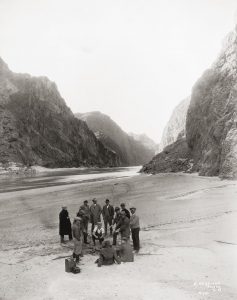
1) A group of people are inspecting the proposed site of the dam in the Black Canyon.

A picture of An inspection party near the proposed site of the dam in the Black Canyon on the Colorado River (1928)

2) A surveyor surveying the site during the construction of the Hoover Dam.

A picture of a surveyor surveying the site during the construction of the Hoover Dam.
(C: CORBIS)

3) A dynamite is detonated in the Black Canyon to make room for the dam.

A picture of the detonation of the dam
(C: CORBIS)

4) The ‘high-scalers’ hammering anything loose. Additionally, the falling rocks were dangerous hence these men covered their hats with tar and left them out to dry; essentially creating the first hard hats.

A picture of the high scalers
(C: CORBIS)

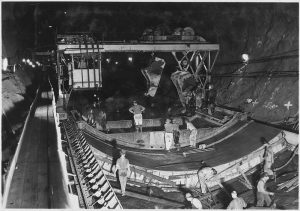
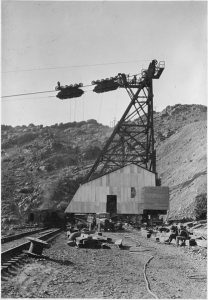
5) The construction of the Hoover Dam required a special steel bucket machine that would transport concrete deep within the tunnels.

A picture of a special steel bucket machine
(C: CORBIS)

6) One steel bucket essentially holds 18 tons of concrete.

A picture of a steel bucket
(C: CORBIS)

7) Here the workers are pouring the arch formwork in place.

A picture of the workers are pouring the arch formwork in place-construction of the Hoover Dam

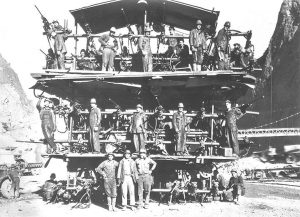
9) The movable cars which transported workers to their stations.

A picture of the movable cars

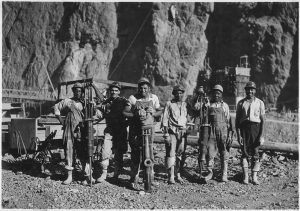
10) One of the unique equipment used for the construction of the Hoover Dam was the ‘drill rig’. Here workers are posing with the ‘jumbo rig’. The rig allowed multiple drillers to work together.

A picture of the jumbo rig

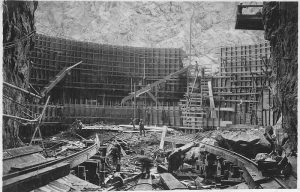
11) The concrete used for the construction of the Hoover Dam required a good formwork. The tall formwork below was used for the diversion tunnel inlet structure.

12) Officials are riding in one of the penstock pipes.

A picture of people stsnfing on penstock pipe-construction of the Hoover Dam
(C: Bureau of Reclamation)

13) Construction workers posing with their equipment.

A picture of construction workers posing with their equipment

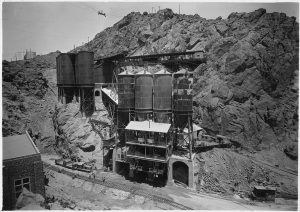
14) A picture of one of the concrete mix plants present at the site. The Hoover dam’s construction required almost 3 million cubic meters of concrete.

A picture of a concrete mix plant

15) A picture of ‘high scalers’, scaling down the walls of the canyon.

A picture of the high scalers duting the construction of the Hoover Dam
(C: CORBIS)

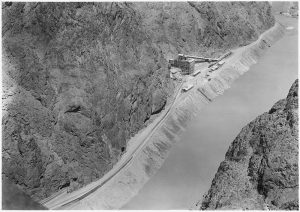
16) An aerial view of the dam’s structure.

An aerial view of the dams structure during the construction of the Hoover Dam

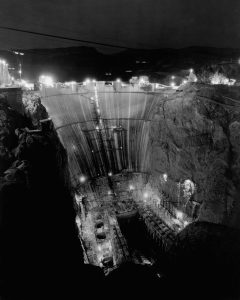
17) The construction of the dam taking place at night.

A picture of the construction of the Hoover Dam at night

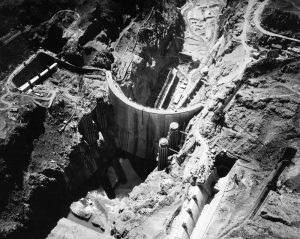
18) Another aerial view of the construction of the Hoover Dam.

A picture of the aerial view of the construction of the Hoover Dam.

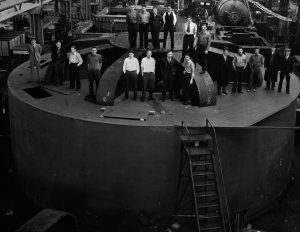
19) People standing on one of the 2 million-pound hydroelectric generators for the dam at the General Electric factory in Schenectady, New York.

A picture of people standing on one of the 2 million-pound hydroelectric generators for the dam=construction of the Hoover Dam

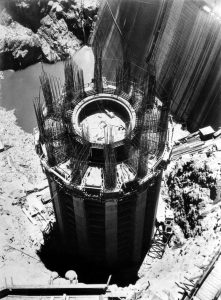
20) A picture of one of the four intake towers of the dam.

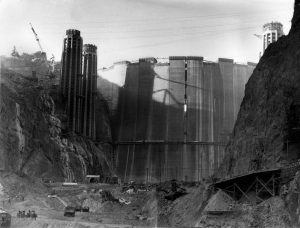
21) The upstream face of the dam.

22) United States President Franklin D Roosevelt commemorates the completion of the construction of the Hoover Dam.

A picture of Franklin D Roosevelt at the inaugration of the dam
(C: CORBIS)

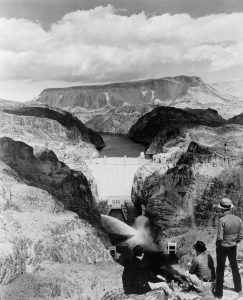
23) A photo of the fully constructed and functioning Hoover Dam, 1940.

A picture of the fully constructed and functioning Hoover Dam, 1940.

Enjoyed the above article? You may also enjoy Hiroshima before and after the atomic bombing- in pictures

10 most famous portrait paintings in art history

Portrait painting is a genre where the main focus of the painting is a human subject. We have compiled a list of famous portrait paintings in art history that enthral the spectator and showcase the inner essence of the subject.

Let us take a look at the most famous portrait paintings in art history.

1) ‘Mona Lisa’ Leonardo Da Vinci, 1503-19- One of the most famous portrait paintings

Without a doubt, one of the most famous portrait paintings in art history is the Mona Lisa. Painted by Leonardo Da Vinci between 1503–19, today it is displayed at the Louvre Museum, Paris. The painting is renowned for the subject’s enigmatic expression and ‘smile’. According to an early biographer, the painting is a picture of Lisa Gherardini, the real-life wife of a Florence merchant. Initially, the painting didn’t have much acclaim but its 1911 theft propelled it into fame almost overnight. After its return, the museum subsequently encased in a bulletproof case. Today the Mona Lisa has been vividly described as “the best known, the most visited, the most written about, the most sung about and the most parodied work of art in the world”.

A picture of 'Mona Lisa' by Leonardo Da Vinci
Mona Lisa- Leonardo Da Vinci

2) American Gothic- Grant Wood, 1930

This iconic portrait painting was exhibited publicly for the first time at the Art Institute of Chicago, winning a $300 prize and instant fame for the artist. It depicts a hard-bitten farming couple and showcases “real Americans”. Grant Wood used his sister and dentist as the subjects for the painting and dressed them up in farming attire. They are posing in front of a white gothic cottage located in the small town of Eldon in southern Iowa. At the time he was an unknown artist, but his iconic painting reached great heights of success. Its reproductions were subsequently displayed in almost every household in Iowa, plus the painting was heavily parodied in American pop culture. Today it is known as America’s Mona Lisa and is one of the most recognised paintings of the 20th century.

A picture of the famous portrait painting American Gothic- Grant Wood
American Gothic- Grant Wood

3) Girl With A Pearl Earring- Johannes Vermeer, c.1665

One of the famous artists of the Dutch Golden Age, Johannes Vermeer’s most recognised and acclaimed work is Girl With A Pearl Earring. It essentially depicts a woman dressed in exotic attire wearing a large pearl earring. What sets the painting apart from the others is that the sitter is a tronie, a Dutch term for a character or type of person. While a lady might have posed for the painting, it was not meant to portray any specific individual. Over the centuries it went by many names until it settled at its current title, one named after the prominent earring. Today the painting is on display at the Mauritshuis in Hague.

A picture of the famous portrait painting Girl With A Pearl Earring- Johannes Vermeer
Girl With A Pearl Earring- Johannes Vermeer

4) ‘Portrait of Adele Bloch-Bauer’ Gustav Klimt, 1907- The nazis once stole this famous portrait painting

This famous portrait painting is one of the most representative works of Gustav Klimt’s Golden Phase. It’s essentially a portrait of Adele Bloch-Bauer, wife of Ferdinand Bloch-Bauer, a wealthy Jewish banker and sugar manufacturer. Additionally, Adele is the only sitter Klimt has painted twice. Also known as The Woman In Gold, in 1941 it was infamously stolen by the Nazis; who displayed it at the österreichische Galerie belvedere. Years later Adele’s niece Maria Altmann made a claim against the gallery for the return of the painting. After a lengthy seven-year legal battle, the gallery returned it to her. Altmann sold it that very same year for a whopping $135 million, which at the time was the highest price ever paid for a painting.

A picture of Portrait of Adele Bloch-Bauer' Gustav Klimt
Portrait of Adele Bloch-Bauer- Gustav Klimt

5) The Arnolfini Portrait- Jan Van Eyck, 1434

Jan Van Eyck was one of the most significant representatives of early Northern Renaissance art. The painting essentially depicts Italian merchant Giovanni di Nicolao Arnolfini and his wife. Also called The Arnolfini Wedding, the painting is known to be the most original and complex paintings in Western art. Its beauty and complex iconography certainly set it apart from the paintings from that era. Another notable aspect of the painting was its illusionism. Its exact symbolism has been the subject of various scholarly debates. Additionally, over the years many have come up with various theories as to the meaning behind each one of its components.

A picture of the The Arnolfini Portrait- Jan Van Eyck
The Arnolfini Portrait- Jan Van Eyck

6) ‘Las Dos Fridas’ Frida Kahlo, 1939- A famous portrait painting symbolising the duality of a woman

Las Dos Fridas translated as The Two Fridas is a double self-portrait by the Mexican artist Frida Kahlo. Kahlo created it after her tumultuous divorce from artist Diego Rivera. It essentially depicts two versions of the artist seated beside each other; one is wearing a white dress while the other is wearing a traditional Tehuana dress. The work has been often analysed and scholars say that the one in white is the European Frida while the other one is the Mexican Frida. The European Frida is missing a part of her heart. The Mexican Frida however possesses her heart and also holds a small portrait of Rivera which shows that he completes her heart. The painting as a whole symbolises the duality of a woman.

A picture of Las Dos Fridas- Frida Kahlo
Las Dos Fridas- Frida Kahlo

7) The Night Watch- Rembrandt van Rijn, 1642

The Night Watch is a famous group portrait painting by Rembrandt van Rijn, one of the greatest visual artists in art history. The painting essentially depicts The Shooting Company of Frans Banning Cocq and Willem van Ruytenburch, most commonly known as The Night Watch. The painting is famous for its massive size and the use of dramatic illumination which shows a violent contrast of light of dark. Another unique aspect of the painting is that the scene has the appearance that an actual historical event is taking place thus giving the perception of motion. A fun fact about the painting is that the scene was originally depicted in daylight. However, over the years the painting has accumulated many layers of dirt and varnish which gives an impression that the scene is taking place at night.

A picture of The Night Watch- Rembrandt van Rijn
The Night Watch- Rembrandt van Rijn

8) Vertumnus- Giuseppe Arcimboldo, 1591

Guiseppe Arcimboldo’s paintings consist of a rich combination of flora, fauna and various other objects. It’s even more evident in his famous portrait of Holy Roman Emperor Rudolf II. The painting essentially depicts a combination of various fruits, flowers and vegetables which come together to form the emperor’s portrait. Additionally, it’s also an intentional reference to the Roman God of seasons Vertumnus, plus the choice of the components is a reference to the emperor’s power and wealth.

A picture of the Vertumnus-  Giuseppe Arcimboldo
Vertumnus- Giuseppe Arcimboldo

9) Las Meninas- Diego Velázquez, 1656

One of the widely analysed works in Western art, Las Meninas is a famous group portrait painting by Diego Velázquez. The painting depicts life in court under King Philip IV of Spain. Las Meninas translates to Ladies in Waiting and its unique aspect is that it is almost akin to a snapshot as it essentially captures a moment. The painting shows Infanta Margaret Theresa, the king’s daughter surrounded by her entourage. Above the princess is a mirror depicting her parents, the king and the queen who appear to be in the position of the viewer. With Velázquez himself behind the easel, it gives an impression that he is painting the portrait of the royal couple.

A picture of the famous portrait painting Las Meninas- Diego Velázquez
Las Meninas- Diego Velázquez

10) Whistler’s Mother- James Abbott McNeill Whistler, 1871

Also called Arrangement in Grey and Black No. 1, it was created by the artist in 1871 when he was living in London. The painting’s subject matter is the artist’s own mother; she is wearing mourning clothes and dons a grim expression on her face. Due to the enigmatic nature of the painting, it is often called the Victorian Mona Lisa. Although the painting did not receive a positive reception in the United Kingdom, it became famous in America where it was embraced as an embodiment of morality and motherhood.

A picture of the famous portrait painting Whistler's Mother- James Abbott McNeill Whistler
Whistler’s Mother- James Abbott McNeill Whistler

Enjoyed the above article? You may also enjoy 10 Famous controversial art pieces of all time

15 interesting facts about the Sedan chair


A Sedan chair is essentially a covered cabin that is carried on poles by two people. It was used in the past for transporting a passenger through the streets of the city. It was especially popular in England during the 17-18th century.

Read 15 interesting facts about the Sedan chair.

1) It is named after Sedan, a town in France where the chair was first used. The men who carried the chair were called ‘chairmen’ and the passengers would get in and out via a hinged door at the front of the chair.

A picture of the chairmen carrying the Sedan chair

2) The Sedan chair was first seen in England as early as 1581 but was unpopular among the public

Additionally, when the Duke of Buckingham began to use one, he received great criticism from the people for making humans do the work of animals. However, as time passed the opinions changed and, in 1643 when Sir Saunders Duncombe introduced the chair in London it was an instant success. At the time the streets were clogged with carriages so the chair was a welcome change. Duncombe consequently acquired a 14-year licence to rent out his own hackney sedans or ‘hackney chairs’.

A picture of a Sedan chair

3) The attributes of the hackney chair

Each hackney chair had to be 5′ 3″ tall and 2′ 2″ wide. They were painted black, with the chair number in white; similar to modern-day taxis, the Sedan chairs had an identifying number plate which was painted on the front, back and top of the chair. The inside of the chair had a padded seating. Additionally, the chair had windows around three sides which enabled the traveller to see outside. These windows also had curtains which allowed privacy and anonymity if required.

An art depicting the Hackney mode fo transport

4) The transport was especially popular among the gentry. During the 17-18th century, the streets of London were filthy, so the Sedan chair was instrumental in keeping the people’s expensive clothes and shoes clean. Additionally, the chair had a detachable roof so it was also convenient for women wearing elaborate hats.

A picture of a woman wearing an elaborate hat

5) Sedan chairs were soon allowed to travel on the pavements which were previously reserved for the pedestrians. The pedestrians were expected to give a vocal warning to the approaching chairmen saying ‘Have a care!’ or ‘By your leave, sir!’. However, this wasn’t always the case and hence there were frequent accidents of the chair tipping over.

A picture of a tipped over chair

6) Subsequently, a law was put into place, like modern taxi stations, the Sedan chairs were supposed to have a separate station from where passengers could hire a chair. Additionally, the chairmen were expected to be licensed; a chairmen’s license cost 3 shillings per chair and the fine for running an unlicensed chair was 13s. Moreover, the chair and the name of the carriers(the ‘pair’) were recorded annually at the corporation.

7) The wealthy, however, did not use these stations. Instead, they sent their footmen out in the street to call for the chair by shouting ‘chair, chair!’. Moreover, some even kept their own chairs which were elaborately decorated with family crests or paintings.

A decorative transport chair

8) Additionally, the fares varied as well. According to a 1768 list of fares in Edinburgh, the fare for travelling within the city was 6d(2.5 pence), for a journey half a mile outside the city it was 1 shilling and 6d(7.5p), and it was 4 shillings(20p) for a whole day’s hire.

9) Sedan chairs were for hire around the clock, however, after midnight the fares doubled. In the dark, the chair was accompanied by ‘link boys’ or torchbearers who would lead the way.

A painting of a woman stepping out for a garden party

10) Sedan chairs in the city of Bath

During the 18th century, Bath had a serious traffic problem with pedestrians, horses and carriages competing for space in the narrow and congested streets. Hence the Sedan chair was the optimum mode of transportation. The Sedan chairs in Bath were slightly different from the regular ones, they were lighter and their poles were shorter as well. However, this was beneficial for the sick and invalid. In fact, Mineral Water Hospital even had their personalised chairs. Additionally, people were picked from their beds and conveyed to take in the waters of Bath. Once they were done they were brought back by the same chairmen. These chairs even had a curtain which prevented any draft of air from seeping in. Furthermore, the doors of the bathhouses were designed in such a way that they could easily fit in the Sedan chair, so the passenger wouldn’t have to step outside.

11) There were no fixed requirements for being a chairman. The men simply had to be fit, strong and healthy. Additionally, most of the chairmen were from the Highlands of Scotland.

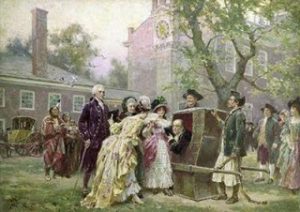
A picture of a painting depicting women greeting a man emerging from the chair

12) The chairmen had a distinctive uniform which varied during the winters and the summers. The uniform consisted of a blue tunic or coat, black knee-breeches, white stockings and buckled shoes which were paired with a large cocked hat.

A picture of two men carrying the chair

13) The chairmen of the Georgian era were prone to profanities and as a result, swearing was a common misdemeanour. This offence incurred fines ranging from one to ten-shilling. However, serious offences such as assaults brought suspension or discharge.

14) Additionally, the chairmen often amused themselves while waiting for a fare. Many kept dogs for company and many indulged in drinking and gambling.

15) Despite the Sedan chair’s popularity, it gradually fell into disuse towards the 19th century. Mainly because the streets became better paved and due to the more comfortable upcoming modes of transportation.


Enjoyed the above article? You may also enjoy 15 Interesting Facts About Saddle Shoes

11 Famous scary paintings that will give you nightmares!

Art history is filled with paintings that visit dark and scary themes such as death and horror. These famous scary paintings were often centred around religious themes, mythology and the artist’s morbid imagination. We have compiled a list of such paintings which will surely give you nightmares!

Take a look at the 11 famous scary paintings that will give you nightmares!

1) Study after Velázquez’s Portrait of Pope Innocent- Francis Bacon, 1953

This famous scary painting is a distorted version of the art piece Portrait of Pope Innocent X by Spanish painter Diego Velázquez. A controversial artist of the 20th century, Bacon spent more than 20 years making different versions of Velázquez’s Portrait. Moreover, he saw the original piece only once in person which was after producing various interpretations of it. The disturbing art piece depicts the pope screaming and the harsh purple brush strokes show the dark theme of the painting.

A picture of the scary painting Study after Velázquez's Portrait of Pope Innocent- Francis Bacon
Study after Velázquez’s Portrait of Pope Innocent- Francis Bacon

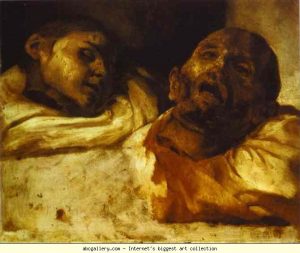
2) ‘Heads Severed’ Theodore Géricault, 1818- a scary painting depicting decapitated heads

As the name suggests, this scary painting is essentially severed heads painted in a grisly and dark manner. Géricault was an influential French painter whose best-known painting is the ‘Raft of Medusa’, which incidentally caused a great scandal. Additionally, he kept dismembered body parts in his studio, which included a severed head.

A picture of 'Heads Severed' Theodore Géricault
Heads Severed- Theodore Géricault

3) Saturn Devouring His Son- Francis Goya, c.1819-23

According to traditional Greek myth, the Titan Cronus (in the title Romanized to Saturn) devours each of his children because he feared they would overthrow him one day. Goya’s painting graphically depicts this act of murder.  This painting is one in a series of 14 ‘black paintings’ Goya painted directly onto the walls of his house which were never intended to be viewed by the public. However, after his death, the painting was transferred onto a canvas and is on display at the Museo del Prado, Madrid.

A picture of the famous scary painting Saturn Devouring His Son- Francis Goya
Saturn Devouring His Son- Francis Goya

4) The Nightmare- Henry Fuseli, 1781

The Nightmare is a 1781 oil painting by Henry Fuseli which horrifies and fascinates patrons and critics alike. The painting depicts a demonic ape-like incubus crouching on a sleeping woman chest, while a horse with flared nostrils peeps from the curtain. Since its first exhibition at the Royal Academy of London, various people have interpreted it differently. Additionally, it has also been the subject of many psychoanalytic theories regarding dreams. The Nightmare is essentially a conglomerate of horror, sexuality, and morbidity which even attracted the renowned neurologist Sigmund Freud who allegedly kept its reproduction on the wall of his Vienna apartment.

A picturee of the famous painting The Nightmare- Henry Fuseli
The Nightmare- Henry Fuseli

5) The Face Of War- Salvador Dalí, 1940

The Face of War is a painting by Spanish surrealist painter Salvador Dalí and it depicts the morbidity of war. The scary painting portrays an emancipated head of a man-much like a corpse- with identical faces in its eye sockets and mouth. The heads wear a miserable and bleak expression while serpents attack them. It was created by the painter during his brief stay in California and is believed to have been inspired by the Spanish Civil War.

A picture of The Face Of War- Salvador Dalí
The Face Of War- Salvador Dalí

6) ‘Dante And Virgil’ William-Adolphe Bouguereau, 1850- a scary painting depicting a scene from The Divine Comedy

The painting essentially depicts a scene from The Divine Comedy, where Dante and Virgil watch a gristly fight between two damned souls. The story goes that when Dante and his guide Virgil venture through hell, they are stopped at the Eighth Circle. This circle belongs to those who cheat and commit fraud on humanity. Here they witness the eternal combat between two damned souls. The painting depicts the fight’s climax where one of the fighters has the upper hand and bites the neck of his opponent. The graphic nature and meaning of the painting truly deem it as a scary painting.

A picture of Dante And Virgil- William-Adolphe Bouguereau
Dante And Virgil- William-Adolphe Bouguereau

7) The Massacre of the Innocents- Peter Paul Rubens, c.1611-12

The painting portrays the biblical incident ‘murder of the innocents’ where King Herod the Great, King of Judea ordered the execution of all boys below the age of 2. This infanticide is graphically depicted in the painting and is not for the fainthearted. Its main theme is centred around the struggle between the mothers, the soldiers and the infants. Rubens made two paintings under the same theme. He painted the one below after his return from Antwerp in 1608. This scary painting is famous for portraying a range of emotions: desperation, violence, grief, motherly love and mercilessness.

A picture of The Massacre of the Innocents- Peter Paul Rubens
The Massacre of the Innocents- Peter Paul Rubens

8) Judith Beheading Holofernes- Caravaggio, c.1578-1599

Judith Beheading Holofernes is Carravaggio’s stark interpretation of an event from the deuterocanonical Book of Judith. According to the parable the widow Judith saves her people by decapitating the enemy general. She does this by charming him, getting him drunk and subsequently beheading him in his tent. Caravaggio’s painting portrays the grisly murder and perfectly captures Judith’s emotions; one of heroic firmness mixed with disgust.

A picture of Judith Beheading Holofernes- Caravaggio
Judith Beheading Holofernes- Caravaggio

9) ‘Flaying of Marsyas’ Titian, c.1570-76- a scary painting that depicts a horrifying incident

One of Titian’s last works Flaying of Marsyas depicts the flaying or killing of Marsyas, a satyr. Marsyas was guilty of rashly challenging the god Apollo to a musical contest. And as he subsequently lost to the god, he was skinned alive. This artwork was inspired by Ovid’s detailed explanation of the event and hence the scene embodies exactly what took place. The piece also portrays the cruelty of the mythical gods.

A picture of 'Flaying of Marsyas' Titian
Flaying of Marsyas- Titian

10) Medusa- Caravaggio, 1597

Another scary and bizarre painting by Caravaggio depicts the exact moment the mythical being was executed by Perseus. Caravaggio created two versions of the painting, one is privately owned while the other is on display at the Uffizi Museum in Florence. The painting is unique because the artist used his own self-portrait in place of Medusa’s head. In this way portraying his own immunity to her terrifying gaze. Additionally, it captures the final moments of her life where she is still conscious with blood dripping from her decapitated head.

A picture of Medusa- Caravaggio
Medusa- Caravaggio

11) ‘The Judgment of Cambyses’ Gerard David, 1498- a scary painting that depicts the flaying of a corrupt judge

The Judgement of Cambyses is a scary painting that shows the graphic flaying of the corrupt Persian judge Sisamnes. The artwork is inspired by an incident that took place in Greek Historian Herodotus’ histories. The story goes that the Persian Emperor Cambyses II ordered the judge Sisamnes to be skinned alive for delivering an unjust verdict after accepting a bribe. Additionally, he ordered that the judge’s skin should be used as padding for a chair from which his successor-his son-would hear future cases. Moreover, the detail on the upper right-hand corner of the painting shows the son delivering justice in the macabre chair.

A picture of the famous scary painting The Judgment of Cambyses- Gerard David
The Judgment of Cambyses- Gerard David

Enjoyed the above article? You may also enjoy 10 Famous controversial art pieces of all time

Pre-war Nazi Germany- in colour pictures

Nazi Germany or the German Reich was the German state between 1933-45 when it was controlled by Adolf Hitler and the Nazi Party. Also called the Third Reich, it was a totalitarian state. It subsequently ended when the Allies defeated Germany in World War II. We have compiled a list of pictures which depict how pre-war Nazi Germany looked in colour pictures. These were taken by Hitler’s personal photographer Hugo Jager who was one of the few who used colour techniques.

Take a look at Pre-war Nazi Germany- in colour pictures.

1) A colour picture of Adolf Hitler making a keynote address to his followers in Nazi Germany at the Reichstag session, Kroll Opera House, Berlin, 1939.

A picture of Hitler making a keynote addres

2) Adolf Hitler and one of the men in his inner circle, Joseph Goebbels (in box) at Charlottenburg Theatre, Berlin, 1939.

A picture of Adolf Hitler and one of the men in his inner circle, Joseph Goebbels

3) Annual midnight swearing-in of Schutzstaffel(SS) corps where they swore an oath of loyalty to Adolf Hitler at Feldherrnhalle, Munich, 1938.

A picture of the Annual midnight swearing-in of SS troops

4) A picture depicting the celebration of the Reichserntedankfest (the Reich Harvest Thanksgiving Festival). Additionally, at the time around 700,000 were in attendance, both Nazi supporters and non-supporters.

A picture depicting the celebration of the Reichserntedankfest

5) A picture of Adolf Hitler saluting soldiers of the Condor Legion who fought alongside Spanish Nationalists in the Spanish Civil War. The coloured picture was taken during a rally upon their return to Nazi Germany, 1939.

6) A picture of Berlin lit up at midnight in honour of Hitler’s 50th birthday, 1939.

A colour picture of Berlin, Nazi Germany's capital lit up at midnight

7) A picture of the League of German Girls(the girls’ wing of the Nazi Party youth movement) dancing during the 1938 Reich Party Congress, Nuremberg, Germany.

8) A colour picture of Nuremberg, Germany where the Nazi Party held large propaganda rallies.

A colour picture of the city of Nuremberg during Nazi Germany.

9) Reich Minister of Propaganda Joseph Goebbels addressing the crowd at the Lustgarten in Berlin, 1938.

A picture of the Reich Minister of Propaganda Joseph Goebbels

10) A picture of the Reich Veterans Day in Germany, 1939.

A colour picture of the Reich Veterans Day in Nazi Germany, 1939.

10) A picture of the Fallersleben Volkswagen Works cornerstone ceremony.

11) A picture depicting crowds of people lined along the roadway to the Fallersleben Volkswagen Works cornerstone ceremony.

A picture depicting crowds of people

12) A colour picture depicting the annual rally of the Nazi Party in Germany.

A colour picture depicting the annual rally of the Nazi Party in Germany. 

13) A picture of Adolf Hitler addressing the crowd at the Lustgarten, Berlin, 1938.

A picture of Hitler addressing the crowd at the Lustgarten, Berlin, 1938.

14) Crowds cheering Adolf Hitler’s campaign for Anschluss(union) of Austria and Germany, 1938.

A picture of Crowds cheering

15) A picture depicting various Nazi officials on their way to the Volkswagen Works cornerstone ceremony, near Wolfsburg.

A picture depicting various Nazi officials on their way to the Volkswagen Works cornerstone ceremony

16) Another picture depicting people gathered at the Volkswagen Works cornerstone ceremony, 1938.

A picture of crowds gathered at the Volkswagon ceremony

17) Nazi officials and supporters gathered at a Christmas Party hosted by Adolf Hitler, 1941.

A pcture of the Nazi Christmas Party

18) Adolf Hitler at the swearing-in of Schutzstaffel(SS) standard bearers at the Reich Party Congress, Nuremberg, 1938.

A picture of Adolf Hitler at the swearing-in of Schutzstaffel

19) A colour picture depicting the Nazi Party rally in Nuremberg, Germany, 1938.

A picture of the Nazi Rally-Nazi Germany in colour pictures

20) A picture of the massive rally and military parade which took place on Adolf Hitler’s 50th birthday, Berlin, April 20, 1939.

A picture of the nazi birthday rally-Nazi Germany in colour pictures

21) Banners displayed in honour of Adolf Hitler’s 50th birthday, Berlin, Germany.

A picture of the Banners displayed in Berlin in honour of Hitlers 50th birthday.-Nazi Germany in colour pictures


Enjoyed the above article? You may also enjoy Hiroshima before and after the atomic bombing- in pictures

The Flower of Scotland- Brief History & Key Facts

One of the most easily recognizable symbols of Scotland is the thistle. It is a wild flowering plant that is deemed as the flower of Scotland. Read below to find out how it became the emblem of Scotland.

Let us take a look at The Flower of Scotland- Brief History & Key Facts.

1) Thistle is essentially a wildflower that is either vivid violet or dark pink. The flower is covered with thorns which protects it from any natural enemies. Additionally, they are found in abundance throughout the Highlands, Islands and Lowlands of Scotland.

2) How did the thistle become the flower of Scotland?

Many legends surround the flower and how it eventually became Scotland’s national emblem. However, one legend stands out, it goes that during the mid 13th century, the flower was instrumental in saving Scotland from invasion. The suggested incident is said to have taken place during the 1263 Battle of Largs. During the reign of Alexander III (1249 – 1286), King Haakon of Norway planned to conquer Scotland. The king’s army subsequently landed on the coast of Largs in the dead of the night.

They intended to surprise the sleeping Scots and even removed their footwear to move stealthily. However, the men were not aware of the thistle which lay at their feet and one of them stepped right on it. He consequently screamed in pain and thus alerted the Scots. The Scots then fought the enemy off and saved Scotland from the Viking invasion. Subsequently, the importance of the flower was recognised and thus it became the emblem of Scotland.

A picture of Viking landing

3) The thistle as the royal symbol of Scotland was first seen on silver coins issued by King James III.

4) The union of the thistle and the rose

The thistle was the symbol of Scotland and at the same time the Tudor rose was the symbol of England. In 1503, King James IV of Scotland was wedded to Princess Margaret Tudor of England. This union inspired the famous poem ‘The thistle and the rose’ by Scottish poet William Dunbar. Princess Margaret subsequently became known as ‘Mary Queen of Scots’. She then incorporated the thistle into the ‘Great seal of Scotland’ which became a symbol for longevity. Since then thistles and roses are a popular combination and are seen in bouquets for special occasions and are also embedded in various emblems.

A picture of the union of the thistle and the rose- flower of Scotland - Thistle
(C: FavPNG)

5) The Most Ancient and Most Noble Order of the Thistle

The Most Ancient and Most Noble Order of the Thistle is the highest cavalry order in Scotland. With the thistle as the order’s primary symbol, the members wear a collar chain whose links are made of golden thistles. The exact date of its foundation is not known but according to legend, it was founded in 809 to commemorate the alliance between King Achaius and Emperor Charlemagne. It is also possible that it may have been founded by James III as he adopted the thistle as the royal badge and even issued coins depicting them. Additionally, it was James II (James VII of Scotland) who was responsible for reviving and restoring the order under new rules to reward Scottish Catholics for their loyalty.

The order’s motto is ‘Nemo me impune lacessit’ which translates as No one provokes me with impunity. Another translation derived from the Scots and Gaelic forms of the motto is No one can harm me unpunished.

A picture of the badge of the thistle order
The badge of the Thistle Order

6) The type of thistle deemed as the flower of Scotland

There are many types of thistles in Scotland. And the one deemed as the floral national emblem is the purple ‘Scotch thistle’, also known as the Scottish thistle. However, this species is not indigenous to Scotland and did not become prevalent until the 16th century.


Enjoyed the above article? You may also enjoy The Parthenon frieze- History| Interpretions| Facts

The controversial life of Charles Saatchi

Charles Saatchi is an Iraqi-British businessman(born June 9, 1943) who collects contemporary art. Over his lifetime he has collected artworks by artists such as Tracey Emin, the Chapman brothers and Chris Ofili. Additionally, the world celebrates him for his support for Young British Artists(YBAs). However, Charles Satchi has been a subject of many controversies, including an infamous one involving his ex-wife Nigella Lawson.

Let us explore the controversial life of Charles Saatchi.

1) Charles Saatchi’s early life

He was born in Baghdad and has three brothers David, Philip and Maurice. Subsequently, his family emigrated to London when he was just a preschooler. Here he fell in love with the U.S. pop culture and became a fan of stars such as Elvis Presley and Chuck Berry.

A picture of Maurice and Charles Saatchi
Maurice and Charles Saatchi (right)

2) The establishment of Saatchi and Saatchi

At the age of 18, Charles Saatchi started working as a copywriter in the advertising business in the London office of Benton & Bowles. And in 1970, he founded the advertising company ‘ Saatchi and Saatchi’, along with his brother Maurice. Later, through its acquisition of numerous marketing firms, the company became one of the largest advertising agencies in the world; with over 600 offices globally!

A picture of Maurice and Charles Saatchi
Maurice and Charles Saatchi

3) Their creativity was soon recognised and they were associated with the Conservative Party, where they helped express the party’s campaign and produced the famous ‘Labour Isn’t Working’ line. However, due to challenges from within and outside the company, the brothers left the agency and formed a smaller company M&C Saatchi.

A picture of the Labour campaign

4) Charles Saatchi and his love for contemporary art

Charles Saatchi has an immense passion for collecting contemporary art pieces. He purchased his first art piece at the age of 26 which was an artwork by Sol Lewitt, an American minimalist. He subsequently started collecting art pieces from other major contemporary American and European artists. In fact, his collecting habits were so prolific that he was spending millions annually on growing his art collection.

A picture of Charles Saatchi
Charles Saatchi

5) The Saatchi Gallery

In 1985, he established the Saatchi Gallery which exhibits all the artworks he collects. During this time his art collection shifted from American minimalism to the contemporary arts from Young British Artists(YBAs). He subsequently acquired many artworks from YBAs and was an important catalyst in their development. He was also instrumental in launching the careers of British artists such as Marc and Hirst.

A picture of the gallery

6) Sensation- the controversial art exhibition

In 1997, he displayed his collection in an exhibition called Sensation, which became a centre of controversy. When the collection was displayed at the Brooklyn Museum in 1999, one noteworthy piece ‘The Holy Virgin Mary’ by Chris Ofili caught the disdain of the New York City’s Mayor Rudy Giuliani, who called it ‘sick’ and advocated to stop the annual grant of the museum. Another controversial display was Marcus Harvey’s painting of Myra Hindley, a child murderer, which received criticism not only from the public but also from the families of the victims.

A picture of 'The Holy Virgin Mary' by Chris Ofili
The Holy Virgin Mary by Chris Ofili

7) The Saatchi Effect

The press is deeply invested in the artworks purchased by Charles Saatchi as he is considered a trendsetter. He often buys artworks created by upcoming artists and ones found in obscure galleries. Thus building a reputation for plucking artists from anonymity and thrusting them into the public glare. Described by many as the ‘Saatchi effect’, it was not beneficial for all. One particular artist Sandro Chia, blames Saatchi for his downfall. Back in the 1980s, Saatchi bought the artist’s entire collection but sold it off shortly at a cheap price. Thus leading to speculation that this act irreparably damaged the artist’s reputation.

A picture of him sitting in a chair

8) A recluse who stays away from the limelight

Despite his fame and fortune, Charles Saatchi is a recluse and rarely comes into the limelight. Additionally, even though he lent his name to the series ‘School of Saatchi’, he did not appear on it even once. It’s natural for celebrities to stay out of the public eye but Saatchi is secretive at work as well; often avoiding his clients when they come to visit him and even refusing to attend the openings of his own exhibitions.

9) Additionally, Saatchi has published several books, including My Name Is Charles Saatchi And I Am An Artoholic (2009), in which he answered questions from the public and journalists, and Beyond Belief; Racist, Sexist, Rude, Crude, and Dishonest (2015), a collection of advertisements from the past that are now widely seen as offensive.

A picture of Charles Saatchi

10) In 2010, the art collector decided to donate the Saatchi Gallery and more than 200 artworks to the British Public. The artworks include Tracey Emin’s My Bed and Jake and Dinos Chapman’s Tragic Anatomies. He further announced to rebrand the institution as MOCA, London (Museum of Contemporary Art, London).

11) The controversy of Charles Saatchi and Nigella Lawson

In 2013, a photo was taken of him with his hands around the neck of his third wife Nigella Lawson. Although he defended the action as ‘playful’, he was given a police caution. Subsequently, the couple divorced; with Lawson accusing him of psychological abuse and domestic chaos.

A picture of a newspaper tabloid

12) A lasting legacy

Despite his professional and personal controversies, Charles Saatchi has created a lasting impact in the world of art. Even though his influence has dwindled over the last years, something that he openly admits- saying that he was once dynamic and has just fizzled out now- he is lauded for giving obscure artists a global platform to showcase their art.

A picture of an old Charles Saatchi

Enjoyed the above article? You may also enjoy Katy Jurado- The iconic Mexican actress

10 Famous controversial art pieces of all time

Someone once said, “Art should comfort the disturbed and disturb the comfortable” and the following famous controversial art pieces justify this. The artists featured in this list repeatedly broke the boundaries of art and were heavily criticised. However, today most of these artworks are recognised as timeless masterpieces.

Let’s take a look at the 10 famous controversial art pieces of all time.

1) The Last Judgement- Michelangelo, 1536-41

The Last Judgement is a controversial art fresco painted by Italian Renaissance painter Michelangelo. It covers the altar wall of the Sistine Chapel in the Apostolic Palace, Vatican City. It portrays the Second Coming of Christ and the eternal judgement of God on all humankind. Michelangelo worked on it from 1536 to 1541, and once completed it was met with numerous criticisms, especially from the counter-reformation Catholic Church. One of the primary reasons for criticism was that all the figures in the fresco were painted nude, and this concern continued even after the death of the artist. In fact, Italian painter Daniele da Volterra was hired to cover up the nudity. He did so by adding leaves and loincloths to the figures.

A picture of the last judgement- famous controversial art pieces
The Last Judgement- Michelangelo

2) ‘Fountain’ Marcel Duchamp, 1917 – the controversial art piece that made people question art

The Fountain is essentially a porcelain urinal signed ‘R. Mutt’. In 1917, Marcel Duchamp anonymously submitted this art piece to the Society of Independent Artists, an institution that accepted any artwork as long as the fees were paid. Although society accepted the art piece it was not displayed as it was indecent. However, the art journal ‘The Blind Man’ defended the art piece and published it as photographed by Alfred Stieglitz. This was the last time the original was seen after which it was lost. Since then at least 16 replicas have been made of the piece. Today, the ‘Fountain’ remains one of the famous controversial art pieces of the 20th century.

A picture of the foutain- famous controversial art pieces
Fountain- Marcel Duchamp

3) The Dinner Party- Judy Chicago, 1974-79

The Dinner Party is an installation art piece by artist Judy Chicago. And it is regarded as the first epic feminist artwork. It is essentially a banquet table that features 39 mythical and historical famous women. Each place setting includes a hand-painted china plate akin to a stylized vulva. Due to its anatomical imagery, the art piece has been heavily criticised; with people labelling it ‘vulgar’ and ‘demeaning to women’. Another criticism was the lack of other ethnicities at the table. Despite the criticisms, the piece is one of the eminent feminist arts and is displayed at the Brooklyn Museum.

A picture of the dinner party- controversial art
The Dinner Party- Judy Chicago

4) Piss Christ- Andres Serrano, 1987

Often critiqued as the ‘object of blasphemy’, Piss Christ by Andres Serrano is a very controversial art piece. The piece is essentially a photograph of a small plastic crucifix submerged inside a glass jar of the artist’s urine. Although it didn’t receive any criticism during its initial exhibitions, things changed when it was exhibited in 1989. The piece consequently put the media into a frenzy and received various criticisms. Some calling it blasphemous and some calling it obscene. Things came to head in April 2011 when the piece was up for display at the Collection Lambert art museum, where vandals managed to give it irreparable damage.

A picture of Piss Christ
Piss Christ- Andres Serrano

5) Yo Mama’s Last Supper- Renée Cox, 2001

Renée Cox’s controversial art piece is an imitation of Leonardo Da Vinci’s painting of the Last Supper. It consists of 5 panels depicting 11 black men, a white Judas and a naked black woman as Christ (which is the artist’s self-portrait). Her iconoclastic depiction of Christ garnered a lot of criticism; especially from the Catholic League. Additionally, New York City’s Mayor Rudy Giuliani labelled the artwork as ‘obscene’. he also asked for the formation of a decency commission that would review such art and prevent them from being displayed.

A panel from Yo Mama's Last Supper
A panel from Yo Mama’s Last Supper- Renée Cox

6) The Holy Virgin Mary- Chris Ofili, 1996

An artwork that has always been associated with controversy is ‘The Holy Virgin Mary’ by Chris Ofili. The art depicts a black woman as Virgin Mary who is surrounded by anatomical imagery. However, its biggest object of criticism is the elephant dung which forms one bared breast. The painting was first displayed in 1999 at the Brooklyn Museum’s show of Young British Artists titled ‘Sensation’. Since then it has received a maelstrom of criticism with then-New York City’s Mayor Giuliani advocating its removal and threatening to cut off all subsidies to the museum. However, the city leaders refused to budge and the work remained on the view. Since then it has even been vandalised a few times and today, the painting is displayed at the Museum of Modern Art in New York City.

A picture of The Holy Virgin Mary- Chris Ofili- famous controversial art pieces
The Holy Virgin Mary- Chris Ofili

7) ‘Tilted Arc’ Richard Serra, 1981- the famous controversial art piece deemed as ‘ugly’

Tilted Arc was a controversial public installation by Richard Serra. It was installed at the Foley Federal Plaza in Manhattan from 1981 to 1989. The arc was essentially a 120-foot-long, 12-foot-high solid, unfinished plate of rust-covered corten steel. The artist designed it in such a way that it made people stop and take in their surroundings. However, after its installation people considered it oppressive and ugly. Subsequently, 15 per cent of the population of the neighbourhood signed a petition to have it removed. And the public outrage just grew over time. As a result, a trial was held in 1985 to remove the Tilted Arc. A ruling was decreed in its favour and after 4 years, in 1989 the sculpture was removed.

A picture of the Tilted Arc by Richard Serra
Tilted Arc- Richard Serra

8) Death of the Virgin- Caravaggio, 1606

This controversial art piece was commissioned for a chapel in the church of Santa Maria Della Scala in Rome. Caravaggio was renowned for his paintings which realistically depicted human emotions. As seen in the painting, the artist depicted Mary realistically with only a thin halo to portray the event. Traditionally, the event would have featured a choir of angels to give a sense of divinity, however, the painting is a complete contrast from that style. The church ultimately rejected the piece either for its stark realism or for the fact that he used a famous prostitute to pose as Mary.

A picture of the death of the virgin
Death of the Virgin- Caravaggio

9) ‘The Gross Clinic’ Thomas Eakins, 1875- the shocking controversial art

Labelled as a ‘shocking’ piece of art, The Gross Clinic has received its fair share of controversy. The painting depicts Dr Samuel D. Gross overseeing a surgical operation and lecturing to a class of medical students. It was submitted to the 1876 Centennial Exposition but was rejected due to its graphic nature. Additionally, art critics criticised it for its gruesome content and melodrama(the hysterical woman covering her eyes). However, today the painting is recognised as a homage to science and is one of the great masterpieces of its time.

A picture of The Gross Clinic- Thomas Eakins- controversial art
The Gross Clinic- Thomas Eakins

10) My Bed- Tracey Emin, 1998

When the artist installed the art piece at the 1999 Turner Prize Exhibition, it received intense negative feedback. The art piece is essentially an unmade bed which the artist used when she was suffering from depression after a bad breakup. Objects such as crumpled tissues, cigarettes, empty vodka bottles and condoms surround the piece. However, due to its raw nature, it caused great public outrage; with various critic labelling her work as crude, primitive, uninteresting, ill-informed and objectionable.

A picture of My Bed- Tracey Emin
My Bed- Tracey Emin

Enjoyed the above article? You may also enjoy 12 Clever War Propaganda Posters

12 Evil Gods you should steer clear of!

A God or a deity is a supreme being who is conceived as omnibenevolent(all-good). Different beliefs and religions have different perceptions of God. He goes by various names, identities and attributes. However, going by the ancient philosophy of yin yang, a dualism of good and bad exists. Hence, there are some evil gods you should absolutely avoid as these evil deities just feed on death, destruction and strife.

Let’s take a look at the 12 Evil Gods you should steer clear of!

1) Chernobog- the Slavic god of bad fate

The first in our list of evil gods is Chernobog, a deity worshipped by the Polabian Slavs. They worshipped two Gods; Bialobog(the white god) and Chernobog(the black god). The white deity was honoured for bringing them goodness and prosperity while the black deity was honoured so that he doesn’t harm them. Additionally, during their feasts, they blessed and cursed simultaneously under the names of their gods; respectively in the name of the good one and the evil one. In their language, Chernobog essentially meant evil deity.

A picture of Chernobog- evil gods

2) Set- a murderous evil Egyptian god

Set is the Ancient Egyptian god of war, chaos and storm. He was initially a benevolent god and was one of the 5 deities established after the creation of the world. However, he grew resentful of his brother Osiris, who was the ruler of the newly created Egypt. The last straw was when his wife was attracted to Osiris and committed infidelity. As a result, Set brutally murdered his brother and was proclaimed as the ‘first murderer’. He subsequently took the throne of Egypt and his reign was filled with chaos, storms and droughts.

A picture of Set
(C: Arcane attic)

3) Sekhmet- the punisher of humankind

Another evil Egyptian god is Sekhmet. Also known as the ‘red lady’ and the ‘lady of pestilence’, Sekhmet was created by Ra to punish humanity for not following his laws. To punish humankind, Sekhmet went on a killing spree, and the fields ran with human blood. Ra was a kind god and could not stomach the bloodbath caused by her and asked her to stop. However, it was too late and her blood lust knew no bounds. Ultimately Ra had to subdue Sekhmet’s bloodlust with alcohol, thus ending her carnage.

A picture of Sekhmet

4) Hel- the cruel ruler of the Norse Underworld

Hel is the daughter of Loki and the ruler of the Norse Underworld. She is essentially the god of cruelty, harshness and greed. Additionally, her appearance is always downcast and gloomy, with one side of her body fully alive and the other side rotting. She is perceived as merciless to her offenders and is simply cold and detached.

A picture of Hel

5) Loviatar- the Finnish god of death and disease

Loviatar is a blind Finnish god who was impregnated by the east wind; subsequently giving birth to ‘nine diseases’. These deadly diseases included cancer, plague, scab and more. According to the epic poem Kalevala, she is the most wretched daughter with the darkest of hearts. Moreover, she is an evil god who inflicts pain and terrible illnesses upon the humankind.

A picture of Loviatar

6) Whiro- the embodiment of all evil

Whiro is the Māori lord of darkness. He stays in the underworld and is responsible for all the illnesses. Additionally, he is also the patron of thieves. And according to a myth, when people die their bodies descend to the underworld where they are eaten by Whiro. Devouring them gives him strength through which he can ascend to Earth and unleash his destruction. Hence, many tribes cremate their deceased as Whiro can’t get strength from the ashes. The evil god also possesses a cave called ‘Taiwhetuki’ where all evil things are preserved.

A picture of Whiro- Evil Deities and gods
An interpretation of Whiro via Deviant Art

7) Apophis- the evil god who embodied chaos

Apophis is an evil Ancient Egyptian god of darkness and is interpreted as a giant coiled serpent. He is the enemy of the light and once even sought to kill the sun god Ra to plunge the world into darkness. Ancient Egyptians used to conduct rituals to protect Ra and destroy Apophis. Although the evil god did not have any formal cult, he would feature in several Egyptian texts which described his efforts to destroy the sun and fill the world with chaos. Apophis is also associated with eclipses, earthquakes, thunder, storms, destruction and death. Moreover, he is also called as the ‘eater of souls’ as he devours both the living and dead. As a result, Ancient Egyptians had various spells buried with the dead which would protect them against him.

A picture of Apophis- Evil Gods

8) Lamashtu- the evil god who menaced women

Lamashtu was a malevolent Mesopotamian god. She would prey on women during childbirth and even kidnapped their baby. She would later kill and eat the infant. Additionally, she would cause expectant mothers to miscarry, eat the flesh of men, bring death and sickness upon humans and induce nightmares. She was a truly evil god.

A picture of Lamashtu- evil gods

9) Lilith- the demoness who vowed revenge on all men

Lilith is a demonic figure from Jewish mythology. She is featured in many texts but her dark origins lie in Babylonian demonology. Depicted as an evil winged spirit, amulets and incantations were used to counter her diabolical powers as she preyed on expecting mothers and infants. However, her most popular portrayal is in the Jewish texts where she is the first wife of Adam. Here she is described as a nonsubmissive woman who abandoned Adam. As a result, God gave him an obedient wife Eve. Lilith was enraged by this and turned into a snake and tempted Eve with the forbidden apple. Consequently, the couple was banished from the Garden of Eden, following which Lilith transformed into a demoness and vowed revenge on all men.

(C: Delaware Art Museum)

10) Ahriman- the evil god of strife and disappointment

Ahriman is an evil god who belonged to the early Iranian religion Zoroastrianism. He is also known as Angra Mainyu which translates to a destructive and evil spirit. He causes chaos, strife, confusion and disappointment in humans. Additionally, he is the enemy of Spenta Mainyu(the good spirit). Ahriman’s principal attribute is Druj, ‘the lie’, which embodies greed, envy and wrath. Moreover, many consider him to be the predecessor of Satan.

11) Adro- the evil African deity

This Central African evil deity is an aspect of the same supreme being. Adro is the evil side to Adroa which is the benevolent side. Adroa is the god of the sky and Adro is the god of Earth. He can come in contact with humans by transforming himself into a snake and sometimes a translucent being. He is associated with death and destruction and possesses and devours humans. Additionally, his children are called the Adroanzi and resemble serpents. They follow people at night and if the followed people look back they are devoured by them.

A picture of Adro and Adroa as one supreme being- Evil Gods

12) Nergal- the evil god who killed people on a whim

Nergal is an evil Mesopotamian deity of war, hunger, devastation and pestilence. He is often seen with a mace and scimitar and destroys lands without any apparent reason sans any regret or remorse. According to a myth, once he was so bored that he laid waste to the city of Babylon just on a whim! However, this incident was not the only one, he frequently went on such rampages and cited bad temper as the reason for his behaviour.

A picture of Nergal

Enjoyed the above article? You may also enjoy 12 major Romans gods you need to know about!

1960s High School Fashion- in pictures

The 1960s brought in a variety of fashion trends, and the high school teens embodied these. Hence, during the 1960s, high school fashion was the one to look out for. It was indeed the decade which broke all traditional fashion norms.

Let’s take a look at the 1960s High School Fashion- in pictures

1) A high school student at Beverly Hills High during the 1960s.

A picture of a student wearing the 1960s High School Fashion
Arthur Schatz/Life Pictures/Getty Images

2) A student wearing bell-bottoms and boots, a typical fashionable piece during the 1960s.

A picture of a student wearing bell-bottoms and boots
Arthur Schatz/Life Pictures/Getty Images

3) Youth wearing the ‘Swinging London’ fashion, as seen on Carnaby Streets, 1969.

A picture of teens in London

4) Another popular fashionable piece of the 1960s were the mini skirts. Here a student is wearing the ‘mini jupe’ skirt.

A picture of a girl wearing the minijupe
Arthur Schatz/Life Pictures/Getty Images

5) High school students wearing typical fashionable pieces during the 1960s.

A picture of a high school girl
Arthur Schatz/Life Pictures/Getty Images

6) A group of women wearing the Emilio Pucci printed leggings.

A picture of women wearing the Emilio Pucci printed leggings-1960s High School Fashion
Arthur Schatz/Life Pictures/Getty Images

7) A high school student from Southern California wearing fashionable hippie prints during the 1960s.

A picture of a girl wearing hippie prints
Arthur Schatz/Life Pictures/Getty Images

8) A high school student wearing the Bishop sleeves. During the 1960s it became an important part of the hippie look.

A picture fo a girl wearing the Bishop sleeves-1960s High School Fashion
Arthur Schatz/Life Pictures/Getty Images

9) A group of students from Beverly Hills High, wearing the typical fashionable pieces from the 1960s.

A picture of Beverly High school students
Arthur Schatz/Life Pictures/Getty Images

10) A high school student marching band wearing the 1960s fashion.

A picture of a marching band-1960s High School Fashion
Arthur Schatz/Life Pictures/Getty Images

11) A student wearing woollen bell-bottom pants and a homemade jacket.

A student wears wears wool pants and a homemade jacket in Denver, Colo., 1969.
Arthur Schatz/Life Pictures/Getty Images

12) Vests were also a popular part of the 1960s hippie fashion. Here a student is wearing the Buckskin leather fringe jacket.

A picture of a student wearing a buckskin vest
Arthur Schatz/Life Pictures/Getty Images

13) A student at Beverly Hills High school wearing a checkered outfit paired with yellow bell-bottoms.

A picture of a girl wearing a chekered outfit and bell bottoms
Arthur Schatz/Life Pictures/Getty Images

14) Tops with lace sewn in were also a popular fashionable piece during the 1960s. Here high school students are wearing a typical hippie look, 1969.

A student donning the hippie look
Arthur Schatz/Life Pictures/Getty Images

15) A high school student from Kansas wearing a mini skirt.

A picture of a Kansas high school student wearing a mini skirt, 1969.
Arthur Schatz/Life Pictures/Getty Images

16) A girl wearing black bell-bottoms.

A picture of a girl wearing black bell-bottoms.
Arthur Schatz/Life Pictures/Getty Images

17) Students from a high school in Southern California wearing printed tops and coloured bell-bottoms.

A picture of Southern California high school students, 1969.
Arthur Schatz/Life Pictures/Getty Images

18) A high school teacher wearing a bold printed dress.

A picture of a hugh school teacher wearing a bold print-1960s High School Fashion
Arthur Schatz/Life Pictures/Getty Images

19) A group of women wearing fashionable mini skirts during the 1960s.

A picture of women wearing mini skirts-1960s High School Fashion

20) Students at Woodside High wearing the typical 1960s high school fashion.

A picture of students at Woodside high-1960s High School Fashion
Arthur Schatz/Life Pictures/Getty Images

Enjoyed the above article? You may also enjoy 10 Popular 1960s Men’s Hairstyles- in pictures

Add to Collection

No Collections

Here you'll find all collections you've created before.